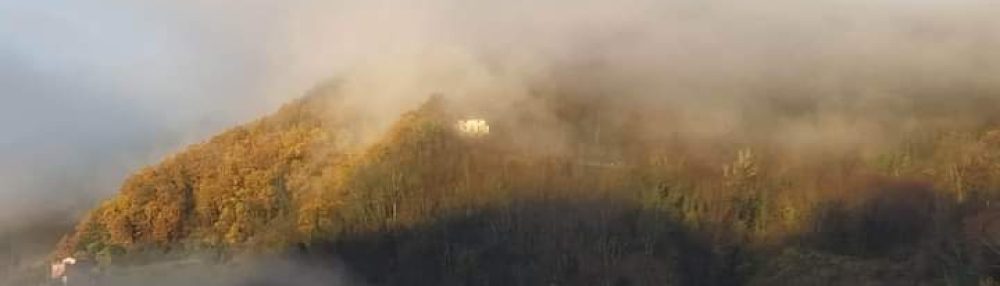
The fortress of Mont’Alfonso which crowns the hill dominating Castelnuovo di Garfagnana was in a sorry state not so long ago. Slowly crumbling away its only use was as a local’s small-holding complete with geese and goats.
Happily, thanks to EU money, the fortress has recently undergone an extensive restoration project: its walls are once again magnificently impressive and its guardhouses and gatehouses have been excellently reinstated.


Mont’Alfonso now hosts several events ranging from food initiative to beauty contests to art shows to car rallies. One of the most memorable of the events we have attended was that dedicated to the great Italo-Argentinian composer and creator of the Nuevo tango Astor Piazzolla whose family it was lately discovered originated from a village in Castelnuovo comune, that of Massa Sassorosso. This gorgeous event with live music and a barbecue is described in my post at
The fortress was built as a garrison of the Duchy of Ferrara to defend the border with the Republic of Lucca. Constructed between 1579 and 1586, it was an Este military garrison in the 16th and 17th centuries and during the Napoleonic period (1805 – 1814) was part of the Principality of Lucca and Piombino.
The fortress was sold back to the Este property in 1814. At the beginning of the twentieth century it passed into the hands of private individuals. The fortress, which had already deteriorated over time, was further damaged by the appalling earthquake that hit the Garfagnana in 1920.
It was only from 1980, that an impressive restoration project has been carried out on the fortress greatly contributing to the cultural and economic revitalization of the upper Serchio valley.
The fortress is also planned to become an important alternative energy research hub rather like the one we visited in Wales: the Machynlleth alternative technology centre.
We found out another use for the fortress yesterday. After attending Santa Croce hospital Castelnuovo we visited Mont’Alfonso. It was a bleak foggy day and we were the only visitors present. In the ‘casa delle arcate’ – the former officers’ mess – we discovered an astounding museum dedicated to vintage wireless sets. It was truly a delightful discovery for us radio hams.
“Radio: Voice of History” is the title of the exhibition of over eighty rare and precious pieces, part of the collection donated by a certain Armando Goldoni. The utterly captivating and certainly nostalgic presentation is a sort of itinerary of the history of radio from its golden years of the 1920s through to the 1960s and from the first ‘crystal sets’ to the sophistication and fashionable design of an item which, before television was certainly the centre-piece of the domestic scene.


(All photos courtesy of Alexandra Cipriani)
The display aims at highlighting not only the technological and aesthetic evolution of the ‘wireless set’, but also its social and cultural function. From being a novelty in Italian homes it spread rapidly throughout the country becoming the first mass communication medium, used for news, political propaganda, both popular and classical music and sports commentaries.


There’s also a section, recounting the contribution of this area of Garfagnana to the history of radio through Francesco Vecchiacchi (1902-1955) who was born in Filicaia, a hamlet in the municipality of Camporgiano. Francesco worked at Magneti Marelli (which still exists today as a major automotive firm manufacturing car dynamos and electronic components), where he took over the direction of the Radio Laboratory directing his research towards new achievements in electronic technology, the transmission of radio signals through radio links and inventing, during the Second World War , innovative radar systems.
The free admission exhibition is open to visitors from Monday to Friday from 9 to 1 pm; on Tuesdays and Thursdays, in addition to the morning, also from 3 pm to 5 pm at other times by appointment only.) More information can be had by phoning 0583 – 643201 or emailing montalfonso@provincia.lucca.it.
