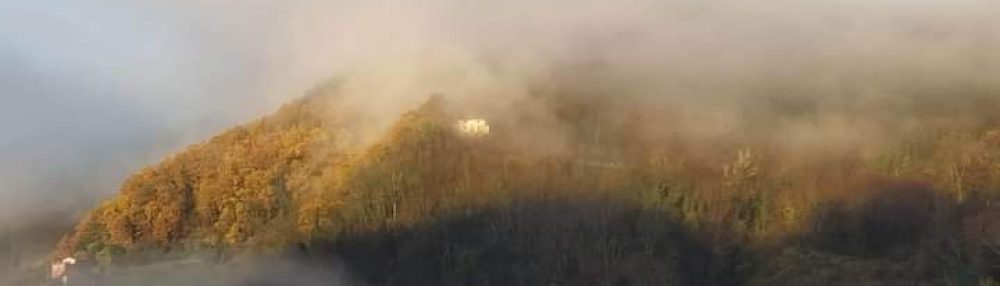
The sequence of pleasant spring-like days has ended damp-squid like and a gloomily drizzly and misty morning has descended upon our Val di Lima. It’s stay-at-home and watch DVDs weather.

Let’s go somewhere warm, at least in our imagination! In recent days I’ve been viewing feature films and TV mini-series dealing with India. Sadly, however, they all seem to have one major theme in common: that of the situation of the chee-chee in the sub-continent. In case you didn’t know the term chee-chee is an ethnic slur against Anglo-Indian or Eurasian half-castes. In most cases, this means a person born of an English father and an Indian mother although more rarely it can be the offspring of an Indian father and an English mother.
Ethnic slurs or ethnophaulisms may range from terms used without too much offence to refer to persons from another country. A yank to refer to a citizen of the USA, for example, does not arouse important objections. However, the use of an infamous N-word certainly does. Many ethnophaulisms used for European peoples relate to the foods they are supposed to eat. The French are frogs, the Germans are Krauts and the English are rostbifs for example. Subdivisions of the English, those who voted for Brexit, even have their food term: gammons.
No such less impolite distinction relates to the chee-chee, however, which is derived from the Hindi word for dirt. In fact to say something is chee-chee means ‘how disgusting.’
The first film I watched regarding chee-chee persons was ‘Bhowani Junction’ directed by George Cukor. Dating from 1956 it is adapted from John Masters’ novel published two years previously. Ava Gardner stars stunningly as Victoria Jones an Anglo-Indian chee-chee with a Welsh father working on the railways and an Indian mother. Her performance forms the highlight of the film which also has a musical score by Miklos Rozsa.
Victoria is torn between her dual heritage. She feels like a foreigner in an Indian milieu but is also an outcast in English society. She is torn between her loyalty to the British in India (after all, she is serving in the army) but is also involved in the fight for Indian independence. This conflict is fully personified in her divided love for an Indian Sikh Ranjit Kasel, an Anglo-Indian Patrick Tayor and an English colonel Rodney Savage. This is where the film differs from the book. In the book, Victoria pairs up with her fellow chee-chee Patrick. In the film, she marries Rodney and goes with him to the UK when he finished his service.
The same theme of the Chee Chee is `Queenie` a 1987 TV miniseries adapted from the novel by Michael Korda based on the life of the actress Merle Oberon. Michael is the son of Vincent, who directed several films starring Merle and whose husband, Alexander Korda, was Michael`s uncle. For once the film is a lot better than the book which I thought was pretty awful.
Queenie is a lovely girl of Indian and Irish descent but fair enough to pass as a white girl until her heritage is found out by her class-mates who taunt her about it so much that Queenie runs away from the exclusive school. Invited by a boyfriend Queenie is also thrown out of the English club when her background is discovered. Incidentally, Queenie is beautifully played by Mia Sarapochiello who is of Italian descent.
Merle Oberon felt she had to hide her Anglo-Indian background and invented a story that she was born and raised in Tasmania with her birth records there destroyed in a fire. Invited by the Tasmanian government to attend a celebration in her honour she retracted her story.
At the moment I am re-watching that magnificently produced ‘The Jewel in the Crown,’ a TV mini-series dating from 1984 and based on Paul Scott`s Raj Quartet. Here, the Anglo-Indian love interest is between Daphne Manners serving in the British Army in India and Hari Kumar a journalist who had received an education in an English public school. The interaction of Art Malik and Susan Wooldridge in these roles is utterly engaging, exposing the divided loyalties of so many English and Indians in the sub-continent.

The general theme is that Anglo-Indians (by which I now include Indians brought up and educated in England) have a searingly tortured sense of not being Indian enough to be Indian in India and not English enough to be English in England.
Incidentally, this epic mini-series was directed by Christopher Morahan who later made ‘The Peacock Spring’ starring his daughter Hattie and which develops the chi-chi theme in the love affair between an ingeniously eager English schoolgirl on holiday in India and an aspiring young Indian poet.
In a previous post, I described Italy as being half-way between England and India in terms of culture including social relationships and religious beliefs. Both my wife and I still find ourselves somewhat echoing the dilemmas faced by the chee-chee. I, born in the UK of an English father and an Italian mother and my wife born in the UK from Italian parents have found ourselves in disconcerting situations where ethnic slurs have occurred. While these incidences are nowhere as extreme as those faced by the black community they can still be disturbing.
Bagni di Lucca is an example of a British community in Italy. It should have been hoped that in our supposedly more open-minded and tolerant western social ethos there would have been no examples of ethnic slurring. However, sadly, this is not strictly true. An example brought to my attention was that of an English person meeting for the first time someone of presumed English heritage chatting with them and, finding out that both the person`s parents originated from Italy, cutting the meeting short. Unfortunately, this example is not unique and has been repeated with English people of other countries’ heritage, for example, Argentina.
An interesting parallel can be drawn between the English leaving India and the English leaving the European Union. Of course, there’s a big difference because Gandhi’s ‘quit India’ campaign was to force the English out of the subcontinent whereas the European Union had no such intention towards the UK since a national referendum decided the issue. Regarding Brexit, however, I note that British persons of English heritage married to British persons of Italian heritage (and usually having dual nationality) voted overwhelmingly to remain in the 2016 referendum.
Of course, in today’s western civilization integration is the key-word. However, I come across too frequently in Bagni di Lucca a distinct Anglo-Italian social segregation. A comment from one English person was ‘I never mix with Italians’. Then why the hell did that person move here I wonder? Wouldn’t a place like Cheltenham have been more appropriate?
I regret that chee-chee type thinking in Italy is still around and that it will take a very long time for this retrograde way of thinking to be finally extinguished. It’s most prevalent with the English among the United Kingdom`s four nations. The Scots, the Welsh and the Irish in our area have no such problem. Perhaps is it because they too have been conquered, colonized and treated like chee-chees?
It is a sad reflection to realise how very racist and unkind people can be whether via nationality colour religion politics sexuality or whatever else. This only goes to highlight their misunderstanding of what life is truly about and about the fundamentals of what being human really truly means. Do we know? Maybe. Maybe not. We are here to learn to improve our lot, we become problem-solving creatures for our daily survival, we are happy to live side by side in a civilized existance with very many beliefs. We come into being through love with a traumatic jolt and we scream at the end of our lives: we depart with a sigh,’ we are remembered and judged by our life’s deeds whatever our lives’ path. Sadly we all have to leave this behind us as we are transformed into another dimension maybe into another planet again… there are many beliefs. I think that Dante and Shakespeare had great visions and insights into the meaning of life; they understood perfectly the complex multifaceted intrigues and worldly problems which generally always get resolved: the good and the evil as Wordsworth states ‘Let Nature be thy teacher’.
Take this Worldwide Pandemic. It is so wicked and yet it has created for a few a more thriving way of life. For others it is not so. Remember the quote “some are born great some achieve greatness and some have greatness thrust upon them”. Ao I posit the question where then is free choice it possibly is chance good luck and being at the right place at the right time. We are but puppets to the gods methinks. The AI is the way forward but it is scary. AI where do you draw the line with reality and dreamlike states of living as we are experiencing the danger is that AI will take over our lives as we will cease to exist and humanity will be fully automated with AI scary creatures at the helm and they will be autonomous commanding over us lifelike creatures born through the figment of our imagination. Maybe they are trying to eliminate the human race, no longer a dvd fantasy but a frightening reality. Maybe they will be more successful at saving our Planet.
Thank you for your comment which raises so many issues.
Sandra your voice is so true.