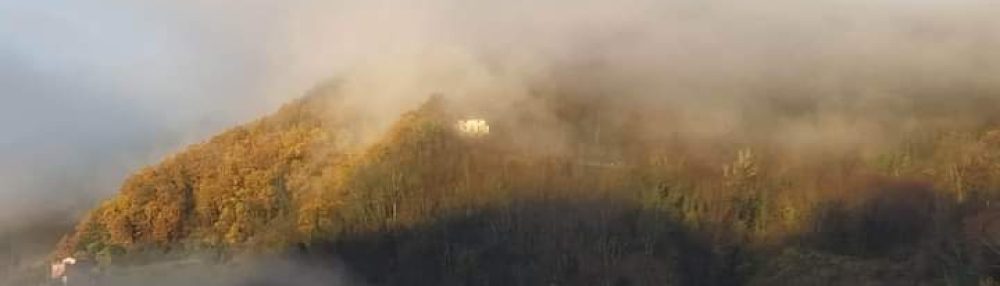
There is an old Italian saying that after ‘Ferragosto’ (August 15th) the weather changes. For weeks we have been sweltering under ‘Lucifero’, the hot weather coming from North Africa with day-time temperatures well above thirty degrees centigrade. Looking at our weather forecast the saying still holds good for there will be a fall in temperature this week. I can feel the change already on my skin and soon a furious Vivaldian thunderstorm storm such as is musically depicted in the ‘Summer’ from his ‘Four Seasons’ concerti may well be inflicted upon us.
There are two similar-sounding Italian words describing holidays and work-days but with opposite meanings. The first is ‘feriale’ denoting any working day and distinguished from ‘festivo’ which means a holiday. The second word is ‘ferie’. If a shop is closed for ‘le ferie’ it means that the owner is on holiday. (It’s somewhat inconvenient for summer visitors to Italy that so many shops close down for the summer when their owners take their holidays. Only the other day I was unable to buy cakes from a shop that sells delicious pastries. Good for them! Why shouldn’t they have their summer holidays like everybody else).
Ferragosto is a conflation of two holidays. The first derives from the holiday given to workers and slaves by the Roman emperor Augustus at the start of the month named after him. The second holiday is a religious one for the feast of the Assumption of the Virgin Mary into Heaven.
Incidentally what is the difference between the Virgin’s Assumption and Jesus’ Ascension? The theological answer is that Jesus raised himself into Heaven through his own power and victory over death. It was an active action. The Virgin, however, was raised into Heaven by the Father. It was a passive action.
Both pre-Christian and Christian ‘ferragosto’ festivals are combined in several well-known Italian events. Siena’s Palio with its famed horse race celebrates the Virgin Mary’s Assumption . Horse races were also held in ancient Roman times on the ‘Feriae Augusti’, the emperor’s festive day when the winner would receive a precious cloth called ‘pallium’ . Today in Siena ‘il palio’, a banner, painted anew each year, is similarly given to the winner of the race.
Regrettably, because of the Pandemic the Palio has again been cancelled. Unlike the recently ended Tokyo Olympics it would be unimaginable to run the Palio without having any spectators!


At the Palio a few years ago 
Like British Autumn Bank Holiday, Ferragosto is a time of considerable movement of people and if one wants to travel anywhere on that day one is likely to encounter crowded trains and traffic jams everywhere. I was to meet some friends at Bagni di Lucca and go with them to Barga for lunch but they were somewhat delayed not just because of the long road queues but because the Brennero road they took is still one-way for a short stretch near the Ponte della Maddalena, more commonly known as the Devil’s bridge, because of reparations to the landslide.
We reached Barga not only in time for lunch at the Capretz restaurant but also to see one of our lunch partners’, Swietlan Nicholas Kraczyna, exhibition.

First we visited Nick’s’ studio nearby where he developed the multi-plate colour etching process which has attracted so many students to his workshops He is a supremely distinguished artist; no wonder his work is included in the Uffizi’s prints and drawings collection.


The way Nick’s art also reflects ancient mythological themes was fully evident in his exhibition which takes its inspiration from a poem by Cesare Pavese.
Here is my translation of that poem:
*
In the clear sky the hill is like night.
It frames your head which scarcely moves
and accompanies that sky. You are like a cloud
glimpsed among the branches. The strangeness of a sky
that is not yours smiles in your eyes.
*
The hill of earth and leaves encloses
your animated gazing with its dusky mass,
your mouth has the fold of a sweet hollow
between distant slopes. You seem to play
with the big hill and in the sky’s clarity:
to please me you reprise the ancient setting
and render it purer.
*
But you live elsewhere.
Your tender blood was formed elsewhere.
The words you say have no comparison
with the harsh sadness of this sky.
You are only a very sweet, white cloud
entwined one night amongst ancient branches.
*
This is the original for those of you who know the Italian language and would like to compare:
*
La collina è notturna, nel cielo chiaro.
Vi s’inquadra il tuo capo, che muove appena
e accompagna quel cielo. Sei come una nube
intravista fra i rami. Ti ride negli occhi
la stranezza di un cielo che non è il tuo.
La collina di terra e di foglie chiude
con la massa nera il tuo vivo guardare,
la tua bocca ha la piega di un dolce incavo
tra le coste lontane. Sembri giocare
alla grande collina e al chiarore del cielo:
per piacermi ripeti lo sfondo antico
e lo rendi piú puro.
Ma vivi altrove.
Il tuo tenero sangue si è fatto altrove.
Le parole che dici non hanno riscontro
con la scabra tristezza di questo cielo.
Tu non sei che una nube dolcissima, bianca
impigliata una notte fra i rami antichi.
Her is one of Nick’s set of variants/variations inspired by Pavese’s poem:


In addition to Pavese’s evocative poem I was reminded of the legends about tree-goddesses, nymphs and dryads in so many of the world’s cultures. Are trees masculine or feminine? They can be both, of course. Daphne was turned into a laurel tree to escape the amorous advances of Apollo, Yakshinis are the enticing feminine inhabitants of India’s sacred trees and anyone who has listened to Tapiola, that haunting orchestral work by Sibelius, knows that Tapio is a god of the Finnish forests.
Dendrologically speaking trees can be both sexes. Male trees have male flowers, which produce pollen. Female trees have female flowers that produce fruit. Kraczyna’s trees are all feminine – not a male among them. So in the artist’s psyche trees appear essentially to be associated with women. Indeed, it was the world’s first female, Eve, who presented the fruit of the tree of knowledge to Adam.
I was very much taken by ‘Nick’s series of etchings which he called variants on a theme. I don’t like the term ‘variant’ too much at the present time as it reminds me of things like Delta variants. But Nick is correct in calling the etchings belonging to one series by that name since strictly speaking, variation is change, and a variant is one of the forms resulting from the change. There are in this respect variations on the theme of woman and tree but clearly the primal design in each series does not change.


The exhibition is on until the end of August.

Our Ferragosto lunch with artist Swietlan Nicholas Kraczyna (front second left),.
Pingback: Fifty years of Etching Love in Barga | From London to La Costa (and Lucca and Beyond) Part Three