Yesterday afternoon, as part of the on-going programme of Bagni di Lucca’s branch of Unitre (University of the Third Age) we attended a lecture by Ilaria Del Bianco, entitled “Pascoli and Emigration.” Del Bianco, who is well-known in the region for her work on local history and migration studies, brought to the subject a combination of academic rigour and personal warmth. Her long involvement with the Associazione Lucchesi nel Mondo, as well as her family’s own history of emigration, gave her words a resonance that went beyond pure scholarship.
She began by recalling how the name Giovanni Pascoli usually conjures up images of the nido domestico, the sheltered “nest,” the half-hidden world behind the hedge, and the muffled sounds of distant storms. But, she reminded us, Pascoli’s life was anything but sheltered. Born in San Mauro di Romagna in 1855, he grew up in a family marked by tragedy: the unsolved murder of his father, the subsequent deaths of his mother and siblings, and the dissolution of the family home. These early fractures shaped his lifelong search for rootedness and belonging.

Del Bianco emphasised how these wounds made Pascoli particularly sensitive to the pain of displacement—not only his own, but that of millions of Italians who, from the late 19th century onward, were forced to leave their homes in search of survival. Pascoli himself knew what it meant to live far from one’s origins: his years wandering between Bologna, Turin, Florence, Messina, and Pisa gave him, in Del Bianco’s words, “the emotional memory of an emigrant, even without crossing oceans.”
She then explored Pascoli’s relationship with our area, particularly Barga and the Serchio Valley, where he lived from 1895 onward at his beloved villa at Castelvecchio. From this vantage point he witnessed the extraordinary exodus of the Lucchesi and the Garfagnini, many of whom left for Scotland, the United States, and South America. “Here,” Del Bianco observed, “he saw the empty houses, the aging parents, the letters arriving late—or never.” This proximity sharpened his poetic empathy.


(Pascoli and his friend Puccini at Castelvecchio. These was talk of a collaboration between the two on an opera libretto but it never materialised. )
One striking example she discussed was Pascoli’s poem “Italy” (L’Italia), inspired by the return of a young emigrant who can no longer speak her mother tongue. Del Bianco read aloud the lines in which Pascoli captures the bewilderment of the girl, raised in America, who answers Italian questions with English fragments:
“Ma la fanciulla parlava un’altra favella,
una favella franta,
simile a quella dei bimbi.”
This linguistic fracture becomes, as Del Bianco explained, a symbol of the fragile thread that binds migrants to their homeland—one that can thin, stretch, and sometimes snap.
She also touched on Pascoli’s socialist sympathies, especially in the 1880s, when he defended workers’ rights, denounced social inequality, and wrote poems like “Il Canto dell’Aratore” that dignified labour. Del Bianco reminded us that Pascoli was even imprisoned in 1879 for participating in a socialist demonstration in Bologna—an early sign of the political conscience that would later inform his reflections on migration. In the poem “Il Musico,” he describes a worker-musician forced abroad by poverty:
“E partì, come gli altri:
per pane e per fortuna andò pel mondo.”
Through verses like these, Pascoli showed that migration was not simply a personal choice but a consequence of systemic injustice—an escape from a country that had failed to feed its own people.
Del Bianco painted migration as a central, not marginal, theme in Pascoli’s poetry:
- the farewell at the station,
- the mother who waits for letters,
- the returning emigrant who no longer recognises home,
- the children who hear Italy only in stories.
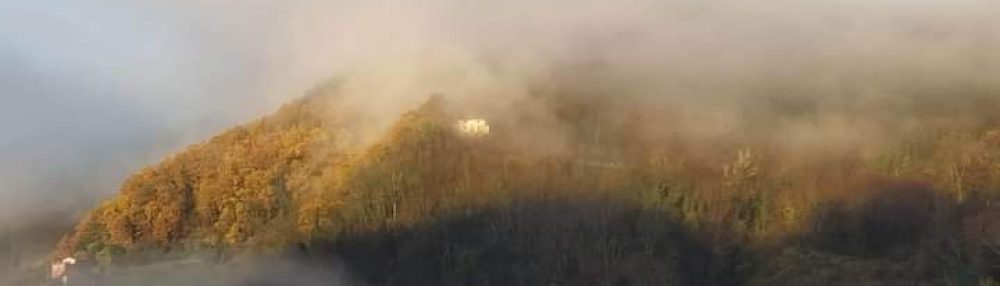
These everyday tragedies, she explained, were happening all around Pascoli in Barga, then one of the most emigrant-heavy villages in Italy. The poet absorbed them into his moral universe. In “Nebbia,” for instance, Pascoli seems to wrap himself in fog as a way of protecting the fragile “nest” from a world defined by departure:
“Nascondi le cose lontane,
nascondimi quello ch’è morto.”
Fog becomes both a refuge and a veil drawn over loss.
The lecture concluded with a powerful reflection by Del Bianco:
Pascoli is often celebrated as the poet of small things, but he was also the poet of great departures.
He understood that emigration is not only a socio-economic fact but also a poetic wound, a fracture in memory, language, and identity.
As we stepped out of the Bagni di Lucca Library at 5:00 pm, many of us felt we had rediscovered a different Pascoli—one rooted not only in the intimacy of the hedge and hearth, but also in the long roads that lead away from home, and in the silent ache of those who take them.
