
Carnival in Italy is another feast in which ancient pre-Christian traditions meld seamlessly with Christian belief. The word itself offers a clue: carne (meat) and vale (farewell) — a farewell to meat. In other words, Carnival takes place before the onset of Lent, the period of abstinence in which rich foods are traditionally given up.
This pattern — indulgence followed by restraint — is not unique to Christianity. One cannot help thinking of parallels in other monotheistic religions, such as the Muslim month of Ramadan. Italy, of course, is less drastic. One eats during the day, but the food is lean and meatless. Yet before any great season of renunciation there is, almost inevitably, a final splurge — and Carnival is precisely that: a last exuberant enjoyment before restraint sets in.


It is also worth remembering that in earlier periods of Italian history, Lent meant giving up more than food. Public entertainments were curtailed: no theatre, no opera. Carnival therefore offered a final opportunity for spectacle, performance and communal pleasure before cultural life temporarily fell silent.
Carnival in Italy takes many forms. Commedia dell’Arte is paramount in certain places — Venice above all — dominated by theatrical traditions shaped by figures such as Goldoni and his predecessors. But there are many other carnivals, each with its own character. Ivrea, for example, claims to host the oldest carnival in the world, while others range dramatically in scale and tone.
Recently we were in Viareggio, famous for its enormous papier-mâché floats — among the most spectacular anywhere in the world. At the same time, there were smaller, more intimate street carnivals taking place alongside the grand parade. Satire is one of Carnival’s defining features: it is the moment when one can let one’s hair down and say what is otherwise unsayable, lampooning political, religious and public figures with impunity. Viareggio is particularly renowned for this sharp political satire; some figures are treated gently, others less so — I will not say which.


I was reminded of a similar spirit elsewhere, though outside the Carnival season and far from Italy. In Stromness, in Orkney, I once witnessed a remarkable local summer carnival which mercilessly lampooned councillors and political figures — mostly English ones — with wit and inventiveness. The impulse was recognisably the same.


Does England have carnivals? It has one — the Notting Hill Carnival — but strictly speaking it is not a carnival in the traditional sense. It does not take place during the Carnival season, nor does it mark a farewell to meat or indulgence. It is better understood as a festival: rooted in Caribbean tradition, now broader and more inclusive, but conceptually quite different. The name has stuck, however, and so it remains the Notting Hill Carnival. Over time it has also become more good-natured, with much of the violence that once marred it gradually ironed out.
The contrast with Viareggio could hardly be greater.


Despite the cold this year — Easter being a movable feast that can bless you with warmth or leave you freezing — we had a thoroughly good time in Viareggio.


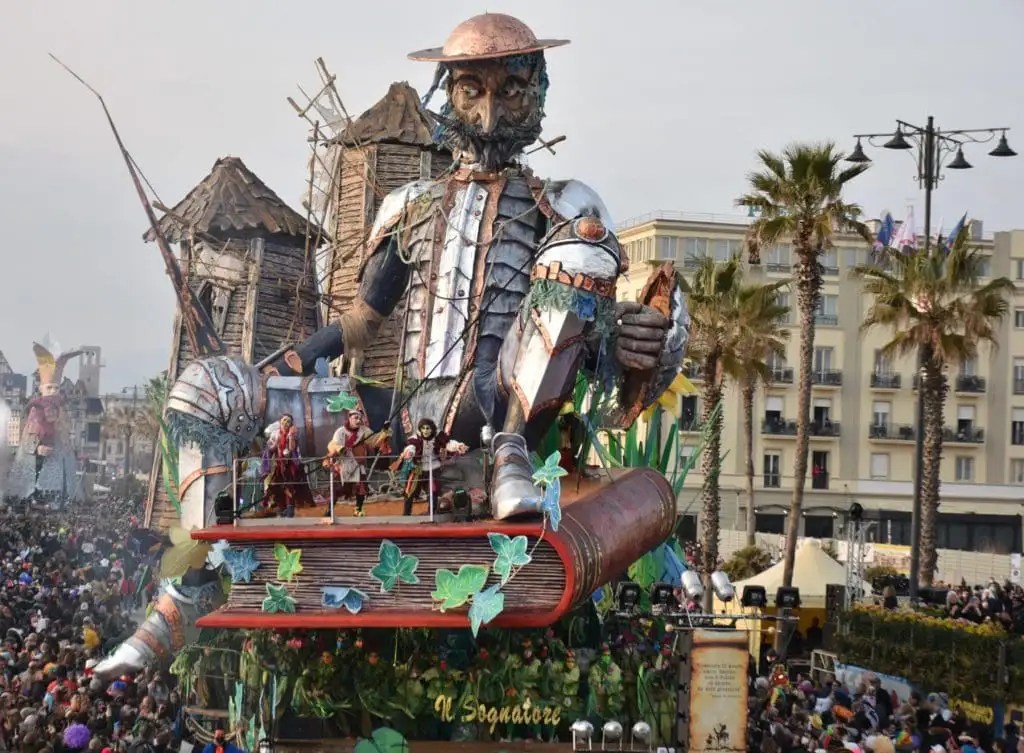


We almost froze to death, but there were compensations: a decent slice of pizza, a bombolone, and later the most wonderful fireworks. We watched them from the beach, standing in the dark after a beautiful sunset, the lights behind us, the sky alive above the sea.


All in all, it was a fine occasion — generous, exuberant, and unmistakably Italian.