While business brought me once again across London, I decided to combine necessity with one of life’s greatest luxuries: wandering.
My destination was Lesnes Abbey, one of my favourite places in London and, curiously enough, one of its least celebrated treasures. The ruined abbey lies close to the southern reaches of the Elizabeth line at Abbey Wood, where modern trains now glide with astonishing speed through landscapes once inhabited by monks, pilgrims, herbalists, and, long before them, sharks swimming in prehistoric seas.


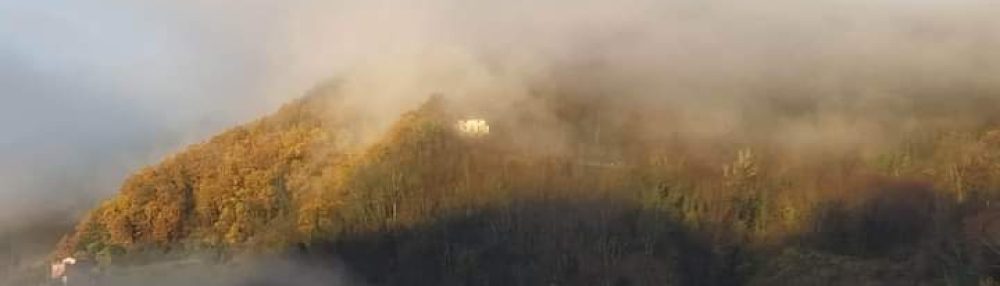
The day itself could not quite decide what season it wished to belong to. Clouds alternated between grim, threatening grey and sudden generous sunshine. Yet the rain, mercifully, never truly arrived. Instead, the dampness left the woods rich with scent and colour, and the intermittent sunlight illuminated the landscape with theatrical brilliance.
After spending some time among the abbey ruins themselves, I set off toward another place I have long loved: the internationally important geological exposures known as the Blackheath Beds. These Eocene deposits, remnants of an ancient tropical environment that once covered this part of England, have yielded fossil sharks’ teeth and traces of early mammalian life. Reaching them requires a walk through the beautiful woods of Abbey Wood itself, and the journey there is half the pleasure.
What always astonishes me about these woods is how little known they remain. They possess nearly everything people seek in far more fashionable London green spaces: mature woodland, shifting contours, hidden valleys, changing textures of light, and a remarkable sense of escape … except the crowds! For almost two hours I wandered through this vast stretch of London woodland almost entirely alone. It was extraordinary — one of those increasingly rare moments when a great city seems to disappear altogether.
Perhaps the uncertain weather kept people away. If so, I was grateful for it.
The fossil beds themselves were damp and not especially easy to search, but persistence was rewarded. Among the pebbles and clay I managed to find a fine fossil shark’s tooth, blackened and polished by immense stretches of time. Holding such an object in one’s hand produces a strange sensation: the sudden collapse of millions of years into a single tangible fragment. One stands in suburban southeast London and yet touches a vanished ocean.


I had hoped, too, to find bluebells. Earlier in the season it had been too soon for them; now, perhaps, it was already too late. Not a single bluebell remained. Nature keeps her own calendar and does not adjust it for our convenience.


Yet what the woods withheld in one form they offered abundantly in another. Emerging from the trees, I encountered a magnificent display of rhododendrons whose colours rivalled anything one might find in the more celebrated parks of London.


Then, beyond them, came an even greater surprise: an arboretum containing dozens upon dozens of tree species, many of them rare and exotic. Among these trees several particularly captured my imagination. There was the Himalayan cedar, noble and fragrant; the tulip tree, named for the elegant shape of its leaves; and then perhaps the most remarkable of them all — the ancient Ginkgo biloba.


The ginkgo is often called a “living fossil,” and rightly so. Its lineage reaches back unimaginably far into geological history, long before human beings existed and even before the dinosaurs ruled the earth. Entire worlds vanished while the ancestors of this tree endured. Seeing one here, after searching the fossil beds below, felt strangely appropriate — as though the whole landscape were quietly reminding the visitor of time’s immense continuity.
I know the ginkgo well from Lucca, where beautiful specimens grow in the botanical gardens and near the city walls, turning brilliant gold in autumn sunlight. To encounter one again here, in southeast London, created one of those small but moving bridges between places and memories.
Eventually I returned to the abbey precinct itself and spent some time in the recreated monks’ garden. The garden is modest, but lovingly conceived, offering at least a glimpse into the world once inhabited by the Cistercian monks who lived there before the Dissolution of the Monasteries in 1537.


It is impossible to stand in such a place without reflecting on what was swept away during that upheaval. The destruction of the monasteries under Henry VIII was not merely architectural or political. It represented the dismantling of an entire ecosystem of belief, ritual, learning, hospitality, and care.
The monks were not simply men who prayed. Many served as physicians and herbalists. They cultivated medicinal herbs — the old “simples” — prepared remedies, copied manuscripts, sheltered travellers, and cared for the sick. The very word “hospital” preserves something of this older world. It shares its roots with “hospitality,” with the offering of shelter and care to strangers, pilgrims, and the vulnerable.
That idea now feels curiously distant in our own hurried age.
Of course, history is never simple. One cannot romanticise the medieval world entirely, nor deny the changes and institutions that later centuries brought. Yet there remains something profoundly moving about these ruined places, something that speaks not merely of destruction but of continuity — of human beings endlessly attempting to create meaning, beauty, refuge, and order against the passage of time.
Perhaps that is why places like Lesnes Abbey affect me so deeply. The ruins themselves are evocative, yes, but they also exist within layers of memory: prehistoric oceans, medieval devotion, Victorian botanical enthusiasm, suburban London, and now the swift electric trains of the twenty-first century passing nearby.
And so the day ended in the best possible way. I met my wife and together we went to one of our favourite places in London, The Golden Chippy in Greenwich, where, in our opinion at least, one can still find some of the finest fish and chips in the capital. After fossils, monasteries, woods, ancient trees, and meditations on history, there was something wonderfully reassuring about good food served warmly and generously.
Hospitality again.


By the time we finally made our way home, the day had acquired that rare satisfying fullness produced only by a mixture of discovery, reflection, companionship, and wandering — business and pleasure intertwined, exactly as life perhaps ought to be.