
The Museum of the Battle. But which battle?
Well, obviously, the battle after which this town is named: the Battle of Vittorio Veneto. But why is it so important?
Because it was the final great Italian offensive of the First World War, the battle which broke the Austro-Hungarian forces on the Italian Front and led directly to the armistice between Italy and Austria-Hungary in November 1918.
But to understand what happened here, we have to go back a little.
The museum is in the old town hall of Ceneda, one of the two historic parts of Vittorio Veneto. The other is Serravalle. They were separate towns for centuries and were united in 1866, when the new municipality of Vittorio was created. The name Vittorio Veneto came later.


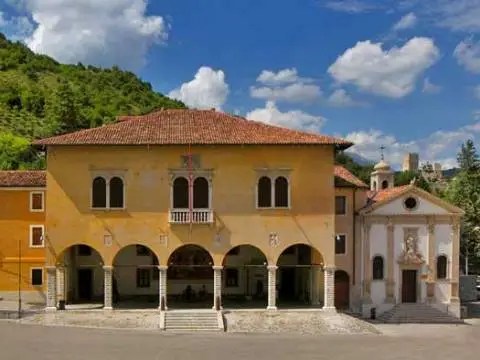
We had visited the museum before, and what struck us this time was how completely it has been transformed.
The old museum was, frankly, rather like a collection of First World War leftovers: shells, rifles, bits and pieces of military equipment, and rather hastily written notices. It was interesting, certainly, but it was much more a memorial to the battle than an attempt to explain the war itself. That was hardly surprising. The museum was inaugurated in 1938, exactly twenty years after the Italian victory, and its original presentation was deliberately celebratory and patriotic. It was founded around the collection of Luigi Marson, a local soldier who had gathered objects and documents from the battlefields.
The museum was radically redesigned between 2012 and 2014, and the difference is enormous.
Instead of simply celebrating victory, it tries to tell the story through the experiences of the people who actually lived through the war. It is divided into three principal sections: life in the trenches, life during the Austro-Hungarian occupation, and finally the Battle of Vittorio Veneto and the myth that grew up around it.
The first section is about the trenches.
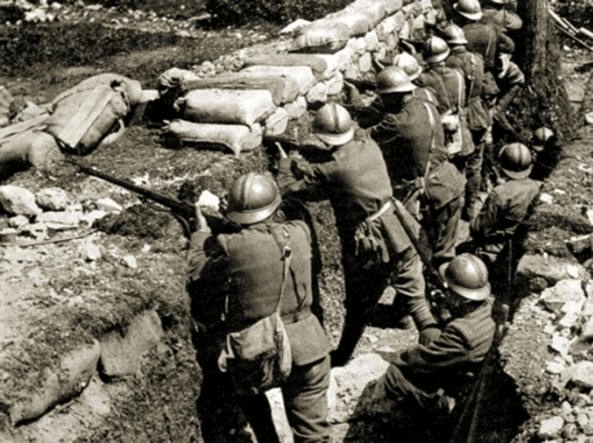
And this is where the museum really comes alive. You walk through a deliberately claustrophobic reconstruction of trench life, surrounded by the objects that made up the soldiers’ everyday existence. There is the barbed wire, the appalling little metal obstacles designed to maim or kill, the cooking tins and mess equipment, personal belongings, letters, photographs and all the other paraphernalia of men who were expected to live for months on end in conditions which are almost impossible for us to imagine.



There are also some extraordinary little objects which tell you something about the human need to carry on living a normal life in completely abnormal circumstances. One of them is a mandolin made from bits of war material. Someone had actually taken pieces of the battlefield and turned them into a musical instrument, presumably in the hope of making an evening in the trenches slightly less unbearable.
And that, really, is what makes this section so effective. It isn’t simply about military manoeuvres and generals moving coloured arrows around maps. It is about people.


The Italian campaign was an appalling business. Around 650,000 Italian soldiers died during the First World War, and the Italian army suffered enormous losses during the disastrous fighting which culminated in the defeat at Caporetto in October–November 1917.
Caporetto changed everything.
The Austro-Hungarian and German forces broke through the Italian lines and advanced deep into Italy, eventually reaching the Piave. The Piave subsequently became one of the great defensive lines of the Italian army. Even today you find references to it as the river that saved Italy and when one crosses that river there is this notice affixed on the bridge: “Piave fiume sacro alla patria” — literally: “Piave, river sacred to the Fatherland.”


And then comes the second section of the museum: the occupation.
After Caporetto, large areas of north-eastern Italy fell under Austro-Hungarian occupation. The museum does a very good job of showing what that meant in everyday terms. There were shortages, requisitions, hunger, displacement and the constant presence of a foreign army. The occupation was not simply a military matter; it affected every aspect of civilian life. The museum particularly stresses things such as requisitions, destruction, surveillance, spying and the complicated relationships between occupiers and occupied. Interestingly Bagni di Lucca gave shelter to many refugees displaced by the fighting.
There is also a particular complication which is easy to forget when we talk about “the Austrians”. The Austro-Hungarian army was not simply an Austrian army. It was the army of a huge multinational empire, containing Czechs, Slovaks, Slovenes, Croats, Serbs, Hungarians and many other nationalities.
And there is an extraordinary historical irony here.
Men from all these different nationalities were fighting together in an empire which was itself beginning to crack apart. Within a few years, many of those nationalities would have their own states. The First World War helped accelerate the destruction of the Austro-Hungarian Empire and the creation of countries such as Czechoslovakia and Yugoslavia, while Hungary emerged as a separate state.
The museum illustrates the occupation with photographs, documents and personal objects, but also with film. In one section you lift up what looks rather like a trench periscope and peer into it to watch historical footage. It is a clever device because it makes you feel that you are looking into another world.
Then comes the final section: the battle itself, and what happened afterwards.
By the autumn of 1918 the Austro-Hungarian Empire was exhausted. The empire was suffering from shortages of food and supplies, and its army was increasingly disintegrating along national lines. The Italian army, meanwhile, had recovered from the catastrophe of Caporetto.
General Armando Diaz had replaced the ineffectual martinet Luigi Cadorna as commander-in-chief after Caporetto, and his approach was very different. By October 1918 the Italians were ready to launch their final offensive.
The Battle of Vittorio Veneto began on 24 October 1918. The fighting spread across the Piave and towards the mountains and plains around Vittorio Veneto. British and American troops were also involved on the Italian Front, alongside the Italian forces and other Allied contingents.
The Austro-Hungarian army simply began to come apart.
The battle ended with the Austro-Hungarian armistice, signed at Villa Giusti near Padua on 3 November and coming into force on 4 November 1918. For Italy, the fighting was over.
Victory.
And what a victory it must have seemed at the time.


But victory turned out to be a rather complicated business.
Italy had entered the war in 1915 partly in the expectation of territorial gains. There had been promises concerning territories under Austro-Hungarian rule, including much of the Italian-speaking and strategically important areas around the Adriatic. But the peace settlement did not give Italy everything that Italian nationalists believed had been promised or deserved.
The resulting sense of disappointment became one of the ingredients of the post-war crisis. Gabriele D’Annunzio’s seizure of Fiume in 1919 was an extraordinary manifestation of this frustrated nationalism.
And then Italy had to return to peace.
Only it wasn’t much of a peace for ordinary people.
There were ruined houses, unemployment, inflation, poverty and enormous numbers of men returning from the army to a country which had very little work for them. Social unrest exploded. There were strikes, factory occupations and revolutionary movements. My own Italian grandfather, as it happens, was involved in this left-wing ferment and became an anarchist organising strikes and demonstrations.
Out of this extraordinary mixture of poverty, resentment, nationalism and political instability emerged another figure: Benito Mussolini.
Mussolini had begun as a socialist. After breaking with the socialist movement over the war, he moved increasingly towards nationalism and eventually founded the Fascist movement. Within a few years he would be running Italy.
But that is another story.
What impressed me most about the Museum of the Battle was the way it has changed its purpose without pretending that the old museum never existed.
The original collection is still there. The old cases and objects have not simply been thrown away. They have been incorporated into the new museum, so that you can actually see something of the old, patriotic memorial alongside the new historical interpretation.
The result is much more interesting.
It is no longer simply a museum saying, “We won this great battle.”
It is a museum asking what it was actually like to live through the First World War: to fight in the trenches, to live under occupation, to endure shortages and fear, and finally to experience victory — and then discover that victory did not necessarily produce the peace and prosperity that people had imagined.
In that sense, it has moved from being a memorial to being a museum of human experience.
And that makes it considerably more powerful.