Architecture, Democracy, and the Shape of Power


Modern democracies often debate electoral systems, party funding, or constitutional reform, yet they rarely confront a quieter but equally powerful force shaping political life: architecture. The physical form of a parliament—its seating, its geometry, its spatial logic—does not merely house democracy; it conditions it. The arrangement of elected representatives influences how power is perceived, how debate is conducted, and ultimately how a nation governs itself.
This relationship between architecture and political behaviour becomes particularly visible when one compares parliamentary chambers across democratic states.


The Westminster Model: Adversarial by Design
The British House of Commons remains the most striking example of architecture enforcing a political worldview. Its famous “ping-pong” arrangement—two sets of benches facing each other across a narrow aisle—was shaped in a period when politics was largely binary. Government and Opposition confronted one another directly, reflecting a two-party system that once dominated British public life.
Yet Britain no longer lives in that world. While the first-past-the-post electoral system still encourages majoritarian outcomes, political reality has diversified. Smaller parties—nationalist, regional, liberal, green—now represent substantial portions of the electorate. Despite this, the chamber itself continues to deny their legitimacy spatially. They sit at the margins, both literally and symbolically. Moreover none of the seats have a desk on which to lay out those papers needed for parliamentary discussion. Furthermore, there is no equipment for electronic voting which is standard in many other parliaments and saves so much time. Instead there is the antiquated lobby division system which grinds procedure to a halt.


The problem is compounded by a practical absurdity: 650 MPs are elected, yet the chamber seats only around 427. Unlike other parliaments MPs do not have their own allocated seats but must grab whatever space is still free. During major debates, members crowd gangways or stand, as though democracy itself has outgrown the room built to contain it. This was once a theatrical quirk; today it is a symptom of institutional mismatch. Absolutely crazy!


Pluralism Made Visible Elsewhere
Contrast this with parliamentary chambers across much of Europe.
Italy’s Camera dei Deputati adopts a true semicircular hemicycle, allowing political forces to spread along an ideological spectrum from left to right.

France’s Assemblée nationale, born from revolutionary principles, explicitly rejected confrontational symmetry in favour of ideological gradation.

The Netherlands goes further still, using a wide horseshoe arrangement that reflects its deeply ingrained coalition culture. There is no single, permanent opposition—only shifting alliances formed through negotiation.

In Germany the Bundestag meets in Berlin’s Reichstag building, whose glass dome allows the public to look down on the chamber below. This design symbolizes a key democratic principle: politicians govern under the scrutiny of the people, who stand above power. Transparency and spatial hierarchy make the message clear — in a democracy, authority ultimately rests with the citizens – a sentiment we experienced clearly during our visit to the Reichstag last year. This is in stark contrast to the UK where the public space is limited and restricted to a cramped gallery at one end of the chamber.


India, the world’s largest democracy, has recently embraced a near-circular chamber in its new Parliament building. The symbolism is unmistakable: unity without uniformity, diversity deliberating around a shared centre.
These chambers do not merely accommodate proportional representation and coalition politics; they normalise them. The visual language of the room reinforces the political culture enacted within it.


Coalitions, Stability, and Misunderstood Democracy
Coalition politics is often misrepresented as weakness or instability. Italy is frequently cited as an example of governmental fragility, yet this obscures a deeper truth: coalition systems reflect social plurality more honestly. The Netherlands, by contrast, demonstrates how coalitions can be stable, durable, and effective when negotiation is embedded culturally and institutionally.
In such systems, the idea of a single, monolithic “government versus opposition” dissolves. Opposition becomes plural. Accountability becomes distributed. Debate becomes less theatrical and more deliberative.
A proportional representation system inevitably weakens the old adversarial axis. To retain a chamber built entirely around that axis is therefore to create a contradiction between how representatives are elected and how they are expected to behave.


Britain’s Architectural Crossroads
The Palace of Westminster itself now stands at a literal and metaphorical crossroads. The building is afflicted by severe structural decay: outdated wiring, asbestos, chronic fire risk, failing stonework. Repair estimates range from several billion pounds to figures so large they verge on the surreal.
This moment forces an unavoidable question: should Britain restore a building that embodies a political culture no longer suited to the country it governs?
The Palace of Westminster is a masterpiece of Victorian architecture, rich in symbolism, history, and artistic achievement. Its pre-Raphaelite murals, stained glass, and Gothic revival splendour deserve preservation. But preservation need not mean continued use.
One compelling alternative is to transform Westminster into a Museum of Parliamentary democracy and a living archive of its evolution. After all the parliament of the United Kingdom is frequently described as the Mother of all Parliaments. Meanwhile constructing a new parliamentary building designed explicitly for modern democracy appears to be the only solution to mend Britain’s political procedures.


A Chamber for a New Democratic Age
Such a building would abandon binary confrontation in favour of inclusion. A circular or elliptical chamber—a true rotunda—would allow political positions to flow into one another: left merging into centre, centre into right, reflecting the continuity of public opinion rather than its forced division.
In this space:
Coalitions would form naturally among ideological neighbours.
Opposition would be multiple, issue-based, and dynamic.
Accountability would remain rigorous but less performative.
Representation would be spatially honest.
This would not merely be an architectural change but a constitutional statement: that democracy is no longer a duel between two camps, but a conversation among many voices.


Conclusion: Democracy Must Fit the People It Serves
Architecture does not create democracy—but it profoundly shapes how democracy is practiced. A plural society cannot be governed indefinitely from a binary room. When political structures evolve but physical institutions do not, dysfunction follows.
To rethink parliamentary architecture is not to abandon tradition, but to honour democracy’s central purpose: the faithful representation of a nation’s will. If democracy is to develop—and indeed survive—it must be housed in spaces that encourage cooperation, acknowledge diversity, and reflect the complexity of modern political life.
The time has come to recognise that the shape of power matters.

A Day in Forte dei Marmi: Rain, Art, and Coastal Beauty

Morning Jouney to San Camillo Hospital
The medical examination required us to go to San Camillo Hospital in Forte dei Marmi. We hadn’t intended to go quite so far! We might have had an appointment nearer home but would have had to wait for it much longer. So we decided to set out for Forte dei Marmi in the Versilia just north of Viareggio on the coast of the Tyrrhenian Sea.


We started on a ghastly, rainy morning. It was still dark when we left. We had to cross the Apennines at the pass near Monte Magno, and then the rain really began to come down with an intensity that was quite alarming. Huge lorries coming towards us splashed water over the car so violently that for moments we could hardly see anything at all. We were worried we might miss the appointment, but I phoned the hospital and was reassured that it would not be a problem.
At the hospital, the doctor examined my ear, which had previously suffered from a basal cell carcinoma and had had to be partially removed. Thankfully, he confirmed that everything was fine and that the ghastly carcinoma was not going to return.


Exploring Forte dei Marmi
Instead of driving straight back, we decided to explore Forte dei Marmi, a town famed for being an upper-class and expensive holiday resort. It is often said to be the favourite haunt of Russian oligarchs, though the mayor insists that it is a place of quality open to everyone. Since the war with Ukraine, however, the number of Russian visitors has decreased, and those who remain tend to keep to themselves. More noteworthy patrons of Forte include the Agnelli family the founders of the FIAT car firm who have their villa here.
That said, Forte dei Marmi is undeniably a place for those with a little money. Porsches and Ferraris are common sights.
Walking through the town, we came across a small and very attractive church: the Church of Saints Francis and Maria Assunta. It was begun in the early twentieth century but not completed until about 1948. It contains the tomb of Father Ignazio da Carrara, a Capuchin friar who refused to leave his parish during the war and cared for refugees. Tragically, just one week before the liberation of the area by the Allies, he was brutally shot by an SS soldier. His tomb is placed in the centre of the nave.
The church itself is beautiful, with Romanesque and almost Gothic elements: a clerestory, a triforium, elegant Corinthian-style columns, and fine stained glass. It is what a church should be, before the brutalist constructions of the 1960s and 1970s, which often resemble nuclear power stations more than places of worship.


The Pier and Stormy Seas
We then walked to the pier — the pontile. By then, the rain had stopped. The pier was originally used to load ships with marble blocks from the nearby Apuan Alps but is now used as a pleasant walkway and an embarkation point for holiday coast steamers. Further up the coast at Carrara marble continues to be exported to many parts of the world including the Middle East emirates.
The sea was extremely rough, with high waves, and apart from a couple of people walking dogs, we had the pier entirely to ourselves. It was a wonderful experience: stormy seas, threatening skies, the wind whipping around us. Reaching the end of the pier, I felt that this alone justified the journey to a slightly distant medical appointment


Coffee at Piazza Garibaldi
We headed to Piazza Garibaldi, where we visited Caffè Soldi, perhaps the most fashionable café in Forte dei Marmi. We enjoyed excellent coffee and cakes — a delightful, though slightly pricey, experience by Italian standards.


Il Fortino and the Exhibition of Costantino Paolicchi
From there, we learned about Il Fortino Leopoldo I, the historic fortress that once defended the town and oversaw the marble trade.

Inside was an exhibition by Costantino Paolicchi, titled Antiche solitudini. Percorsi tra memoria e natura (1990–2025). Paolicchi (born Florence, 1948) is an artist deeply rooted in the culture and landscapes of Versilia. He spent many years as a curator and cultural organiser before focusing on his own painting, exploring forests, trees, seascapes, and memories of place. His work is known for its intimate engagement with nature — the textures of bark, moss, and forest were brought to life on the canvas in a way that made them feel almost tangible.


Going up to the first floor, the landscapes shifted from coastlines to mountains and dense forests. I have rarely seen trees painted with such sensitivity and precision. The paint seemed part of the forest itself; the atmosphere, moss, and bark textures were captured perfectly. The exhibition, spanning two floors of the fort, was a privilege to see — absolutely stunning, and a memory I will always treasure.


Costantino Paolicchi’s paintings at Il Fortino, capturing the forests, sea and mountains of Versilia.

in one.of the rooms was the artist’s manifesto:

“The sea has this ability:

I belong to the sea. There’s an ancient bond that comes from a sailor father, and from generations of sailors before him. There’s a love that my mother passed on to me through her genes and that she taught me to cultivate. She couldn’t live without the sea and couldn’t stay away more than a day from her hometown, where she grew up on that long beach around the mid-19th century, when those few marble shippers and shipbuilders took root, building their homes near the fort erected by Peter Leopold to defend the coast.

Forte dei Marmi and the sea were, for me as a boy, the centre of the world, where I discovered the wonders of nature that manifested themselves in every season, on the edge of the waves or in the calm of the calm, in the stands of pines and holm oaks scorched by the salty wind, in the orderly countryside of the small plain.

Already at fourteen, I was earning my living by working on the beach as a lifeguard’s assistant during the summer, and then as a certified lifeguard during high school and college. It was hard work, starting at five in the morning, scooping or “sbaronare” the sand (a “baron” is a simple wooden tool used to smooth it), setting up tents and umbrellas, rigging boats and paddle boards; then I’d wander up and down the scorching sand all day. I was amazed by the sea, which changed colors as the hours passed, from the silent stillness of dawn to the last gleam of the sun setting behind the hills of La Spezia. I listened to its solemn breathing even at night, because I had sharpened my senses to detect changes in the weather. If it blew south-west, I could hear the storm coming from the roar of the surf and the rustling of the trees around my little house on Via dei Mille. Then I had to run to the beach and carry the boats and equipment from the beach resort where I worked, further up the coast, to safety, away from the crashing waves. When the sun rose behind the sharp profiles of the Apuan Alps, where the clouds driven by the southwest wind gathered dark and threatening, the grandiose spectacle of nature rewarded me for my efforts.

The most beautiful and intense moment of the entire day was around eight in the morning, when everything on the beach was finally in order. Then I would stop to observe the sea, its different shades of green and blue, and I would guess the spots where the currents carried seaweed and objects lost or uncivilly thrown from the boats. Dark lines that could be seen even from afar because the sea waters were truly clear then. I watched the passing clouds on the sea horizon, and the stormy skies above the sharp crests of the Apuan Alps. My father, a sailor, had taught me to read the signs in the sky to predict changes in the weather. I especially loved the solemn silence of that hour. Soon the beachgoers would arrive, and the magic of the morning would be shattered.

Today, the silence is everywhere drowned out by the deafening noise of the cities, the loud music from public places, homes, even passing cars. People walk the streets and talk loudly on their cell phones to—to us—unknown interlocutors. Loudspeakers call out to people even on the beaches in summer, motorboats and jet skis roar. “Noise has become obligatory: perhaps it fills the void of those who don’t know what to say, and thus covers the enigmas and sounds of silence.”


Lunch at Baracca
By this stage, we were hungry and chose Baracca, a simple but excellent restaurant near the pier. We ordered baccalà alla livornese (cod in tomato sauce), which had to be reheated to reach the right temperature, but once warm it was superb. We also shared shrimp and I had an extra plate of chips. The restaurant was already filling with local patrons, a good sign of its popularity.
The system is peculiar: you tick off what you want on a menu and take it to the cash desk, pay and then return to your table where you wait for the food. It worked well, and the cod was very good. I’m sure there are more sophisticated eateries in town, but this suited us perfectly.


Journey Home
After lunch, we returned to our car. Parking had been free and straightforward, despite the busy morning. We stopped for coffee at a small café at the top of the Apennine pass, where a young Polish woman served us. We chatted about Poland and agreed it is one of the fastest-developing countries in Europe, thriving without losing its charm.
We returned home via Gombitelli and the Lucese pass, then down towards Diecimo. We had a minor scare when we realised we were low on petrol. Fortunately, we made it. Along the way, we passed the home to the last traditional smithy in the area, run by Mr. Galgani, and then through Piegaio. In Diecimo, we visited a small shop run by a Scottish lady to have our car keys cut.
Finally home, after being up since five o’clock in the morning we made a simple soup of Roman cabbage and pastina and went to bed. Reflecting on the day, I realised that even a hospital appointment in Italy can turn into a rich, memorable adventure — full of rain, storm, art, history, and simple pleasures, all in one of the most dramatic and beautiful corners of the world.


Farewell to Meat?


Carnival in Italy is another feast in which ancient pre-Christian traditions meld seamlessly with Christian belief. The word itself offers a clue: carne (meat) and vale (farewell) — a farewell to meat. In other words, Carnival takes place before the onset of Lent, the period of abstinence in which rich foods are traditionally given up.
This pattern — indulgence followed by restraint — is not unique to Christianity. One cannot help thinking of parallels in other monotheistic religions, such as the Muslim month of Ramadan. Italy, of course, is less drastic. One eats during the day, but the food is lean and meatless. Yet before any great season of renunciation there is, almost inevitably, a final splurge — and Carnival is precisely that: a last exuberant enjoyment before restraint sets in.


It is also worth remembering that in earlier periods of Italian history, Lent meant giving up more than food. Public entertainments were curtailed: no theatre, no opera. Carnival therefore offered a final opportunity for spectacle, performance and communal pleasure before cultural life temporarily fell silent.


Carnival in Italy takes many forms. Commedia dell’Arte is paramount in certain places — Venice above all — dominated by theatrical traditions shaped by figures such as Goldoni and his predecessors. But there are many other carnivals, each with its own character. Ivrea, for example, claims to host the oldest carnival in the world, while others range dramatically in scale and tone.


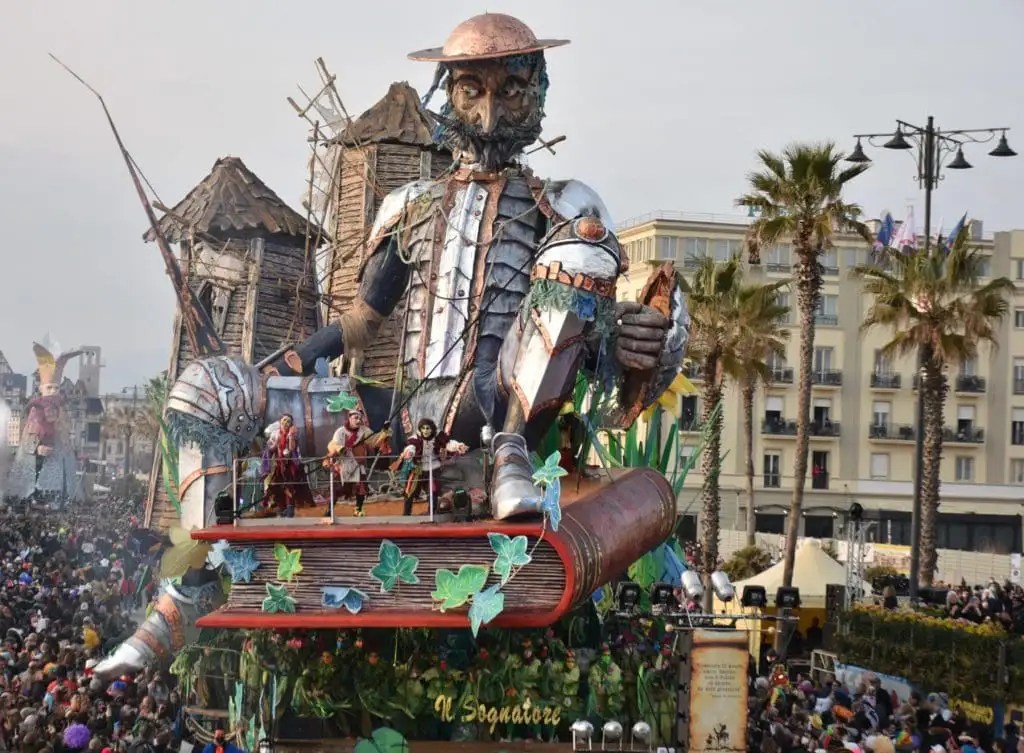
Recently we were in Viareggio, famous for its enormous papier-mâché floats — among the most spectacular anywhere in the world. At the same time, there were smaller, more intimate street carnivals taking place alongside the grand parade. Satire is one of Carnival’s defining features: it is the moment when one can let one’s hair down and say what is otherwise unsayable, lampooning political, religious and public figures with impunity. Viareggio is particularly renowned for this sharp political satire; some figures are treated gently, others less so — I will not say which.


I was reminded of a similar spirit elsewhere, though outside the Carnival season and far from Italy. In Stromness, in Orkney, I once witnessed a remarkable local summer carnival which mercilessly lampooned councillors and political figures — mostly English ones — with wit and inventiveness. The impulse was recognisably the same.


Does England have carnivals? It has one — the Notting Hill Carnival — but strictly speaking it is not a carnival in the traditional sense. It does not take place during the Carnival season, nor does it mark a farewell to meat or indulgence. It is better understood as a festival: rooted in Caribbean tradition, now broader and more inclusive, but conceptually quite different. The name has stuck, however, and so it remains the Notting Hill Carnival. Over time it has also become more good-natured, with much of the violence that once marred it gradually ironed out.
The contrast with Viareggio could hardly be greater.


Despite the cold this year — Easter being a movable feast that can bless you with warmth or leave you freezing — we had a thoroughly good time in Viareggio.

We almost froze to death, but there were compensations: a decent slice of pizza, a bombolone, and later the most wonderful fireworks. We watched them from the beach, standing in the dark after a beautiful sunset, the lights behind us, the sky alive above the sea.


All in all, it was a fine occasion — generous, exuberant, and unmistakably Italian.

New Towns for Old


For many visitors from England, one of the first impressions of Italy is space. Leave the city and, almost without warning, the land opens out: hills, fields, and mountains replace streets and traffic. The calm feels physical, something you step into rather than merely observe. It is a sensation increasingly rare at home. Italy’s population density is almost half of England’s, and the difference is felt not in numbers but in experience. Italy breathes more easily.


Nowhere is this clearer than in the mountains. In England and Wales, even comparatively modest peaks can draw long queues on a fine weekend. Snowdon, for all its grandeur, often feels shared by thousands. We were fortunate when we crossed Crib Goch — that narrow, vertiginous ridge leading to the summit of Yr Wyddfa — to find only a handful of others on the route. Such moments are memorable precisely because they are unusual.


In Italy, mountains are not special destinations but part of the everyday landscape. The Alps rise in the north, the Apennines run like a spine down the peninsula, and between them lie valleys, passes, and high plateaux. It is often possible to walk for hours without meeting anyone at all. When you do encounter another walker, there is an unspoken recognition: a shared understanding of why you are there. Conversations begin easily; friendships sometimes follow.


Even the Po Valley, that great industrial heartland, retains a surprising openness. Canals, fields, and farm tracks weave between towns and cities, softening their edges. Life does not end abruptly at the city boundary. By comparison, much of England feels tightly stitched together, each place pressing against the next. There are exceptions, of course. The Breckland forests near London offer an unexpected sense of scale and silence, though even these are largely planted landscapes, shaped by policy rather than geology or time.


This abundance of space is reflected in how people live. In England, especially in the south-east, housing has become a source of anxiety: too little of it, too expensive, too confined. In Italy, homes are more varied and often more generous. In hill towns such as San Romano, stone houses open onto courtyards warmed by the sun, their roofs looking out over olives and vines. In cities like Bologna or Parma, balconies and small gardens are common, modest extensions of private life into the open air. Beyond the towns, villages sit quietly amid fields, many houses shuttered not through neglect but because there is simply no pressure to occupy them.


Daily life unfolds differently too. Italian towns encourage movement on foot or by bicycle. Markets punctuate the week; errands become social encounters. A mother cycles to the baker with a child perched behind her; an older man lingers at a stall discussing tomatoes. In Lucca, children make their way to school along paved streets, pausing to greet neighbours or buy bread still warm from the oven. In the evening, families gather in piazzas and on church steps, children playing while adults sit and talk, watching the slow rhythm of the town.


In England, life is more tightly choreographed. The commute dominates the day. Cars and trains dictate movement; shopping is often displaced to the margins of towns. High streets thin out, parks feel less certain after dark, and even residential areas can seem tense, compressed by numbers and pace. Space exists, but it is rationed, scheduled, and increasingly contested.


These differences are deeply rooted in history. England’s post-war new towns — Stevenage, Welwyn Garden City, Basildon — were bold attempts to improve life through planning. At their best, they offered light, greenery, and a sense of order. Some of that vision remains, particularly in places like Welwyn, but much has been eroded by sprawl and repetition, until the ideal has faded into familiarity, and occasionally into parody.


Italy’s idea of the city was shaped much earlier. During the Renaissance, thinkers such as Leon Battista Alberti imagined towns as moral and social instruments: places where proportion, beauty, and civic life reinforced one another. The painted visions of ideal cities, now hanging in museums, show arcaded streets and balanced squares designed not to impress, but to civilise.


These ideas were built as well as painted. Palmanova, with its star-shaped plan, still reads as a diagram of Renaissance order. Sabbioneta, created by a cultured ruler of Mantua, contains within its walls a theatre, library, palace, churches, and a synagogue — a small town designed as a complete human world. Children grow up walking these streets, absorbing a sense of measure and continuity without being taught it. Pienza offers the same lesson, quietly and daily.


Later, these ideals travelled north, influencing England’s own garden cities. The belief that towns might improve human life did not originate in Britain, but it was taken seriously there for a time. What feels striking now is how far modern development, in both countries, has moved away from that ambition.

Modern Italian new towns were usually responses to specific needs rather than population pressure: the draining of the Pontine Marshes (Pomezia, Latina), the creation of mining communities in Sardinia (Carbonia – where my mother-in-law worked in her uncle’s hotel), post-war redistribution around Milan, Florence, and Rome. Sprawl exists, certainly, especially around industrial centres and popular coasts, but it remains contained. It has not yet become the dominant form.


Geography and geology play their part. Italy’s young, restless landscape brings landslides and instability;

England’s older ground is steadier but increasingly prone to flooding and coastal erosion. These forces shape how and where people build, and how densely they live.
To travel through Italy is to feel how these layers come together. Vineyards follow the road out of town; olive groves surround roundabouts. Bread is delivered to village squares; children walk to school unaccompanied. Evenings stretch gently as families stroll, talking, lingering. Such scenes still exist in England, but they feel harder won, more fragile, often curtailed by weather, distance, or sheer busyness.


Ultimately, what Italy offers is not perfection, but space — physical, social, and mental. Its population, similar in size to England’s, is spread across a much larger and more varied landscape. Towns retain their edges, countryside remains close, and daily life is still shaped by place.


For those attuned to history, to landscape, and to a slower, more humane rhythm, Italy continues to offer something England increasingly struggles to sustain: towns with character, cities scaled to people, and an enduring belief that the built environment should serve human well-being. Alberti’s ideal city was never meant to be utopian. It was meant to be livable — and in many parts of Italy, it still is.

Fifty Years of Etching Love in Barga

Originally posted on July 1, 2023

It is with great sadness that I share this post, as Swietlan Nicholas Kraczyna, a truly remarkable artist, has recently passed away. This exhibition in Barga was the last we had the privilege of visiting with him. Both the artistic world and our community will feel his loss deeply — Nick was a pioneer of multi-colour lithography, a magical landscapist, and a generous, inspiring presence. His work and spirit will be remembered and cherished forever.

Fifty years of art. Fifty years of love for Barga, going back to that iconic print commissioned by Bruno Sereni of the beautiful Borgo, with its Romanesque Duomo crowning the palazzi and forming a miniature mountain. Fifty years of consummate artistry. Thank you, Swietlan Nicholas Kraczyna. Thank you, ‘Nick’!

Born in the warring borderland between Poland and Russia, Nick’s family fled from the Red Army to find a calmer life in the USA. There, he developed his skills with particular emphasis on multi-plate colour etching, becoming a pioneering master in the field.

Visiting the exhibition, I was struck not just by the technical brilliance of his etchings, but by the emotion and imagination woven into every scene. Nick declared himself not merely a landscape artist but a “magical landscapist,” where the outer world mirrors his inner vision. In Barga, his adopted summer home, he said, “Here, everything does not simply need to be seen but experienced as well.” Standing among his work, I understood exactly what he meant — the landscapes, mythologies, and transformations he depicted seemed to breathe and shimmer with life.

The celebration of Nick’s half-century of creative work was inaugurated at Barga’s Galleria Municipale with the artist cutting the tri-colour ribbon to his exhibition, in the company of Barga’s mayor Caterina Campani and colleagues Kerry Bell and Giorgia Madiai. The sound of Metamorphoses — Britten’s oboe piece inspired by Ovid — filled the gallery, perfectly echoing the mystical world of his etchings.

Nick also shared insights into the painstaking technique of multi-plate etching, or Intaglio, where what is removed from the plate is filled with coloured inks and pressed on paper to create the final work. The alignment of multiple plates requires not just precision but inspiration, and Nick’s mastery made the process look effortless — though every piece carries a lifetime of skill and dedication.

Barga’s Municipal gallery exhibition, largely didactic in approach, was just a taster for the larger show at the Santa Elisabetta conservatory. Further homages were planned on the facade of the Teatro dei Differenti, and from September to October at the museum of the house of poet Giovanni Pascoli. The exhibition catalogue is published by Maria Pacini Fazzi Editore.

Visiting this exhibition, knowing now it was the last with Nick, is a memory I will always hold dear. His work leaves a lasting legacy of colour, imagination, and emotional depth, and his presence — warm, humble, and radiant with curiosity — will be sorely missed. Barga, the art world, and everyone who has experienced his vision have lost a rare and extraordinary soul.

Melifluous Meloni

Giorgia Meloni, Italy’s (first woman) Prime Minister, has recently found herself at the center of a curious intersection of art, politics, and public perception. In the historic Basilica of San Lorenzo in Lucina in Rome, a recently restored cherub fresco unexpectedly drew attention for its striking resemblance to Meloni.

The artwork, restored due to humidity damage, became an instant sensation when observers noticed the cherub’s face seemed to mirror the Prime Minister’s own features. The restoration was carried out by Bruno Valentinetti, a long-time sacristan and decorator with over 25 years of experience in church restorations. Valentinetti maintains that he did not intentionally depict Meloni, but simply sought to restore the artwork to its original form. The parish priest confirmed that the restoration aimed to preserve the fresco, not to make any political or cultural statement, while the Vicariate of Rome, representing the Pope at the diocesan level, expressed some embarrassment and initiated an internal review to ensure that sacred art was not used for personal or political symbolism. This clearly has hardly been the case in the history of Italian art where virgins, saints and other religious icons have often been deliberately modelled on the patrons who commissioned the art work and their followers. There has, however, been no direct comment from the Pope himself, though the Ministry of Culture is monitoring the situation due to the media attention it has attracted. Meloni herself responded with humour, sharing the cherub photo on social media and acknowledging the resemblance in a lighthearted manner, highlighting her ability to navigate public perception with grace and wit. ‘Actually I’m no angel’, she quipped.

This incident offers a fascinating insight into the ways women in politics are perceived. Meloni is not only a serious political leader but also carries a dual public image akin to a “First Lady” figure, enhancing her visibility and influence. She skillfully blends political authority with personal presence, style, and charisma. She is certainly, for many. a rather attractive woman. Among female European leaders, Meloni stands out not just for her policies and leadership skills, but for how effectively she leverages her presence and public image to reinforce her political role. This duality has become part of the conversation surrounding her, amplified further by this unexpected artistic connection.

It is also important to note Meloni’s political positioning. She is firmly a right-wing Prime Minister and, during her early political career, her positions were even more extreme, at times flirting with ideas closely associated with Italy’s far-right past. This is an intriguing trend when observing female leaders globally, as many prominent women in politics have emerged from right-leaning or conservative traditions. Margaret Thatcher in the United Kingdom serves as a classic example, and while other female right-wing leaders exist worldwide, the phenomenon is noteworthy and often sparks discussion about gender and ideology in leadership.

Giorgia Meloni’s administration is recognized as the third longest-serving government in the history of the Italian Republic. Having taken office on October 22, 2022, her government has achieved a rare level of stability in a country where governments average only 16 months in duration. That is no mean thing in Italy’s volatile political world. Could Italian ‘mammismo’ have a part to play in this I wonder? Certainly her well-known declaration “I am Giorgia, I am a woman, I am a mother, I am Christian” has become a slogan for her conservative, nationalist views and identity, highlighting her emphasis on traditional values supported by so many Italians especially in view of an increasing non-christian population due to decreasing numbers of practising catholics and increasing 3rd world immigration.

The fresco incident, combined with Meloni’s personal and political image, illustrates the complex interplay between culture, media, and politics. It serves as a reminder that the public presence of a leader—particularly a woman of a particular Italian personal attractiveness —can be influenced not only by policy and leadership but also by imagery, perception, and even chance events in the cultural sphere. In Meloni’s case, a cherub in a Roman church unexpectedly reinforced her dual role as a powerful political figure and a highly visible public persona. The story is a compelling mix of humour, art, and the strategic use of image, demonstrating how sometimes the paths of history and contemporary life intersect in the most unexpected and fascinating ways.

PS News just in: they’ve given the OK for work to start on the restoration of the Sistine Chapel:

PPS The restorer of the fresco which apparently represented Giorgia Meloni has destroyed his controversial creation in favour of a less explicit representation which the local vicar hopes will dissuade the crowds from entering his church not for prayer but to gloat over their presumed prime minister’s features.