Flora

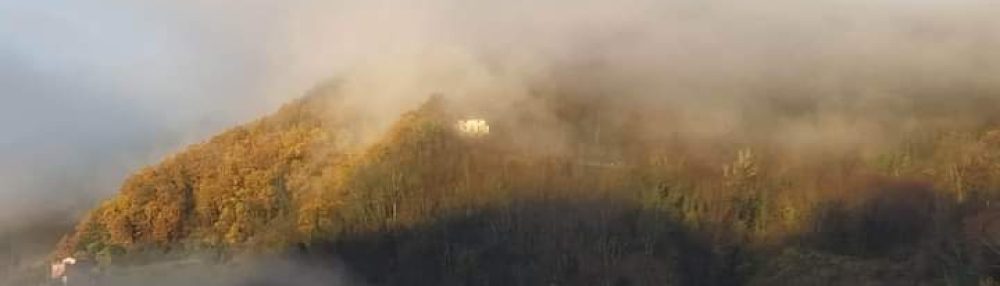
The month of May has not so far been particularly merry this year. We’ve had some lovely days admittedly but for much of the time our valley has been covered by a mist which could be more fittingly called a cloud. We are all living in this cloud but it is not quite cloud cuckoo land although the plaintive two-note call of the spirit bird echoes across our glades.

This week marks Christ’s Ascension and the Redeemer of mankind was swallowed by a cloud to be taken up to the Celestial city of God the Father.

In the Acts of the Apostles it is written: ‘So when they had come together, they asked him, “Lord, will you at this time restore God’s kingdom?” He said to them, “It is not for you to know times or seasons that the Father has fixed by his own authority. But you will receive power when the Holy Spirit has come upon you, and you will be my witnesses to the end of the earth.” And when he had said these things, as they were looking on, he was lifted up, and a cloud took him out of their sight. And while they were gazing into heaven as he went, behold, two men stood by them in white robes, and said, “Men of Galilee, why do you stand looking into heaven? This Jesus, who was taken up from you into heaven, will come in the same way as you saw him go into heaven.”

A good lady in our village of Longoio was taken from us too this week and she will surely join her Redeemer. Flora’s health had not been very encouraging for some time but she battled on with fortitude. Flora’s funeral in our little cemetery just outside Longoio, near Mobbiano, was accompanied by truly disconsolate weather; a constant drizzle misted up my glasses already fogged over by the anti-covid mask we are still obliged to wear for any kind of public gathering in this part of the world.

Don Franco, the parish priest, had foregone the normal church funeral service in our local church of San Gemignano and conducted the entire ceremony of the blessing of the deceased in the cemetery’s damp atmosphere.

The attendance, despite the weather, was a praiseworthy one for Flora was a much-loved as well as a much-respected lady and we all mourn her departure but know she is going to a better place.

For Flora of Longoio

*

The heavens weep upon an earth drowned in sorrow;

we cry quite needlessly for we forget

there will be eternal hope on the morrow.

*

The land lies silent and only the crow

lets his black croak break the sodden wet.

The heavens weep upon an earth drowned in sorrow

*

and will that day ever come we call tomorrow?

The spring flowers and on garden’s red rosette

there will be eternal hope on the morrow.

*

Yet the path is rough and the way is narrow,

there is danger of being caught in a net:

the heavens weep upon an earth drowned in sorrow.

*

Our days are subject to time’s cruel arrow

but although life seems a game of roulette

there will be eternal hope on the morrow.

*

To heal our souls rises the magic yarrow

and we pass by like a tiny vignette.

The heavens weep upon an earth drowned in sorrow:

there will be eternal hope on the morrow.

Olive Oyl?

An Italian saying describes February as a month that is nasty weather-wise but which is also thankfully short. True, much of February has been filled with some very trying times here in the Val di Lima. The month has either given us days of continuous deluging rain or inflicted temperatures descending to minus seven. For Saint Valentine’s day, we woke up to fresh snowfalls and to be outside for just a few minutes without gloves meant frozen fingers and red cheeks.

Within the past few days, the climate has completely changed. True, the nights remain still comparatively cold although now above freezing. During the day, however, the temperature has soared above twenty degrees centigrade; not only can coats come off but sweaters too and yesterday I opened a sunshade on my terrace since the midday sun had become a little too hot.

Talk of global warming! I don’t remember a heat haze quite like this in February…and it`s scheduled to continue for at least another week.

Time to look at doing some serious gardening. I walked to my little olive grove the other day and was shocked to find that two trees had almost been uprooted as a result of completely sodden ground and some strong winds.

With the help of neighbours, the trees were uprighted and I`m sure they will be saved.

Meanwhile, all the signs of spring are here including some delightful clumps of daffodils which my wife had planted with English bulbs.

Let’s hope we won’t go to the other extreme and find a water shortage as has sometimes happened at this time of year…

Signs of Spring

Barely a week ago the weather around Longoio was like this:

Longoio recorded temperatures of minus 5 and l have rarely seen the ice in my tub so thick.

I was worried for my camellia buds:

And Cheeky looked despondently on the desolate scene.

It’s been all change this week, however. Temperatures have risen by over ten degrees and the skies have turned to muggy mists rather than the freezing blues we’ve been having.

In the wood surrounding our cottage a welcome bunch of daffodils are blossoming, ready for March and Saint David’s day.

The hardy hellebores line our forest paths:


Our scattering of garden flowers are recovering.

The fountain in our outside wall retains its hardy foliage 

while the terracotta Madonna I placed there all those years ago when I first came here looks benignly on the scene.

My coveted calendar, given free at the Erbolario natural medicine shop at Fornaci, reflects the patch of snowdrops nearby.

In English the name ‘snowdrop’ implies that these bold little flowers have dropped onto the white stuff from above. In Italy these flowers are even more audacious since the name given to them is  ‘bucaneve’ – literally ‘snow piercer’.

Let us emulate these flowers and all that spring promises in our own hopes at these difficult times and may they be equally positive. 


Can Spring Be Far Behind?

The snow is melting, the buds on our camellia are appearing, the pansies seem to have resisted the frost and there is a warm sun inviting us to spend a lunch-hour on a deck chair. Is this truly the beginning of the end of winter?

Let’s not be too sure for the coldest days are traditionally held to be between the end of January and the start of February. However, it is wonderful to have a sunny day like today to encourage one to hope in a spring that will bring new life to our suffering planet. And every day we have now lasts that little bit longer for we are now well past the darkest night of the winter solstice.

A Snowy Fish Friday

On Fridays we eat fish – at least we do in our household and, as it seems so many others do the same. For example, over a quarter of all fish and chips eaten in the UK are sold on a Friday.

What is the association of fish with Friday? As someone brought up as a Roman Catholic the answer is easy. Jesus died on Good Friday and the church decided to commemorate this by cutting out any meat dishes on that weekday. Moreover, there is a symbolic association between Christ and fish. The Greek word for fish, “ichthys”, was turned by Christians into an acrostic: Iesous Christos Theou Yios Soter, i.e. Jesus Christ, Son of God, Saviour and the fish was used as an indication that there was a Christian congregation nearby as is especially seen if one visits a Roman catacomb.

The king of England, Henry VIII, with his great schism from Rome removed the importance of eating fish on Friday as he disliked the Romish connection of this custom. However, in more recent years, thanks also to advertising campaigns from the UK’s leading supermarkets, fish Friday has come back into fashion in the UK.

For me it did not matter too much being cut off from visiting the fish fry boats of Viareggio because of the harsh winter weather. After two days of snow and sleet, blue skies and crisp air announced a very special fish Friday for me. I decided to use the ample layer of snow on our outside table to prepare a slightly frugal but still delicious fish lunch. At least the fish was frozen fresh!

The first course consisted of prawn in mayonnaise sauce.

The second course introduced salmon, with lettuce condiment and lemon juice.

The third course was a tuna, tomato puree and caper (our own capers) mix.

All this was served with our home-baked bread and a bottle of Vernaccia di San Gimignano.

Desert consisted of a Ferrero Rocher chocolate which I like to call an Auroville mini-mandir because of its similarity to the religious building in the centre of south India’s Auroville where we stayed just four years ago. (Of course, there was no snow on the tables there!).

My meal is no longer to be called a rustic variant of ‘nouvelle cuisine’ but is a completely different type of eating experience coming under the title of ‘cuisine neigeuse’. La cuisine neigeuse should always be served on a table well-coated with snow to preserve the freshness of the food and excite the eating experience

Just a word of warning. Ensure that no felines are lurking about as they too enjoy a fish meal!

Finally, every good square meal should be rounded with a sunlit siesta in order to avoid that flat feeling…

A New Year Filled with Rain and Sleet

Yet another day of rain and sleet is assailing us here in Italy. The start of 2021 has not been very propitious what with the new covid mutant and the final act of the Brexit tragedy. At least, however, there are signs that the light at the end of the tunnel has not been a mirage. Things can only get better on the supposition that it would be difficult to have them get worst.

Actually, of course, staying in Longoio, a little village of barely twenty souls in a remote corner of the Apennine, is the best place to be in a pandemic.

Throughout the history of plagues the first thing any sensible person did was to clear out of overcrowded urban centres. Samuel Pepys, for example, fled to Greenwich, then very much a country retreat, and that wonderful compendium of tales by Boccaccio, the Decameron, is the result of a group of young people escaping the Florentine plague and seeking refuge in a villa on the surrounding hills.

(Early New Year’s Day at Longoio)

Blocked by the atrocious weather and by plague restrictions there is not much else to do but keep warm, weather the storm and read a good book (at the moment mine’s Goethe’s ‘Italian Journey’).

There will come a day, no doubt, when we will look back on these times with a certain nostalgia….

What is next…

What a strange approach to Christmas we are experiencing!

In the Christian calendar it is called Advent but I have never felt an Advent like this. No living cribs, no presepi, no Christmas markets. Not even a lovely Christmas carol concert such as we experienced  in Southwark cathedral a couple of years ago with my own school and also at the Convento del Angelo.

Indeed, what a strange year is drawing to its weird close. Unwelcome? To be thrown out like a pet’s mischief on our kitchen floor? No certainly not! We should be grateful for every day of life we have been given on this planet (which a few ignorant megalomaniacs are still attempting to destroy). No, we should be appreciative to have reached this far and to have had the resilience to live through the most life-changing epoch so many of us have experienced.

I certainly do not believe in the axiom that this year is a write-off. Absolutely not! How can we write off the time that we have lived? Indeed, as every day in our lives teaches us something and imparts a  parable, so this year should be a huge lesson for us all. A lesson principally of the definition, of the adventure into our own humanity.

I have been so used in a custom-built community like village Italy to look forwards to the next big event whether it be ‘la Befana’ or the ‘Carnevale’ (at least we were present at the last ‘normal’ event we experienced at Viareggio’s carnival this February), at the events of the ecclesiastical year: Easter, Marian May, Ferragosto, and the local events of our mountain community reflecting the agricultural year: the Fornoli harvest commemorations, the chestnut festivals, the great fiestas of Gallicano and so, so much more. Even the intellectual occasions: the annual De Montaigne festschrift for academics, the theatre season, and the wonderful concerts our talented musicians are able to muster up for us. All gone, all gone with the wind, all cancelled with nothing in our calendar dates to remind us of what might have been and all that has passed. No markers, no alarm calls, no days to tick off the calendar. No hugs, no hand-shaking, no kissing, no warmth of human contact. Yet ever, ever, invisible loving, even illicit, behind social distancing and masques. It is almost like wearing a watch without hours or minutes to tell the time.

What remains then? The planet, around its solar parent, the seasons, the advent of hopeful spring, the ecstatic heights of summer, the reflective season of autumn and now, in the depth of winter, the approach to the longest night, the vigil of Saint Lucy… and the snows on our Apennine peaks. Yes, let us relate to ourselves to the seasons, so disparate in England where my continental friends say that all four can occur in single day. Let us return back to the cycle of nature. Let us remember  the environment. Embrace her with all the love we can possibly give with our tiny mortal incapable selves. Let us listen to the call of bird-song, feel the crunch of falling leaves, revel in the ending warmth of setting rays on our cheek, observe the inescapable changing of our sphere, regain our innermost strength, and just live for one second in eternal ecstasy and joy!

The Year 1631

A few years ago I wrote a prose poem in Italian chronicling the main events of 1631. This poem was read to inaugurate an evening of poetry readings at our little church. I thought, for reasons that will become obvious towards the end of the poem, of translating it into English and editing it for this post.

SHORT CHRONICLE FOR THE YEAR OF OUR LORD 1631

The first day of the year 1631 was a Wednesday.

At the beginning of that year, could be heard the desperate screams of more than twenty thousand inhabitants, men, women and children,  who were massacred by the sword in the German city of Magdeburg, which had already been sacked by an imperial army.

It was the year when, in Massachusetts in the New World, John Winthrop was elected the first governor, when “La Gazzette”, the first French newspaper, was founded, when the Treaty of Cherasco ended the war of the Mantuan succession, and when Algerian pirates sacked the port of Cork in Ireland.

It was the year when the city of Wurzburg was captured by the king of Sweden, Gustavus Adolphus, but not before about nine hundred people were burned at the stake for the crime of witchcraft.

Woe to those who play with the forces of darkness! The witches meet each night on the Prato Fiorito, where they reside in a deep ditch near the ruins of an ancient monastery. Hear their gloomy moans during stormy twilights, do not enter the fantastic castles they build on mountain tops, be afraid and keep away from the forces of necromancy and the flattery of the Devil!

It was another year in the most merciless war of all time – the Thirty Years’ War. The elector of Saxony – until now neutral – sided with the king of Sweden to drive the imperial army out of Saxony. The Spanish fleet was intercepted and almost entirely destroyed by a Dutch fleet in the Battle of the Slaak. Blood dripped endlessly, and in the autumn of the same year, at the battle of Breitenfeld, the imperial army was defeated by the king of Sweden, marking the first victory for the Protestants in the infamous war.

It was the year when, in the orient, in the city of Agra, part of the Mughal Empire, the architects Ustad Ahmad Lahauri, Indian, and Geronimo Veroneo, Italian, began to build the Taj Mahal, supreme sign of a man’s love for a woman, and one of the new Seven Wonders of the World.

(My photo of the Taj, taken a long time ago)

In this year, among many others who are either remembered or forgotten, were born:

  • The Welsh poet, Katherine Philips
  • The English poet, John Dryden
  • Salem Witchcraft Judge William Stoughton
  • The English philosopher, Lady Anne Finch Conway.

Those who died this year included:

  • Michelagnolo Galilei, composer and luthier, Galileo Galilei’s younger brother
  • The English poet and prelate, John Donne.
  • Mumtaz Mahal, the exquisite wife of Shah Jahan, creator of the Taj Mahal
  • Cesare Cremonini, Italian philosopher.
  • Guillén de Castro y Bellvis, the Spanish playwright
  • The Queen of Denmark, Sophie of Mecklenburg-Güstrow,
  • Michael Drayton, the English poet, friend of Shakespeare

In the year 1631, as we read on the cornerstone, unknown architects and forgotten masons built, between the forest and the mule track that leads to the fortress tower, in the Controneria of the Lima valley, by the village of Longoio, our own little church or Chiesina ‘della Margine’ dedicated to the Madonna dei Sette Dolori (Madonna of the Seven Dolours*)

Our chiesina was built to honour the Virgin who saved the inhabitants of our village from the great Pandemic sweeping throughout Italy and beyond.

Here is our chiesina’s corner stone bearing the date 1631.

*The Seven Dolours, (or sorrows), of the Virgin are:

  1. The prophecy of Simeon that he would live to see the Redeemer of Mankind
  2. The flight of the Holy family into Egypt
  3. The loss of the Child Jesus in the Temple of Jerusalem
  4. Mary’s meeting Jesus on the Via Dolorosa
  5. The Crucifixion of Jesuson Mount Calvary
  6. The Piercing of the Side of Jesus with a spear, and his descent from the Cross
  7. The burial of Jesus by Joseph of Arimathea

PPS My most critical reader and the one who puts her first like on my post:

Prehistoric Mists

We are really looking forwards to a spot of sunshine. For almost a week now our valley has been immersed in thick mist from which the silhouettes of spectral hills occasionally appear.


It’s a bit reminiscent of those pictures one sees of the Colombian rainforest or of the plateau of Roraima, Conan Doyle’s lost world. Will dinosaurs perhaps peer through the vaporous horizon?

Will pterodactyls beat their huge bat-like wings above our heads

or sabre-toothed predators enter our bedroom?

The valley is truly atmospherically locked down here in the Lucchesia. Friends have told us of a similar situation in their part of the area. Indeed much of Italy appears submerged under a vast cloud.  Anyway, let’s look towards the end of this week when things should brighten up a bit… I bet there will be a splurge of woodland mushrooms everywhere! There might even be a rainbow bringing promise to our skies like there was last week over our village…

A Tankard-full of Chanterelles

Mushrooms, for so many people in our area, mean ‘porcini’, or ceps mushrooms. However, there are several other species which in our view are just as good to eat and, in some respects even superior. Among these is the chanterelle. There are plenty of these delicious fungi around at this time of the year when rain alternates with sunny days and leaves are falling fast.


We find chanterelles have several advantages over other edible mushrooms. They are more easily identified than many others and, thus, less likely to have one poison oneself and be placed under dialysis for life or, even worse, buy it. They also have a very subtle taste with a hint of apricots and even a touch of pepper. I enjoy them sauted with a dollop of cream: that’s a great way to combine fresh woodland produce with excellent nutritional value! They can also form part of a delicious flan:

Why are these mushrooms called chanterelles? It’s because the name derives from from the Greek kantharos meaning “tankard” or “cup”, referring to their shape.

Here is an example of a kantharos from ancient Greece:

Every season has something great on offer but autumn with its mushrooms is truly special!