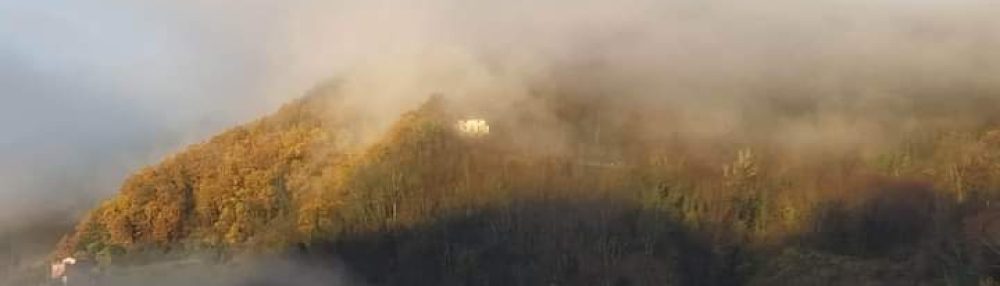
Walled in? Walled in like a seventeenth century novice nun deprived of her handsome secret cavalier and immured in a convent ruled by a merciless mother superior. Walled in like a nameless prisoner in an iron mask locked away in a dank dungeon as a pretender to the throne. Walled in like a vast kingdom of Cathay protected from plundering troupes of marauding Mongols by a barrier it was said could be seen from outer space.
Walled in certainly but only because this wall protects us from the possibility of any future landslide which might have seen our sweet little habitation slide down into the tartarean depths of the Camaiore valley. The wall, constructed in barely three weekends, is now practically finished.. It was erected with the assistance of our valiant comrades from Kosovo.
And it replaces sections of two previous walls which had collapsed in unknown times.
Built of giant breeze blocks, each one weighing a good thirty kilos, the wall was selected from possible options we had considered. First was a timber palisade but this was rejected on the grounds that timber does rot relatively quickly and that part of our land is quite dark and damp. Second possibility was a set of ‘gabbioni’ or stone piles kept together by wire cages. But this too we rejected on the grounds that in the present site they would prove unstable and difficult to position. Third was the dry stone wall. We had participated building one in Shetland to prevent sheep from plunging to their depth from a cliff-top when we volunteered for a Scottish conservation party. These walls can be very attractive and, in the right hands, very durable. Indeed part of our older walls are made in this manner. However, they require a lot of very decent stones and, what is more, excellent artistry. We also felt the pressure of the mountain descending upon them could easily have dislodged the stones as we had seen in several fallen examples in our area.
So we stuck to the breeze blocks, not the paragon of elegance, but made a little more attractive by being rendered with ‘schizzi’ of cement upon them.
I surveyed the wall today and decided it was a job well done. We feel safer for it. Not safer, that is, from immured nuns or prisoners in iron masks or pillaging Mongol hoards but safer because we know that we can live in our cottage in the woods for quite a few more years without moving – moving that is to another terrace further down our mountain slope.
What is an added bonus to the new walls is that they have produced some extra space which we can use for a well-drained and sun-lit vegetable patch. The tomatoes are growing particularly nicely.
Ah well all there’s need for me to do now is enjoy our hanging gardens our house and to play one of my favourite albums and enjoy a Campari and soda!
Abandoned railways have fascinated me from an early age. Ever since my uncle took me and my cousins for a Sunday afternoon walk along that ‘mysterious railway line’ I have always been keen to follow discarded ways of getting from A to B. Roads enter this sphere, especially Roman roads so many of which can still be traced in once far-flung areas of that glorious empire like the province of Britannia.
A line that fascinated me from my early teens was that proceeding from Nunhead to Crystal Palace in London. The line once terminated in a magnificent high-level station servicing one of the most extraordinary buildings the Victorian built: a gigantic greenhouse housing the industry of Empire and presenting the grandest of Handelian concerts.
Regrettably the palace was burnt in a huge fire in 1936. The railway line lingered on for a few more years until it was finally ripped up in the early sixties when the High-level station was also demolished since it was then regarded as leading nowhere. Today the railway would have been kept as an alternative to car-choked London roads and a means of getting to a major sports centre. At least the subway connecting the station to the Palace was preserved (by being forgotten) and its spectacular Moorish-style arcades are now being restored to their former glory. It’s definitely going to be one of the essential sights to see on my next trip to the great Wen.
That railway line still exists but now as a nature trail – at least those parts that have not been sold for housing developments However, the section traversing Dulwich Woods will remain for ever one of London’s wildest spots. Two tunnels cut through the South London hill ridge, tunnels which in my youth were open to all and sundry, even hosting impromptu rave-rock concerts, but which now are firmly under the grimmest lock and key. We could see the light at the end of the first tunnel and happily trod through its shadowy dampness. I seemed to breathe the layers of soot deposited on the tunnel’s bricks from generations of steam trains that had used it to transport happy holidaymakers to their palace of dreams. However, no light was visible at the end of the second tunnel and we were too frightened to venture into it for more than a few hundred yards. No surprise since the tunnel had executed an immense curve before opening out onto the high-level station.
Between the two tunnels a massive escarpment soared high. It was for me an early attempt to climb up steep slopes covered by the longest grass. Unsurprisingly, many years later when I ascended the Pisanino Mountain in Tuscany’s Apuan Alps memories of the Crystal Palace line escarpment came back to me!
Railway lines no longer carrying express trains, abandoned formerly-busy roads, filled-in canals, and overgrown runways once sending young pilots into the Battle for Britain continue to haunt me. The other day I found myself at Ripafratta a little town on the road skirting the Pisan Mountain between Lucca and Pisa. Crossing a somewhat rickety and narrow bridge I noticed another one further up on the canal we had traversed.
The abrupt gap that bridge sported on its southern side got me guessing. Was it another abandoned railway line? I thought of the Lucca to Pontedera route which after WWII bombing had been finally abandoned in 1958. No it was not any part of that. Pontedera lay a good deal to the east of where I was. But the rest of the bridge was still standing. What kind of architecture had bridged the gap? I became curious.
In fact the gag-toothed bridge had once been part of one of Italy’s earliest motorways, the Firenze-Mare (Florence to the Sea) inaugurated in the Fascist era of the 1920s. Why was it abandoned then? It was because at that time the ’autostrada’ was single carriageway. In the 1960’s because of increasing traffic it was rebuilt as a dual-carriageway. This involved a change of route for the Ripafratta area and a new alternative road ,or ‘variante’, was constructed to its north But why the gap? I’m sure I’d seen something filling it there not so long ago. In fact a couple of years previously a suspension-style concrete bridge still graced the part of the road crossed the Lucca-Pisa railway. Note how this bridge is really three bridges in one. Each part is built with a separate technique, uses different construction materials and covers a different communication means. From left to right a brick arch jumps across a road.Then a steel girder bridge goes over a canal. Finally a concrete suspension bridge crosses a railway. I find this quite fascinating.
I
Due to concrete rot and steel rust it had become dangerous and had to be blown up by controlled explosion, an operation which in Italian is known as ‘brillare’. During the procedure much of Ripafratta’s population was evacuated and the railway line was closed down for over a week. Here is a video of that explosion:
So what is going to be the fate of this abandoned stretch of road? Plans are there for it to become a trekking / cycling route and a pedestrian bridge is to be built across the missing section. I hope that happens soon as I’d love to walk this stretch of Tuscan river valley landscape.
As for Ripafratta today, it is a little run down – a settlement one rushes through on a route to Pisa which avoids the San Giuliano tunnel. But there is much to see at Ripafratta too. The castle of San Paolino formed part of the formidable fortifications separating the Pisan republic from Lucca. We managed to reach it a few years back but were short of a machete to hack our way through the strangling vegetation and make a completely successful advance. At the present time it is disintegrating slowly with the same mysterious air as Enid Blyton’s Castle of Adventure. Let’s hope that this border-country area will see better days soon again.
Fifty years of art. Fifty years of love for Barga going back to that iconic print, commissioned by Bruno Sereni, of the beautiful Borgo with its Romanesque Duomo crowning the palazzi and forming a miniature mountain. Fifty years of consummate artistry. Thankyou Swietlan Nicholas Kraczyna. Thank you ‘Nick’!
Born in the warring borderland between Poland and Russia Nick’s family fled from the Red Army to find a calmer life in the USA. Here the artist developed his skills with particular emphasis on multi-plate colour etching of which he is a pioneering master.
The celebration of Nick’s half century of creative work was inaugurated yesterday at Barga’s Galleria Municipale with the artist cutting the tri-colour ribbon to his exhibition in the company of Barga’s mayor Caterina Campani and organizational colleagues Kerry Bell and Giorgia Madiai.
The sound of ‘Metamorphoses’ filled the gallery – Britten’s oboe piece inspired by Ovid. I recalled that Kraczyna’s themes comprise mythologies, transformations, magical landscapes and music itself: in 2021 I visited the artist’s exhibitions on the subject of tree-goddesses, described in my post at Tree-Goddesses | From London to La Costa (and Lucca and Beyond) Part Three (wordpress.com). Indeed, Nick declares that he is not just a landscape artist but a magical landscapist where his scenes are closely related to his inner emotions. As he says about his adopted summer residence at Barga: ‘here everything does not simply need to be seen but experienced as well.’
The artist gave us a little talk on the subject of multi-plate etching, a technique best described by the Italian word ‘Intaglio’ or ‘cutting into’ whereby it is what is removed from the plate that, filled, by coloured inks and pressed on paper, supplies the finished product. Here precision is married to inspiration for the different colour plates must integrate exactly into one other.
Barga’s Municipal gallery exhibition, which is largely didactic in approach, is just a taster for the much larger show of Nick’s work to be inaugurated at the town’s Santa Elisabetta conservatory this Sunday, 2nd July at 5 pm.
Further homages to Barga’s supreme artist will be present on the facade of the Teatro dei Differenti with a spectacular installation created from Kraczyna’s works and also, from 23 September to 31 October, at the museum of the house of poet Giovanni Pascoli
The exhibition catalogue is published by Maria Pacini Fazzi Editore.