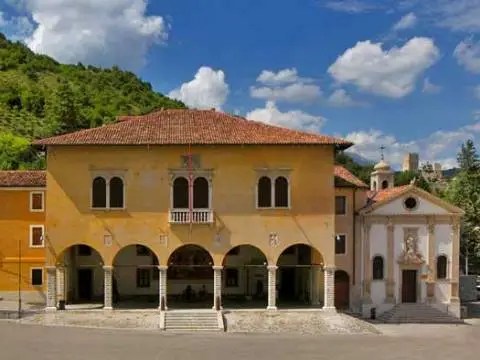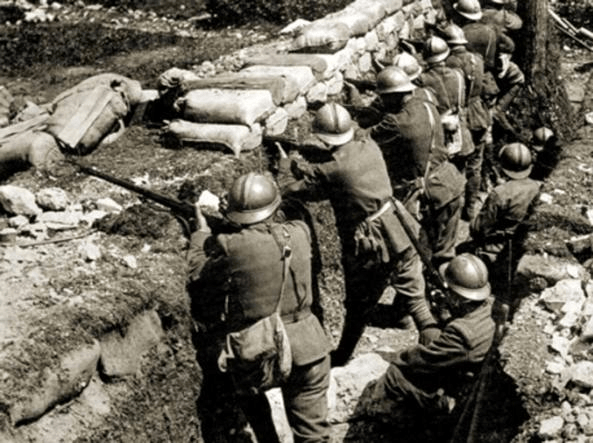
The Museum of the Battle

The Museum of the Battle. But which battle?

Well, obviously, the battle after which this town is named: the Battle of Vittorio Veneto. But why is it so important?

Because it was the final great Italian offensive of the First World War, the battle which broke the Austro-Hungarian forces on the Italian Front and led directly to the armistice between Italy and Austria-Hungary in November 1918.

But to understand what happened here, we have to go back a little.

The museum is in the old town hall of Ceneda, one of the two historic parts of Vittorio Veneto. The other is Serravalle. They were separate towns for centuries and were united in 1866, when the new municipality of Vittorio was created. The name Vittorio Veneto came later.

We had visited the museum before, and what struck us this time was how completely it has been transformed.

The old museum was, frankly, rather like a collection of First World War leftovers: shells, rifles, bits and pieces of military equipment, and rather hastily written notices. It was interesting, certainly, but it was much more a memorial to the battle than an attempt to explain the war itself. That was hardly surprising. The museum was inaugurated in 1938, exactly twenty years after the Italian victory, and its original presentation was deliberately celebratory and patriotic. It was founded around the collection of Luigi Marson, a local soldier who had gathered objects and documents from the battlefields.

The museum was radically redesigned between 2012 and 2014, and the difference is enormous.

Instead of simply celebrating victory, it tries to tell the story through the experiences of the people who actually lived through the war. It is divided into three principal sections: life in the trenches, life during the Austro-Hungarian occupation, and finally the Battle of Vittorio Veneto and the myth that grew up around it.

The first section is about the trenches.

And this is where the museum really comes alive. You walk through a deliberately claustrophobic reconstruction of trench life, surrounded by the objects that made up the soldiers’ everyday existence. There is the barbed wire, the appalling little metal obstacles designed to maim or kill, the cooking tins and mess equipment, personal belongings, letters, photographs and all the other paraphernalia of men who were expected to live for months on end in conditions which are almost impossible for us to imagine.

There are also some extraordinary little objects which tell you something about the human need to carry on living a normal life in completely abnormal circumstances. One of them is a mandolin made from bits of war material. Someone had actually taken pieces of the battlefield and turned them into a musical instrument, presumably in the hope of making an evening in the trenches slightly less unbearable.

And that, really, is what makes this section so effective. It isn’t simply about military manoeuvres and generals moving coloured arrows around maps. It is about people.

The Italian campaign was an appalling business. Around 650,000 Italian soldiers died during the First World War, and the Italian army suffered enormous losses during the disastrous fighting which culminated in the defeat at Caporetto in October–November 1917.

Caporetto changed everything.

The Austro-Hungarian and German forces broke through the Italian lines and advanced deep into Italy, eventually reaching the Piave. The Piave subsequently became one of the great defensive lines of the Italian army. Even today you find references to it as the river that saved Italy and when one crosses that river there is this notice affixed on the bridge: “Piave fiume sacro alla patria” — literally: “Piave, river sacred to the Fatherland.”

And then comes the second section of the museum: the occupation.

After Caporetto, large areas of north-eastern Italy fell under Austro-Hungarian occupation. The museum does a very good job of showing what that meant in everyday terms. There were shortages, requisitions, hunger, displacement and the constant presence of a foreign army. The occupation was not simply a military matter; it affected every aspect of civilian life. The museum particularly stresses things such as requisitions, destruction, surveillance, spying and the complicated relationships between occupiers and occupied. Interestingly Bagni di Lucca gave shelter to many refugees displaced by the fighting.

There is also a particular complication which is easy to forget when we talk about “the Austrians”. The Austro-Hungarian army was not simply an Austrian army. It was the army of a huge multinational empire, containing Czechs, Slovaks, Slovenes, Croats, Serbs, Hungarians and many other nationalities.

And there is an extraordinary historical irony here.

Men from all these different nationalities were fighting together in an empire which was itself beginning to crack apart. Within a few years, many of those nationalities would have their own states. The First World War helped accelerate the destruction of the Austro-Hungarian Empire and the creation of countries such as Czechoslovakia and Yugoslavia, while Hungary emerged as a separate state.

The museum illustrates the occupation with photographs, documents and personal objects, but also with film. In one section you lift up what looks rather like a trench periscope and peer into it to watch historical footage. It is a clever device because it makes you feel that you are looking into another world.

Then comes the final section: the battle itself, and what happened afterwards.

By the autumn of 1918 the Austro-Hungarian Empire was exhausted. The empire was suffering from shortages of food and supplies, and its army was increasingly disintegrating along national lines. The Italian army, meanwhile, had recovered from the catastrophe of Caporetto.

General Armando Diaz had replaced the ineffectual martinet Luigi Cadorna as commander-in-chief after Caporetto, and his approach was very different. By October 1918 the Italians were ready to launch their final offensive.

The Battle of Vittorio Veneto began on 24 October 1918. The fighting spread across the Piave and towards the mountains and plains around Vittorio Veneto. British and American troops were also involved on the Italian Front, alongside the Italian forces and other Allied contingents.

The Austro-Hungarian army simply began to come apart.

The battle ended with the Austro-Hungarian armistice, signed at Villa Giusti near Padua on 3 November and coming into force on 4 November 1918. For Italy, the fighting was over.

Victory.

And what a victory it must have seemed at the time.

But victory turned out to be a rather complicated business.

Italy had entered the war in 1915 partly in the expectation of territorial gains. There had been promises concerning territories under Austro-Hungarian rule, including much of the Italian-speaking and strategically important areas around the Adriatic. But the peace settlement did not give Italy everything that Italian nationalists believed had been promised or deserved.

The resulting sense of disappointment became one of the ingredients of the post-war crisis. Gabriele D’Annunzio’s seizure of Fiume in 1919 was an extraordinary manifestation of this frustrated nationalism.

And then Italy had to return to peace.

Only it wasn’t much of a peace for ordinary people.

There were ruined houses, unemployment, inflation, poverty and enormous numbers of men returning from the army to a country which had very little work for them. Social unrest exploded. There were strikes, factory occupations and revolutionary movements. My own Italian grandfather, as it happens, was involved in this left-wing ferment and became an anarchist organising strikes and demonstrations.

Out of this extraordinary mixture of poverty, resentment, nationalism and political instability emerged another figure: Benito Mussolini.

Mussolini had begun as a socialist. After breaking with the socialist movement over the war, he moved increasingly towards nationalism and eventually founded the Fascist movement. Within a few years he would be running Italy.

But that is another story.

What impressed me most about the Museum of the Battle was the way it has changed its purpose without pretending that the old museum never existed.

The original collection is still there. The old cases and objects have not simply been thrown away. They have been incorporated into the new museum, so that you can actually see something of the old, patriotic memorial alongside the new historical interpretation.

The result is much more interesting.

It is no longer simply a museum saying, “We won this great battle.”

It is a museum asking what it was actually like to live through the First World War: to fight in the trenches, to live under occupation, to endure shortages and fear, and finally to experience victory — and then discover that victory did not necessarily produce the peace and prosperity that people had imagined.

In that sense, it has moved from being a memorial to being a museum of human experience.

And that makes it considerably more powerful.

Fabled Follina

I first visited Follina many years ago reaching it on an old and rather rickety bicycle; I remember it very fondly. I enjoyed the ride past the Revine lakes, had a very good welcome when I arrived, and the place made quite an impression on me.

So when Sandra drove me back to Follina this time, I found myself looking at the road and thinking that I had actually cycled all this way once. I could hardly believe it.

It was lovely to come back.

Follina itself was every bit as beautiful as I remembered, perhaps more so. It is a small place, but it has a surprisingly noble centre, with handsome old houses, palazzi, little streets and water running through it. And then there is the Abbey of Santa Maria, which seems almost too grand for such a small town.

There is, as it turns out, a very good reason for that. Follina was once considerably more important than it is today.The water is the first clue. Springs come down from the Prealps and the river Follina runs through the town. That water eventually made Follina an important centre of wool production, but first it attracted the monks.

Cistercian monks arrived here in the twelfth century and developed the area around their monastery. Their ideal was ora et labora — prayer and work — and Follina provided excellent conditions for both.. The present abbey church dates mainly from the early fourteenth century and is beautifully simple.

But the gem of the monastery is its charming cloister which was completed in 1268. I remembered it particularly well from my earlier visit, especially the columns, which are all slightly different, and the extraordinary semi-knotted ones at the end. Yr last photo on this sequence dates back to that very first visit ….in 1985!

The monks also helped establish the wool industry for which Follina became famous. The name itself is connected with follatura, the fulling of woollen cloth. The plentiful water was ideal for the process.

By the seventeenth and eighteenth centuries Follina had become an important textile centre, with woollen manufactories and prosperous families. This helps to explain the handsome palazzi and the rather grand character of the little town.

Follina was also well placed between the Venetian plain and the mountains, with routes leading through the nearby passes. It became part of the Venetian world, while the abbey accumulated considerable wealth and influence.

Eventually the Cistercians disappeared. The monastery was finally suppressed in 1771, and the old wool industry gradually declined. Much of what had made Follina prosperous disappeared with it, although the textile tradition survives in the Lanificio Paoletti.

What remains is the beautiful little town we see today.

The great wool industry has gone with it. The Cistercian monks have gone too. But Follina remains — a remarkably beautiful little town whose modest size gives very little indication of the history contained within it.

On the Family’s Silk Road

When we visited the Museo del Baco da Seta at San Giacomo di Veglia, I found myself looking at the history of silk rather differently.

This was not simply another museum about an old industry. Alexandra’s mother came from this part of the world and worked in the silk industry, feeding mulberry leaves to silkworms. So, for us, there was a very personal connection with what we were seeing.

And I was genuinely impressed by the museum. It is housed in the former Maffi silk-reeling factory, an old industrial building that was finally disused in the 1960s. The museum itself was inaugurated in 2010 and has been carefully created not simply as a collection of old objects, but as a record of an entire way of life. It was recently reopened after improvement works in August 2026.

The presentation is excellent. There are machines and equipment, photographs, documents, old films and other material showing how the industry actually worked. But what impressed me most was something rather more valuable than the machinery: the voices of the women who had actually worked there.

The museum has collected oral histories from former workers, and these are fascinating. They explain, in their own words, what happened in the filanda: the different jobs, how the cocoons were handled, how the silk thread was produced, who did what and what it was actually like to work there. One testimony, for example, comes from Francesca Giordan, who entered a filanda at only twelve and describes the hierarchy of the women workers and the jobs involved in producing the thread.

That makes the museum much more than a collection of old machinery. It is a valuable historical resource because it preserves memories that would otherwise simply disappear. The official description talks about recovering both the personal and collective memories of the industry, and that seems exactly right.

And this was a huge industry here. Sericulture began as something families did alongside agriculture, but it eventually became one of the principal activities of the area. Mulberry trees were everywhere. The raising of silkworms, the work in the filande and the scientific establishments connected with silk involved a very large proportion of the local population. In 1873 a Regio Osservatorio was established here, and Vittorio Veneto subsequently became an important centre for silkworm research and the production of silkworm seed.

Which brings me back to Alexandra’s mother.

She was part of this world. She fed the silkworms with mulberry leaves. It sounds almost ridiculously simple when you put it like that. Yet that small job was one stage in a remarkable chain.

The silkworm produced its cocoon. The cocoon was collected. The silk was reeled. Women worked in the filande turning it into thread. Eventually that thread could become the luxury fabrics that travelled across Europe.

The story goes back much further, of course. Silk originated in China and gradually travelled westwards along what we now call the Silk Road. There is the famous Byzantine story, recorded by Procopius, of monks bringing silkworm eggs to Constantinople during the reign of Justinian. Whether every detail is literally true is another question, but by the Middle Ages silk production had spread across the Mediterranean world.

Italy became one of Europe’s great silk centres. Lucca was particularly important, and its merchants and craftsmen helped establish the city’s wealth through silk manufacture and trade.

You can still see traces of that world in Lucca. And then there is Jan van Eyck’s famous Arnolfini Portrait, painted in Bruges in 1434. The man is generally believed to be the Lucca-born Italian merchant Giovanni Arnolfini, and his magnificent outer garment is probably silk velvet. The woman’s green dress, interestingly, is fine wool rather than silk.

The painting isn’t a documentary about the silk trade, but it gives us a glimpse of the extraordinary luxury that silk could represent.

Eventually the centre of Italian silk production moved northwards, particularly towards Lombardy and Como. But the old rural system declined. Agriculture changed, labour became more expensive, synthetic fibres appeared and Asian competition became increasingly difficult to resist. The great silk industry of Vittorio Veneto disappeared.

Yet silk itself did not disappear from Italy. Como is still an important centre for high-quality silk textiles. What Italy largely lost was the beginning of the process: the mulberry trees, the silkworms, the cocoons and the huge numbers of people involved in producing raw silk.

So the Silk Road has not really disappeared. It has acquired lorries, ships and containers.

What I found particularly moving in San Giacomo di Veglia was that the museum brings the enormous history of silk down to the level of individual people.

It tells us about machines and factories, but also about women who got up in the morning and went to work. It preserves their voices. It tells us what they did, how they did it and what life was like.

And one of those women could have been Alexandra’s mother.

That makes this little museum much more than a museum about silkworms.

For us, it is also a small piece of family history.

***

If you enjoyed this post, please consider clicking the Like button or leaving a comment. It lets me know that my writing is reaching people.

An Alpine Plateau

Yesterday we took the road from the Veneto plains and drove up by a twisty mountain road to reach an incredible plateau or tableland called the Cansiglio.

The Cansiglio is essentially a limestone mountain plateau surrounded by the higher peaks of the Southern Dolomites and Prealps. I was trying to work out how this extraordinary area was actually formed. It goes back millions of years, of course, to geological uplift and to the action of water dissolving the limestone, producing the characteristic karst landscape. There are hollows, dolines, sinkholes, caves and underground drainage systems, many of which you would never guess were there as you drive across the apparently peaceful landscape.

Then there is the forest. The wonderful beech and pine forests which cover much of the Cansiglio are partly natural, but the woodland has also been shaped by centuries of human management. The Venetian Republic was particularly interested in the Cansiglio because it needed timber, especially for shipbuilding. The forest became an important source of wood for the Venetian fleet and was consequently very carefully protected and managed.

There is another fascinating part of the Cansiglio’s history: the Cimbrian people. These were German-speaking communities who settled in the area and developed their own distinctive culture, traditionally associated with forestry, woodworking and the exploitation of the mountain forest.

Things have changed slightly since then. The Venetian Republic no longer needs the Cansiglio to build its ships, having been rather unceremoniously swept away by Napoleon following the Treaty of Campo Formio in 1797. A horrible bloke, really, when you think about it.

Today the Cansiglio is a wonderful mixture of forest, open pasture, sinkholes and traditional malghe. Malghe are the mountain buildings where cattle are taken to graze during the summer months, and where traditionally the milk is turned into the characteristic cheeses of the mountain areas.

And this is what makes the Cansiglio so remarkable. You can drive through dense woodland and, quite suddenly, emerge into enormous expanses of wonderfully green alpine pasture. There is something almost theatrical about it. Within ten or fifteen minutes you can go from the undulating country around Vittorio Veneto to a completely different mountain world.

I have known this area for years, and on one occasion, several years ago, I actually took that famous rickety bicycle of mine — the same famous rickety bicycle that I once took all the way to Follina — and cycled up to the Cansiglio.

Now, Vittorio Veneto is at roughly 150 metres above sea level, while the Cansiglio plateau is around 1,000 metres and, in places, considerably higher. So that was quite a bit of pedalling.

But I didn’t stop when I reached the Cansiglio.

No. I carried on.

Eventually I found a route towards one of the higher peaks of the Pre-Dolomites, Monte Cavallo, which rises to 2,251 metres (7,385 feet) above sea level, and decided, for reasons which now escape me, that I would tackle the mountain by myself. I have always rather liked tackling mountains by myself, although nowadays I would probably regard the idea with considerably more caution. At the time, however, off I went.

I reached the top hoping for a magnificent view over the surrounding countryside. Unfortunately, the clouds had other ideas. They closed in and the great panorama disappeared.

There was, fortunately, a rifugio nearby, and I managed to make a radio phone call to Sandra who stayed below. I remember ringing to say that I was coming down — which, in fact, I did.

Looking back, I suppose it was quite a remarkable thing to have done. I certainly wouldn’t have the energy to cycle up there and then climb Monte Cavallo today. I might manage the telephone call.

But yesterday it was wonderful simply to be back in the Cansiglio.

The skies were an extraordinary blue, the pastures an almost impossibly brilliant green, and the great beech and pine forests surrounding them looked magnificent. The woods are full of wildlife — deer, and even wolves — while high above us eagles and other birds of prey were making use of the thermal currents rising from the mountains.

It is difficult to imagine anything more pristinely beautiful.

After all those years, it was great to be back.

The Caves of the Cauldron

The Grotte del Caglieron are one of the most distinctive features of the north eastern part of Italy we are visiting.. They are basically a deep gorge through which the Torrente Caglieron rushes, producing a series of beautiful waterfalls, particularly spectacular after a lot of rain. And there has been quite a bit of rain over the last few days, so we thought we would take another look.

There is actually an interesting story behind the name Caglieron. It seems to derive from the local word “cagliere”, the great copper cauldrons once used for cooking things such as polenta. At the foot of the waterfalls the water has carved out large rounded hollows in the rock, known as marmitte, and these resemble enormous cooking pots. So, in effect, the Caglieron is the stream of the cauldrons.

The gorge itself is the product of a much longer process. The rocks here were laid down millions of years ago, when this part of the world was covered by the sea, and they subsequently became layers of limestone, sandstone and marl. The upheavals that produced the Alps raised these deposits, and the Caglieron then began doing what mountain streams do so well: finding weaknesses in the rock and gradually cutting its way down through them.

The waterfalls and the great round pools beneath them are the result of this continuing erosion. The water, often carrying stones and other debris, swirls around in the rock and slowly enlarges the hollows. Over immense periods of time this produced the deep, narrow gorge we see today.

But the water did not do everything. Some of the most impressive “caves” were actually made by people. From at least the sixteenth century, local stonecutters came here to quarry the soft sandstone known as “piera dolza”, or soft stone. It was used for building, particularly for door jambs, lintels and other architectural features, and examples can still be seen in the older buildings around Vittorio Veneto.

The quarrymen followed the natural layers of the rock, cutting out large blocks but leaving pillars behind to support the roof. These old workings now form some thirty or so artificial galleries along the gorge. So what we see at Caglieron is really a remarkable combination of natural and human activity: the stream created the gorge, the waterfalls and the rounded pools, while generations of stonecutters enlarged parts of it to obtain their building stone.

It is also what makes Caglieron rather different from the Orrido di Botri. At Botri you are essentially walking through a natural gorge. At Caglieron, you are walking through a landscape in which water and human beings have both been at work for centuries. And it was particularly good to see it again. We first came here many years ago, not long after we were married.. Everything seemed remarkably well maintained, including the wooden walkway which allows you to negotiate the gorge without getting your feet wet – although, after all the recent rain, we certainly got our share of spray from the waterfalls.

It was great to discover that this little pilgrimage of ours is still every bit as atmospheric as we remembered it. Thankyou caves and canyon of the cauldron!

Italian Soldier Internment Day

An important day is coming up which is particularly relevant to all of us who have a place in Bagni di Lucca, because we live in or around the territory of the former Gothic Line.

On 20 September Italy will observe the Giornata dell’Internato Militare Italiano, established by Law No. 6 of 13 January 2025. It is a day to remember the Italian military and civilians who, after the Armistice of 8 September 1943, refused to collaborate with Nazi Germany and the Italian Social Republic and were consequently imprisoned, subjected to violence and forced to work for the German war economy.

The date is not accidental. On 20 September 1943, Adolf Hitler ordered that captured Italian soldiers be classified as Internati Militari Italiani rather than prisoners of war. This deprived them of the protections of the Geneva Convention and assistance from the Red Cross and exposed them to particularly harsh treatment. Around 650,000 Italian servicemen were interned, and it is estimated that at least 50,000 died from starvation, mistreatment, disease, exhaustion and other causes during their captivity.

The background is the extraordinary and tragic collapse of Italy in 1943. Italy had entered the war alongside Germany in 1940, but after three disastrous years the King dismissed and arrested Mussolini and the Italian government signed the Armistice with the Allies. The Germans then occupied much of Italy, the country became divided, the Resistance developed and eventually the fighting reached the Gothic Line.

And this is where the subject becomes particularly relevant to us. The Gothic Line was not some distant battlefield somewhere else in Italy. It ran through the wider territory in which we live, and the German occupation, the Resistance and the fighting affected the towns, villages and families of our area. So this is a subject which matters to us locally just as much as it matters nationally.

Many of us will also have encountered this history through Captain Corelli’s Mandolin, the enormously successful novel and subsequent film starring Penélope Cruz. Although set on the Greek island of Cephalonia, it tells the story of Italian soldiers suddenly caught in this extraordinary situation after the Armistice and the terrible consequences that followed.

There is therefore a particularly good opportunity to learn more about this history locally.

On Saturday 19 September, there will be a meeting at Sala Auser Ponte32, from 15.30 to 20.00, specifically to remember the Italian Military Internees. Everyone is invited.

It takes place the day before the national day of remembrance and should be an excellent opportunity to understand more about what happened after the Armistice, what the Italian soldiers endured and how these events connect with the history of our own area.

For those of us with a connection to Bagni di Lucca and the former Gothic Line, this isn’t simply a piece of national history. It is part of our local history too.

From Power Stations to Planetariums

There are some people you meet in the Lucca area who seem to have a particular talent for making things happen, and Giacomo Brunini is certainly one of them.

I have known Giacomo for some time. He is a brilliant guitarist and also the director of the Scuola Civica di Musica “Marco Salotti” in Borgo a Mozzano, the comune just next door to us.

But there is something else about Giacomo’s concerts which makes them rather special. He has a wonderful way of finding places in which you would never necessarily expect to hear a classical concert.

Over the years I have been to concerts of his in lonely little chapels up in the hills, in buildings with fascinating histories and including a power station. There was even one in a planetarium. So when Giacomo announces a concert, the first question is sometimes not “What are they playing?” but “Where on earth are they playing it?”

And that is very much the idea behind his Incontri Musicali – i luoghi del bello e della cultura. The concerts take place in different parts of the territory, bringing good music together with places which are themselves worth discovering.

The 2026 season has just begun, and there are six concerts.

It started on 12 September at the Biblioteca di Cune, with Dall’Opera alla danza, performed by the guitar quartet Le Consonanze, with Dario Atzori, Marta Marchetti, Alessandro Nobili and Giacomo Brunini. The programme ranges from Rossini and Bizet to Boccherini, Torroba, Bellinati and Dyens.

On Sunday 20 September the series moves to the Biblioteca San Giovanni Leonardi in Diecimo for El Canto del Sur, with Giulia Giannetti on flute and Giacomo on guitar. The programme is devoted to South American music, including Villa-Lobos, Piazzolla, Jobim, Gnattali, Machado and Blázquez. There will also be guitars made by the local luthier Raffaele Guidugli on display, with some of them actually being used in the concert.

Then on 27 September there is Dialoghi at the Church of Santa Maria Assunta in Rocca, with the guitar duo Roberto Masini and Simona Costantino. Their programme includes Granados, Puccini, Brahms, Morricone, Piazzolla, Marchelie and Gangi.

On 11 October we return to Borgo a Mozzano, to the Sala Consiliare in the Palazzo Comunale, for Bassorilievi a due Viole da gamba, with Francesco Tomei and Gustavo Cardamone Carloni playing viola da gamba. Their programme takes us back through Couperin, Boismortier, Jenkins, White, Schenck and Schaffrath.

On 18 October there is Il pianoforte romantico at the Church of the Convent of San Francesco in Borgo a Mozzano, with Alberto Lodoletti playing Beethoven, Chopin and Liszt.

And finally, on 25 October, the series ends at the Biblioteca Comunale in Borgo a Mozzano with Ahi vista! Ahi conoscenza!, an unusual programme of Renaissance music, reciting voice and Renaissance flute based around Tasso’s Gerusalemme Liberata, performed by Elisa Cozzini and Giuseppe Nitti.

All the concerts begin at 5 pm, with a chance to visit and discover the location beforehand, and admission is free, with a voluntary contribution.

What I particularly like about these concerts is that the music never seems to be treated as something separate from the place. Giacomo has an instinct for finding buildings, chapels and other corners of the territory which make you look at the area around us in a different way.

And, of course, the music itself is the most important thing. There is no point finding a wonderful chapel, a power station or a planetarium if the concert isn’t any good. Fortunately, that is not a problem with Giacomo and the musicians he brings together. The playing is consistently excellent.

So a Giacomo Brunini concert is rather more than going to hear some music. You may discover a place you have never seen before, meet some very good musicians and hear some excellent playing — and occasionally find yourself wondering how on earth Giacomo managed to persuade everybody to put a concert there in the first place.

That, I think, is part of the fun.

If you live around Lucca, Borgo a Mozzano or the Garfagnana, or happen to be visiting the area, keep an eye open for the next Giacomo Brunini concert.

You won’t be disappointed.

I

Zenophilia


One of the highlights of our stay in Verona was, of course, Aida at the Arena. That was the main event, and quite an event it was.
But there was another discovery which, in its own rather different way, was just as memorable: San Zeno.
We had wanted to see the Basilica of San Zeno for years. And, rather embarrassingly, we had never actually got round to it. The reason is partly that it isn’t right in the centre of Verona. It is a little way out, and somehow, on previous visits, it had always been one of those places that we would get round to seeing “next time”.
Well, this time we finally did.
And I have to say, we were absolutely bowled over.
San Zeno is the patron saint of Verona, and his basilica is quite simply one of the great Romanesque buildings of Italy. In fact, I would put it among the most beautiful buildings we have seen anywhere in the country. It has that wonderful quality that some medieval buildings possess: enormous solidity, but at the same time an extraordinary elegance and sense of proportion.
And then there is the rose window — the famous Wheel of Fortune, dating from the 12th century. It is a wonderful thing, both artistically and symbolically, because the whole idea is that fortune is continually turning: one moment you’re on top, the next you’re at the bottom. Rather appropriate, really, for human life.

But what really stopped me in my tracks were the bronze doors.
They are made up of dozens of individual bronze panels, put together almost like a gigantic medieval comic book — except that this is one of the world’s great works of medieval art. They tell the stories of the Bible and the Scriptures through pictures, at a time when most people couldn’t read.


You can get very close to them. Almost ridiculously close. You can practically touch them.
Of course, you shouldn’t touch them. But you could.
And I couldn’t help thinking: Good heavens, surely these things are worth protecting a little better than this? They are priceless works of art, and yet you can stand there with your nose almost against them. Perhaps I’m being unnecessarily alarmist, but I certainly wouldn’t want to be the person who accidentally fell against one of them!
Inside, the basilica is magnificent. Great columns, enormous arches, pinky marble stone everywhere, and that slightly mysterious darkness which seems to belong to Romanesque churches. It has a tremendous sense of weight and age without being gloomy.

And then, of course, comes Mantegna.
His magnificent triptych, painted around 1457–1459, is one of the great masterpieces of the early Renaissance. The Madonna and Child sit in the centre, surrounded by saints, with Mantegna creating this extraordinary architectural space around them. You can almost see Renaissance painting taking off before your eyes.

And underneath all this is the crypt.
It is glorious in its own right — and it contains the remains of San Zeno himself. So you have, in effect, the whole history of the place underneath your feet: the saint, the medieval church, the Romanesque basilica and then the Renaissance masterpiece above.

The Basilica of San Zeno also has a very beautiful cloister. I loved the olive tree in one corner


Dante spent time in Verona during his exile, and San Zeno was part of the medieval city that he would have known. You suddenly become aware that this isn’t merely an old church that happens to contain some wonderful works of art. This is a place that has been part of Verona’s life for something like 1,500 years.
Rather stupidly, we discovered that there was something else we should have seen.
The Ponte di Castelvecchio, the wonderful fortified bridge over the Adige, is not far away.
By this stage we were absolutely exhausted. The heat had finally caught up with us. There comes a moment on a sightseeing trip when another magnificent monument is no longer a cultural opportunity but simply another bloody thing to walk to.
So we missed the bridge.
But perhaps that isn’t such a bad thing.
It means we have to come back.
And, frankly, Verona is hardly somewhere you need an excuse to revisit. I think it must be one of the most beautiful cities in Italy. It has the Arena, the Adige, the medieval centre, the Scaligeri, Shakespeare, Dante — and now, for us, San Zeno.
It is also the city where one of my favourite English writers on Italy, Tim Parks, lives.
So that was San Zeno.
We finally got there after all these years, and it turned out to be every bit as wonderful as we had hoped.
We just forgot to visit the bridge.
Which, I suppose, is Verona’s way of telling us that we haven’t finished with the place yet.

***

If you enjoyed this post, please consider clicking the Like button or leaving a comment. It lets me know that my writing is reaching people.

Roll Out the Barrel


A Wine Barrel Rolling Competition?
Well, that’s what we enjoyed on Saturday at Serravalle, and it’s all part of a national wine barrel-rolling competition which has both old and modern roots.
It’s old because, in the old days, wine was stored in wooden barrels — and these were 500-litre wine barrels. And it’s modern because, now that these enormous barrels are no longer normally used for storing wine, the barrels themselves have been turned into the competitors.
The national competition began in 2006, and the idea actually originated here in Vittorio Veneto. Since then it has developed into a proper national competition, with teams from wine-producing parts of Italy competing at different stages before the grand finale.
Anyway, we went along to Serravalle to see what it was all about, and it was great fun — although quite exhausting even to watch.
In the main square there was a sort of slalom competition. In other words, the competitors had to roll their wine barrels between a series of poles, rather like a skiing competition. Each barrel was controlled by two people, and there was also a relay race in which the first two competitors were women and then handed over to two men.


Now, you might think that all you’ve got to do is roll a wine barrel along. But it’s not quite as simple as that. A wine barrel isn’t just spherical: it has a particular shape, and you have to be remarkably skilful about the pressure you apply at either end. Push it in the wrong place and the thing can suddenly head off in almost any direction.
There were penalties, too: two seconds were added whenever a competitor knocked down one of the poles.
There were teams from all over Italy, including Tuscany, the Marche and other wine-producing areas, and the atmosphere was tremendous.
They also had a competition involving carrying the wine barrel on a sledge, which was pretty amazing in itself.
These are all part of the various stages of the national championship. The different competitions around Italy award points, and the best-performing teams eventually qualify for the national final.
And there is still one more qualifying round to come after Vittorio Veneto: Santa Venerina in Sicily on 27 September. Then the whole thing moves south for the grand finale.
The Finalissima will take place in Bianco, in Calabria, in the province of Reggio Calabria, on Saturday 17 and Sunday 18 October. Ten teams will eventually contest the national final — the eight cities qualifying on points, together with the defending champions and the host city, according to the competition rules.
And the final really does mean pushing these enormous 500-litre wine barrels around a course through the town, going up and down the streets and round the bends. And believe me, these are not lightweight objects.
It was one of those wonderfully Italian events which you go along to thinking you’ll have a quick look — and end up staying because it’s so much fun.


Everybody seemed to enjoy themselves, competitors and spectators alike.
It was brilliant.
And I’ll never look at a wine barrel in quite the same way again.


Acknowledgement to Sandra for many of the pictures.

***

If you enjoyed this post, please consider clicking the Like button or leaving a comment. It lets me know that my writing is reaching people.

A Detour to Montecuccolo Castle


There it was. Suddenly, as we turned a bend in the road, this extraordinary structure appeared before us. It looked like a castle — and, as it turned out, it was a castle.


It doesn’t matter how carefully you plan a journey. There are always things that suddenly appear and tempt you to abandon the predetermined route – in our case the route from Modena to Verona. And that is one of the great pleasures of travelling: allowing yourself to be distracted.
So we took the turn and went in search of the castle.
At first, the approach was through the rather nondescript little town of Montecuccolo. But then, quite suddenly, everything changed. The road ascended, the surroundings became increasingly picturesque, and we found ourselves climbing through beautiful woodland until, almost unexpectedly, we arrived at the castle itself.


The castle was built by the Montecuccolo family, and inside we discovered a fascinating history. The family produced one of the great military commanders of the seventeenth century: Raimondo Montecuccoli.
Montecuccoli became a commander in the service of the Habsburg Empire and played a significant role in the wars against the Ottoman Turks. The Ottoman armies had pushed deep into Central Europe and, most dramatically, had reached the gates of Vienna. Montecuccoli’s military skill and tactics contributed to the Habsburg victory over the Turks, helping to halt their expansion into Central Europe. The eventual defeat of the Ottoman forces allowed territories such as Hungary to be gradually recovered by the Habsburgs.


Standing in the very castle from which this remarkable family emerged, it was fascinating to discover just how important a role one of its members had played in European history.
And the castle itself is a delight. From the top there are the most extraordinary views across the surrounding countryside and mountains.

But it isn’t simply a historical monument. Inside, there iare a delightful collection of Presepi – Christmas cribs –

a surprisingly impressive collection of modern art, with works by artists who lived or worked in the area,

alongside a beautifully presented natural-history section and an archaeological collection.


We thoroughly enjoyed exploring it all.
And, naturally, no successful excursion is complete without refreshments. After our visit to the castle, we settled down in the little bar-restaurant within the complex and enjoyed coffee — iced coffee this time, which seemed particularly appropriate after our climb.
It was one of those completely unplanned diversions that makes a journey memorable.
You can plan a route from A to B down to the last detail, but sometimes the best things happen when you abandon the plan. You see something intriguing, take a turning, and simply follow the road.
In our case, that little detour to Montecuccolo and its remarkable castle was well worth it indeed.

***

If you enjoyed this post, please consider clicking the Like button or leaving a comment. It lets me know that my writing is reaching people.