
From London to La Costa (and Lucca and Beyond) Part Three

From London to La Costa (and Lucca and Beyond) Part Three

Scribble About Scrabble

Here are snaps of some of the items on sale. Don’t miss out on the tents outside which are a prime source for exercise bikes, among other items!

Apart from one or two days of respite it has been weather for the ducks. It’s the sort of weather to read, watch Netflix or, to avoid the worst symptoms of cabin fever, play what in Italy are called ”giochi sociali” – i.e. games where you don’t have to exercise prehensile thumbs and avoid conversation to play.( Incidentally  in Italy this year, giochi sociali have outsold all those games consoles).

Our favourite is “Scrabble” and, of course, chess. When particularly mentally lazy we enjoy Chinese chequers too.

We enjoy “Travel Scrabble” even if not travelling because the letters are well secured to the board and thus don’t tend to fly around. We are not brilliant Scrabble players and the days when a seven-letter word (the maximum length allowed in our version) appears on the board are truly red-letter ones.
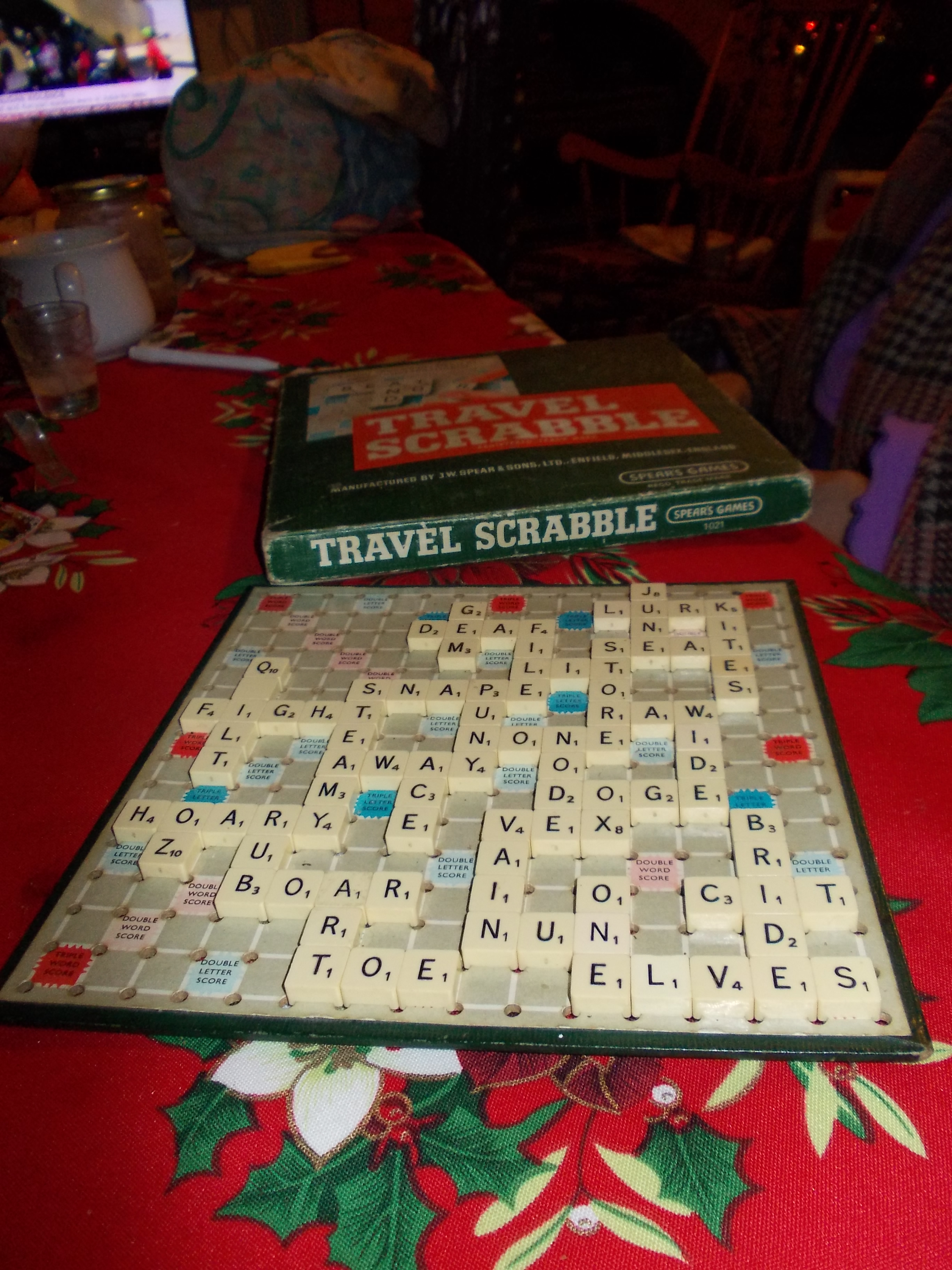
12272013 014

Incidentally, “Scrabble” was invented in 1938 by an architect named Alfred Mosher Butts. Butts worked out how many points should be given for each letter by counting how often particular letters are used in the English language. The original game was called “Criss-Crosswords”. But Butts was not a successful salesperson and in 1948 James Brunot, a lawyer, bought the game’s rights. Brunot simplified the rules and renamed the game “Scrabble”.

There is a similar word game called “Scarabeo” which is an Italian variant of “Scrabble” and was created in the late fifties by Aldo Pasetti.

However, an exact Italian version of “Scrabble” has now come out and tournaments in this country are played using Scrabble (with Italian words of course!)

Parenthetically, Pasetti was accused by “Scrabble” of breach of copyright, but was acquitted by Milan’s Court of Appeal in 1961. So now it’s perfectly legal to play the “Scrabble” Italian –style. If there’s a travel version of this game (which surely must have different letter frequencies in Italy) then we’ll buy it for next Christmas!

It would be nice to have a “Scrabble” tournament among aspiring Italian language learners instituted in Bagni di Lucca (already famous for its historical games such as “Biribisso” and also for its summer open-air Burraco tournaments).

The only snag about “Scrabble” (apart from finding the last letters one picks from the bag are X and Z and that there’s no location free on the board in which to place them) is losing the blasted letters. EBay has helped in the past but we did find we were four letters short. How frustrating!

However, if one is bored by the weather there’s nothing to beat a good board game! And that’s what we managed to find at the Diecimo second hand shop and picked up an excellent vintage Scrabble in the deluxe version, the type that can often sell for over euros fifty. Clearly the set must have been left by an English family. (How can they possibly live without a Scrabble set now?)

However, the sheets where one can plot one’s game had a line written, enigmatically, in Italian.

Anyway we did enjoy our Scrabble game later that day and found the game board’s turntable particularly useful.

Ti Riuso will also take items for sale if they are suitable and in a clean condition.. The seller must present his or her ‘documenti’ including fiscal number and the items are duly noted in a database and a receipt issued. The seller can set the price for the item and the mercantino takes a commission. It’s worth investigating if your Italian attic is getting a bit full or if you want to return to enjoy post-Brexit Britain.

Continue reading

A Lovely Visit to Lucca’s Green Walls Garden Festival

Last Saturday was a perfect day to enjoy Lucca’s Verdemura garden festival. It’s now in its twelfth year and is bigger and better than ever before. I was glad I went on that day as Sunday had rather somewhat dull and drizzly weather.

The hippie axiom ‘make love not war’ is singularly appropriate when dealing with Verdemura as the show is laid on the top of Lucca’s classic defensive walls, now over five hundred years old. Where there were cannons there is, instead, an encampment full of flowers and colour.

Lucca’s walls are the second major example in Europe of walls built according to the principles of modern fortification, taking firepower into consideration,  that have been preserved completely intact in a city. They are two and a half miles long and took from 1504  to  1648 to build. There are eleven bastions or bulwarks. (The walls of Nicosia, Cyprus, hold the record with a length of  three miles, also with eleven bulwarks).


The walls were designed as a deterrent and were never taken in anger. They did prove useful, however, when the Serchio flooded and their new ruler, Elisa Bonaparte had to be hoisted over them from a boat. Even today, after heavy rainfall the area encircling the walls tends to be flooded and a temporary moat is created.

The garden festival is centered around the Porta Santa Maria and extends to two bulwarks, Santa Croce and San Donato.

Here is a selection of photos I took of this year’s brilliant show. Were you there?


Lucca’s Saint Zita Converts Flour to Flowers

What better idea to have a flower fair than on Saint Zita’s anniversary! Saint Zita is Lucca’s patroness saint and yesterday we spent a colourful afternoon in and around the city’s amphitheatre square – yes, it used to be Lucca’s former amphitheatre and that’s why it’s oval in shape – admiring the flowers and replacing those of our plants (including our kumquat) which had become martyrs to the dismal sun-less, rain-sodden winter-spring we’d experienced here until the other week.

In the great basilica of San Frediano the saint’s body had been hauled out of her side-chapel and placed on display in the main nave. St Zita’s followers bought some white flowers from a desk to the right, touching them against the glass containing her naturally mummified body and a verger gave us a commemorative immaginetta.

Santa Zita, patron saint of that increasingly rare species, the domestic servant (and, perhaps more usefully for most of us to be invoked for help in finding lost keys, thus avoiding that boring dialogue: “You’ve got the car keys”. “No, I haven’t!” “Yes you have.”  etc.) was a poor peasant girl born near Monsagrato (where there is a chapel dedicated to her, visited a few years back when it was being painstakingly restored) who was taken into employment by a rich family as a scullery maid? Through plain hard work she became principal housekeeper (St Zita believed that a hard graft rather than prayer was the way to produce results – which I would certainly not disagree with!) She was generous to the poor and needy and on one occasion was accused of having stolen bread to give to them. Zita was strip-searched but instead of the stolen goods they found beautiful flowers in her apron pockets (hence the appositeness of having that market fair on her day).

(Several photos by grateful acknowledgment to Alexandra)


Saint Zita’s flower market has been extended for two more days to create a ‘Ponte’ or bridge to Italy’s next big national Holiday, May 1st where the main street of Fornaci di Barga will be pedestrianized and blossoming with more flowers. The lovely weather we’re experiencing now must be a welcome reward for all those overcast and gloomy weeks we’ve had to endure….

So today and tomorrow you can still enjoy St Zita’s transformation of flour in flowers apart from having your first really welcome ice-cream of this glorious season!

******

PS There are BIG happenings in Bagni di Lucca too. The schools and colleges theatre season opens with the biggest array of events ever – over ninety  in just five weeks plus a great venue in Villa Ada where a marquee has been set up for all sorts of exciting events including circus, acrobatics, music and lots more. Who wants to be anywhere else in the world now that spring is here!


A Taste of Finland in London

The Surrey docks in Rotherhithe, before they closed down, were a principal centre for the import of timber from Canada and the Scandinavian countries. To cater for shore leave for sailors from Nordic lands, missions and churches were set up. Thus, there is, within a small area of London, a Norwegian church, a Swedish chapel (unfortunately closed in 2012 but now listed as a fine example of post-war Scandinavian architecture and safe from demolition) and a Finnish church. (Further afield there is also a Danish and a Swedish church).

The Finnish Lutheran building was designed by the great Helsinki architect Cyrill Mardall-Sjostrom (1909-1994). It dates from 1958 and is listed as a fine example of the superb modern architecture Finns produce. The church has an unusual bell-tower and the apse is of serene beauty, faced by grey rock slabs from Finland.


There has been a Finnish mission in London since 1882 to give assistance, shelter and social life to seamen from that country. Now that the docks have closed the chances of coming face-to-face with a Finnish seaman in Rotherhithe are somewhat slim. However, today the church serves as a social centre for all Finns; it has a shop selling Finnish food items and includes hostel accommodation.

Quite by chance we found ourselves a couple of days ago in the middle of a Finnish Christmas market which spilled out on the streets in front of the church.

dscn3387-658x493-2013548849.jpg

Closing the street of the Christmas market was the distinctive spire of the Norwegian church, inaugurated by the future king Haakon VII in 1927 and a centre of the Norwegian government in exile during the dark years of the war.


The atmosphere was most congenial and there was even a lady playing Finnish folk songs.


As always with London it’s possible to travel the world for the price of a bus ticket and for a couple of hours we were in Finland, especially when attempting to decipher what all those weirdly named food products being sold turned out to be. At least we now know that limpuu, reikaleipa and hapankorppu are all delicious types of dark rye bread (a staple diet among Finns it seems) and that ligonberries and cloudberries abound together with reindeer meat and moose, not to leave out the Plevnan Siperia Imperial stout!