From London to La Costa (and Lucca and Beyond) Part Three

From London to La Costa (and Lucca and Beyond) Part Three

Of Vines and Olives

It’s not been the easiest of times for us two – indeed for all of us; a personal health crisis at the start of the year merged with the world health crisis brought by covid19. Even more disturbing is how time’s winged chariot seems to be pulled by ever faster steeds.

Difficulties in getting back to Italy have meant that we don’t have very much to show for in our field. Yet there are two crops which will ever survive – two items which sum up so much of Italy for me: grapes and olives.

Our vines climbing up the annexe to our house have been truly prodigious this year. Yet we have just been picking on them as a sort of dessert: we’ve never gone into wine-making although we have contributed to friends’ vendemmie (grape harvests).

When I was a kid and had already been on a couple of trips from the UK to Italy I tried to find the main reason why two European countries could have such differences between them. I suddenly blurted out ‘Italy has wine!’ ‘That’s right’, confirmed my mum. Of course, today England has some good vine growing areas particularly in Kent and Sussex but my childhood revelation continues to have some truth in it. Wine remains an essential tradition of Italian life in the way that it is not in the UK.

As for Olives several of those saplings I first planted in our field over ten years have matured into fine trees and carry their fruit with abundance this year. This is particularly heartening as it needs ten kilos of olives to produce one litre of oil.What more could one wish to have: a deep blue sky and truly warm sun around mid-day and one’s own little supply of olive trees while all around the warmth of late autumn colours embrace and the lenticular clouds above fascinate with their patterns.

It takes very little to make one happy in this world. Truly the best things in life are free – or rather they are impregnated with freedom, far away from those horrible restraints that the world (and oneself) is constantly trying to impose upon life’s essential being, particularly during this year. Liberty is there, truly, for the gathering, for the choosing….

It’s that time again in our part of the world: olive-picking time. In Longoio we are near the top height for growing olives (and vines) – 1750 feet. This year at least we’ve got something worth picking in our miniscule grove of twenty-odd trees.

If those of you living in northern climes think all this is irrelevant think again. There are now olive groves in southern England (see http://www.bbc.com/news/uk-england-kent-18551076 ) and, indeed, some London streets are lined with them (ever been down Islington’s Fife terrace?). Whether the fruit will be as succulent as that coming from the deep south of Europe is another matter of course…

Plant you own little olive tree and wait and see. The olive is a sacred tree redolent of peace and harmony and everything that can be said to be positive in our disquieting times. We’ll be back during the following weeks to collecting the fruit from this sacred tree whose oil was used to anoint kings and athletes in ancient Greece and which remains holy to this day for so many of life’s ceremonies.

Scribble About Scrabble

Here are snaps of some of the items on sale. Don’t miss out on the tents outside which are a prime source for exercise bikes, among other items!

Apart from one or two days of respite it has been weather for the ducks. It’s the sort of weather to read, watch Netflix or, to avoid the worst symptoms of cabin fever, play what in Italy are called ”giochi sociali” – i.e. games where you don’t have to exercise prehensile thumbs and avoid conversation to play.( Incidentally  in Italy this year, giochi sociali have outsold all those games consoles).

Our favourite is “Scrabble” and, of course, chess. When particularly mentally lazy we enjoy Chinese chequers too.

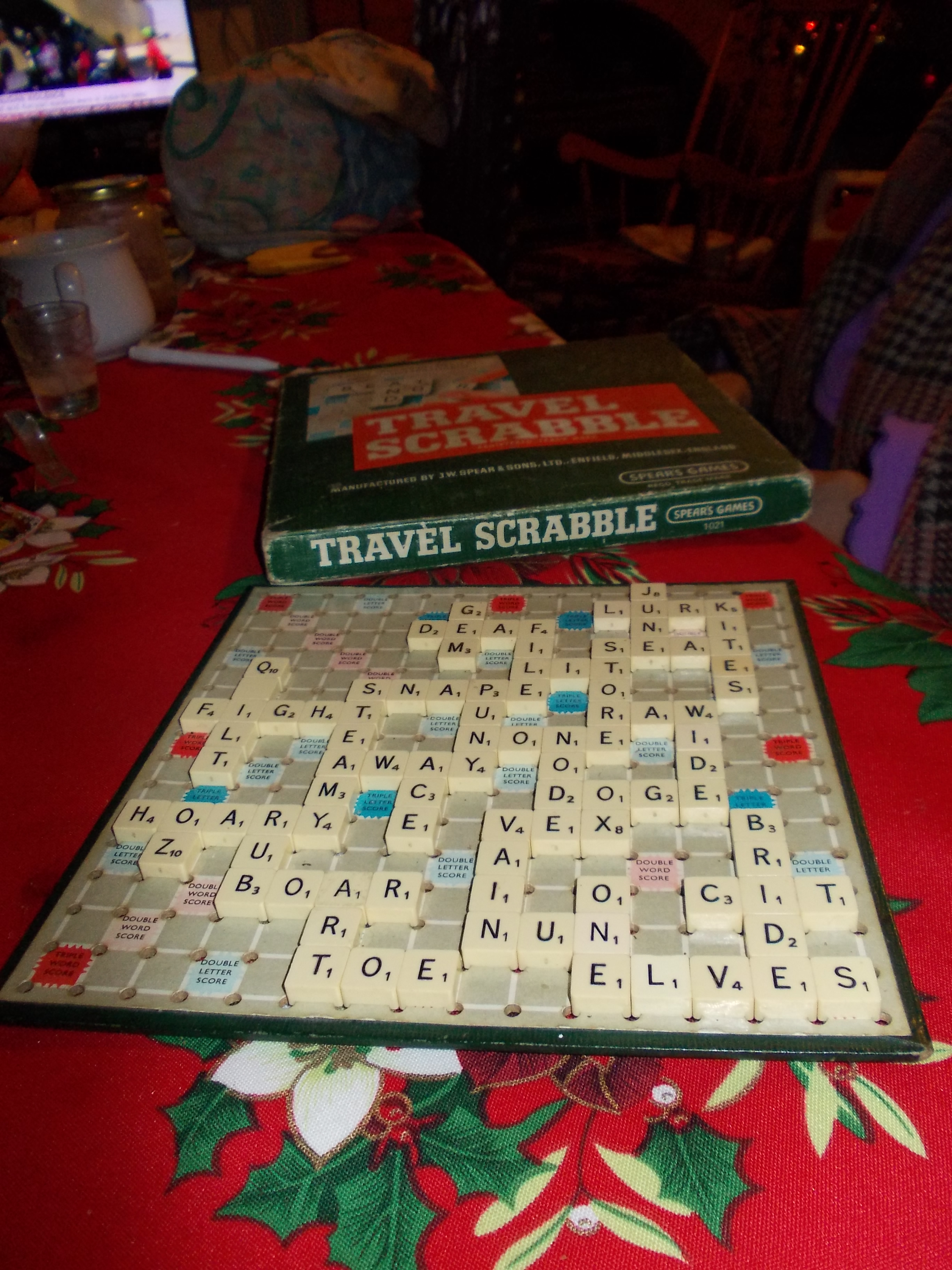
We enjoy “Travel Scrabble” even if not travelling because the letters are well secured to the board and thus don’t tend to fly around. We are not brilliant Scrabble players and the days when a seven-letter word (the maximum length allowed in our version) appears on the board are truly red-letter ones.

12272013 014

Incidentally, “Scrabble” was invented in 1938 by an architect named Alfred Mosher Butts. Butts worked out how many points should be given for each letter by counting how often particular letters are used in the English language. The original game was called “Criss-Crosswords”. But Butts was not a successful salesperson and in 1948 James Brunot, a lawyer, bought the game’s rights. Brunot simplified the rules and renamed the game “Scrabble”.

There is a similar word game called “Scarabeo” which is an Italian variant of “Scrabble” and was created in the late fifties by Aldo Pasetti.

However, an exact Italian version of “Scrabble” has now come out and tournaments in this country are played using Scrabble (with Italian words of course!)

Parenthetically, Pasetti was accused by “Scrabble” of breach of copyright, but was acquitted by Milan’s Court of Appeal in 1961. So now it’s perfectly legal to play the “Scrabble” Italian –style. If there’s a travel version of this game (which surely must have different letter frequencies in Italy) then we’ll buy it for next Christmas!

It would be nice to have a “Scrabble” tournament among aspiring Italian language learners instituted in Bagni di Lucca (already famous for its historical games such as “Biribisso” and also for its summer open-air Burraco tournaments).

The only snag about “Scrabble” (apart from finding the last letters one picks from the bag are X and Z and that there’s no location free on the board in which to place them) is losing the blasted letters. EBay has helped in the past but we did find we were four letters short. How frustrating!

However, if one is bored by the weather there’s nothing to beat a good board game! And that’s what we managed to find at the Diecimo second hand shop and picked up an excellent vintage Scrabble in the deluxe version, the type that can often sell for over euros fifty. Clearly the set must have been left by an English family. (How can they possibly live without a Scrabble set now?)

However, the sheets where one can plot one’s game had a line written, enigmatically, in Italian.

Anyway we did enjoy our Scrabble game later that day and found the game board’s turntable particularly useful.

Ti Riuso will also take items for sale if they are suitable and in a clean condition.. The seller must present his or her ‘documenti’ including fiscal number and the items are duly noted in a database and a receipt issued. The seller can set the price for the item and the mercantino takes a commission. It’s worth investigating if your Italian attic is getting a bit full or if you want to return to enjoy post-Brexit Britain.

Continue reading

The Abandoned Village of Fociomboli

I have been organizing my photographs during this continuing lock-down situation and it’s both a rewarding and an emotional experience. There is so much happiness in the photos in the wonderful times I’ve had with friends and relatives. There is however, some sadness. It’s not just those persons we have lost through the grim reaper, it’s the friendships we have thrown away through misunderstanding and intolerance or just changes in attitudes. As the great Doctor Samuel Johnson wrote: ‘ life has no pleasure higher or nobler than that of friendship. It is painful to consider that this sublime enjoyment may be impaired or destroyed by innumerable causes, and that there is no human possession of which the duration is less certain’.

Certainly friendship is a transient phenomenon. Humanity, sadly, takes hardly any example from other animals whose solidarity and faithfulness is proverbial like the swan, the yellow crested penguin, the gray wolf or the French angelfish.

penguin

Looking through photos of by-gone parties and get-togethers it’s hard to believe that people we would not be in any hurry to see today were once our treasured guests! Ah… such is the sad fate of humanity….or dishumanity!

More pleasurable are those photographs dealing with places and, although now technology can tag these scenes with their precise location, there was a time when we had to rely on our memory. Such is the case with my photos of one of the many abandoned villages in our Serchio valley whose exact location I could not remember.

For there was once a time when families would abandon their winter dwellings and practise transhumance, moving flocks of sheep and goats to the Apuan mountains’ upper pastures. Summer villages would spring up, complete with their chapels, to take full advantage of the luscious summer meadows.

Immagine 018

I placed my photographs of one of these villages on the Apuan Mountains web page at https://www.facebook.com/groups/63530040096/ asking if anyone recognized the location.

I quickly obtained an amazing response with over a hundred reactions. I think I now know what the name of the place is!

There was, however, disagreement among some respondents about whether the village was Campanice or Col di Favilla. Let the comments speak for themselves:

The place is Col di Favilla. In 1921 it was still an inhabited village. There was a village shop, a tavern and a tobacconist. Until 1970 it was lived in by an elderly husband and wife. They were shepherds who raised Pontremolese cows. When these cows died the bull remained for a long time time in a wild state. This bull often attacked hikers and my father was a victim.The church was renovated with donations from emigrants to the Americas”.

Immagine 022

However, another person writes:

“It is not Col di Favilla. It was completely abandoned in the 1950s and the church was restored by emigrants living in the Versilia plain. The cows were left in the wild by a lady from Isola Santa called Vince. I think you’re confusing it with another place.”

Campanice seems a popular choice of location.

It’s Campanice. It’s under the Freddone mountain that divides Campanice from Puntato mountain. It’s reached from Fociomboli going from Merletti bridge immediately after the Cipollaio tunnel. Together with Favilla it’s another village not too distant from the Pizzo delle Saette in the Pania range. You can get there by going up the path that crosses Isola Santa dam or by going down from Mosceta or from Puntato. The roadway there is closed by a barrier because it’s private. However, your photos show Campanice. If I am not mistaken it would have its annual feast’s day.”

Campanice is again confirmed as the village’s name:

“It’s Campanice, with behind it the west ridge of Mount Freddone.” An explanation of the name follows:The name ‘Campanice’ means ‘field sown in panic’… the village was born as a mountain pasture in Terrinca along an ancient transhumance road.”

Finally another commentator suggests the following visit:Go back and then take a walk to Puntato behind the Freddone….another paradise.”

Anyway, thanks to all those contributors who answered my question asking for a location for my photographs. They really make me want to return to the enchanted abandonnment of a village which I visited with a friend those many years ago, a friend who, alas, is no more – not because of any misunderstanding but because of the grim reaper himself.

Immagine 011


Cannibalism at La Chiesaccia

Fornovolasco is an attractive little town at the head of the Turrite di Gallicano valley. It has an iron-smelting past having been founded by master smiths from Brescia. The name, in fact, means ‘Volasco’s furnace’, Volasco being a common surname in that north Italian city.

There are several wonderful walks with a starting point from Fornovolasco and, on one occasion for us, with a finishing point when we descended from the summit of that queen of all Apuan peaks the Pania Della Croce.

We were lucky not to be eaten alive according to a story we were later told. It’s to do with the cannibal friars of Fornovolasco.

Going up the Turrite di Gallicano stream through the Fornovolasco woods on the path that leads to Monte Forato one comes across a ruin known as the ‘chiesaccia’.

Immagine 008

Italian has various suffixes that can be added to a noun. For example, if ‘piatto’ means ‘dish’ adding ‘ino’ to the end of the noun, changing it into ‘piattino’, means ‘little dish’. Similarly, ‘one’ added to ‘piatto’, changing it into ‘piattone’, means a big dish. Adding ‘accio’ and changing ‘piatto’ into ‘piattaccio’ means a bad dish (in the case of food) or an ugly dish (in the case of crockery).

So ‘chiesaccia’ may mean an ugly church (in terms of its architecture or structural condition) or a bad church in terms of its clerics and beliefs. I leave you to decide what meaning should be applied in our case.

In 1260, the ‘Libelli extimi Lucanae Diocesis’, a document listing all churches, monasteries and places of worship in the Lucchesia, names the ‘chiesaccia’ among those churches dependent on the Pieve di Santa Felicita of Valdicastello. The latter structure, consecrated to S. Maria Maddalena, was located in Petrosciana along a branch of the Via Francigena, at the time the only route between the Middle Serchio valley and the Versilia. The Augustinian friars were its custodians from around 800 AD.

The “Chiesaccia” was mainly used to welcome and refresh wayfarers who, for business or pilgrimage, travelled from the Garfagnana to Versilia and the sea via the Foce di Petrosciana pass. It’s said, however, that these friars were not as pious and merciful as they wished others to believe. In fact, wayfarers who stopped for hospitality at this monastery were never seen again! The reason? During the night the friars gave themselves to cannibalism and ate the poor wayfarers alive, maybe with a little salt and pepper added. During these “special” evening banquets the bells of the monastery would ring throughout the valley.

Hearing the nocturnal sound of these deadly bells, the local faithful knew that the friars had feasted that night too!

Immagine 009

Another version connects the derogatory “Chiesaccia” to the fact that the monks, if not actually killing them, would frighten and prey on the wayfarers and pilgrims who passed along the Petrosciana path. What can one say? Legends are not born by chance!

The indications for the C(lub)A(lpino)I(taliano) signed paths are soon spotted at the bridge next to Fornovolasco’s ‘La Buca’ inn. After about ten minutes the paths leave the asphalt road. They continue together passing first a spring and then a cave known as ‘la tana che urla’ (the den that screams) because of its remarkable echo. Shortly afterwards the paths divide: no. 6 leads to Petrosciana while no. 12 heads for the amazing natural arch of Monte Forato (see my post on that at https://longoio.wordpress.com/2013/06/11/crossing-the-monte-forato/).

Follow no 6 that with a long but fairly gentle ascent alongside almost all of its stretch up a stream.

Immagine 001

Along this path you will find the ruins of an old mill

Immagine 006

and then come across the “Chiesaccia”.

Immagine 007

If you manage to avoid being barbecued by the monks you can continue up and reached the Petrosciana pass and the path following on which is number 137.

Immagine 014

Happy walking!

A Chopped-up Knight and Much Else

Last Sunday’s concert in Borgo a Mozzano’s “il bello e il buono” series took place in the town of Diecimo which, as its name implies, is ten Roman miles north of Lucca. As an added bonus we were treated before the event to a guided tour of the town’s remarkable Romanesque pieve (parish church) by Silvia Valentini, an estate agent and local historian.

Image00012

Dedicated to the Virgin Mary, the church was begun in the twelfth century by order of the Countess Matilde di Canossa (see my post on this remarkable mediaeval woman, who was also responsible for our area’s distinctive Devil’s bridge or Ponte della Maddalena, at https://longoio2.wordpress.com/2015/11/15/borgo-a-mozzanos-matilde/) .

Image00007.jpg

(Our recent ‘piena’ on the Serchio)

The church, which consists of a nave, two aisles and a large semi-circular apse, is built of local dark-hued limestone blocks.

Image00013

Above its entrance door is a beautiful carved lintel which our guide suggested represents the parable of the Vineyard. (See Matthew, Chapter 20, verses 1 to 6).

Image00014

I particularly liked the little carvings on the apse cornice and a distinctive ‘ocular’ window. Be aware, too, that the lower of the two entrances of the campanile lead into the town gaol.


Next to the nave stands the imposing bell tower, with its characteristic succession of single, bifurcate, trifurcate and quadrifurcate windowed stages.

Image00019

The pieve’s stately interior has sculptures dating from the first half of the thirteenth century.


There’s a bas-relief depicting the prophet Isaiah, two column-bearing lions and a capital with eagles.

Image00049

The sad thing is that these sculptures are all that remain of a pulpit which was once on the same scale as that which can still be admired in Barga cathedral. The eighteenth century was not so appreciative and the pulpit, (or ambo as it’s technically known as), was crudely dismantled and largely dispersed.

I absolutely adore these lions: one is seen attacking the evil monster hydra:

Image00052

The other is fending off an attack from a heretic who is trying to stab its throat with a dagger.

Image00057

Clearly the lions are symbols of the Church Triumphant.


Other sculptures include a thirteenth-century hexagonal baptismal font demonstrating that once Roman Catholic baptism meant complete immersion – still practised by some Christian denominations to this day (e.g. the Baptists and the Church of Latter Day Saints).

Image00026

There’s an outstanding Roman sarcophagus adorned with lion masks:

Image00028

There’s also this strange slab depicting a knight almost hidden behind a large shield and locally known as King Pepin. Silvia theorised with regard to two odd features of this sculpture

Image00024

One, it’s not that the knight is a dwarf but that the horse merely carries, as was the wont of the times, the helmet of the dead knight in a funeral procession. It’s rather like the British army’s tradition of mounting a dead warrior’s boots upside down in the stirrups.

Two, the lower part of the slab was quickly finished off by an apprentice, hence its clumsy appearance.  Perhaps the knight had lost favour or his descendants failed to finish paying for the monument?

After this enjoyable and instructive visit we made our way towards the birth-house of Diecimo’s local hero, Saint Giovanni Leonardi, passing his recently-erected statue near the churchyard on the way.

Image00059.jpg

San Leonardi was the youngest of seven children born to artisan parents in Diecimo. Aged seventeen, he began a ten-year study to become a certified pharmacist’s assistant in Lucca. Later, he studied for the priesthood and was ordained in 1572.

Among Leonardi’s achievements was to gather a group of volunteers to work in hospitals and prisons. He was also an important contributor to the devotional movement known as the Counter-Reformation and took much interest in the Council of Trent reforms as a result of which he founded a congregation of secular priests, the Lucca fathers, which still exists to this day under the name ‘Congregation of the Mother of God”.

Indeed, our host at San Giovanni Leonardi’s house, padre Francesco Petrillo, is a member of this order which has in recent years returned to minister at its founder’s birthplace.

Image00060

He displayed to us the sweet presepi or Christmas cribs in the pieve’s sacristy which he makes himself and sells to boost church funds.


Padre Petrillo also showed us the precious collection of saintly reliquaries containing the bones of various martyrs.


There’s much more to say about San Giovanni Leonardi: his resilient personality and his friendship with Saint Philip Neri (without whom London would not have had its Brompton oratory), for example.

Leonardi was made a saint in 1938 by Pope Pius XI; his liturgical feast is celebrated on October the 9th and his relics lie in the church in Santa Maria in Campitelli, Rome. Diecimo, however, has the honour of his birthplace and housing a museum dedicated to him:

Not surprisingly, Saint Giovanni Leonardi is the patron saint of chemists given his long career in this occupation. (I wonder how many Boots assistants know that…)

The fourth concert of the musical season promoted by the Borgo a Mozzano’s Salotti music school was an absolute treat. ..I don’t think I’ve been so enveloped by guitarists: the room was small and I was triphonically surrounded by the players. No problem, the music was brilliantly performed (and with acoustic guitars there’s no problem of anything being too loud).

The Lydian Guitar Trio is formed by Nicola Fenzi, Dario Atzori and Giacomo Brunini (the artistic director of the festival) and the programme ranged from the classical period to the present day with music by Filippo Gragnani, Astor Piazzolla, Paul Hindemith, and contemporary composers Antonio Gabriele Martinique and Luca Guidi. It was particularly enjoyable to have living composers in the packed room introducing their music and they could have had no better set of musicians to perform their adventurous offerings.

Image00064

The encore was a repeat of one of four beautiful Basque tunes; it was truly an utterly memorable way to spend a somewhat intemperate evening.

If you are a Fornolian try not to miss next Sunday’s concert, on the first of December, which will take place at 5 pm in Fornoli’s parish church. It’ll be presented by our journalist in resident and master of ceremonies Marco Nicoli and is sure to be another delectable way to spend a late autumn afternoon.


Elusive Elegance

Cavemen enfolded by their sabre-toothed tiger furs, imperial Romans draped in their togas and, to the present, that most ancient of clothing, the sari of the Indian sub-continent, worn since sanskritical times: these images of primal memories are evoked in the exhibition “Every garment tells a story” created by Kerry Bell at Barga’s Oxo gallery and viewable until September 30th.

It was the folds in the dresses that principally engaged my attention: those sinuous contours, the interweaving lines, highlighted by the subtle use of lighting, which continued their journey, projecting multi-layered silhouettes onto the gallery walls and forming a profound dialogue between the object and the aura it created.

Kerry has had long experience in fashion design and the industry it has formed. From those draperies differently textured dresses and costumes have been cut and tailored; strict forms have evolved which mark each age as the harbinger of a particular way of interpreting that most public and, at the same time, most intimate of artistic expressions: the manner in which we elaborate the cover to our original nakedness and make statements about how we see and feel ourselves or want the world to see and feel us.

Kerry has described the way she wishes her exhibition to be self-revelatory: each garment can generate feelings and emotions which may naturally be quite different for diverse people. Does the clearly unfinished appearance of this dress point to some tragic incident? Are the bleached colours of that gown related to the wearer’s character? And what social enigmae are prefigured in the classical folds of this blouse?

There is an arcane visual poetry in these items which seduces one with distant associations of place and time, whether they be Cunard line elite of the thirties or fin de siecle salon hostesses or street sleepers of every age (but especially ours.)
Food for thought or drink for the soul? Make up your own minds and go to be captivated by this alluring show.

DSCN5435.JPG

Enter a caption

Liberating Lucca

September is the most important month for Lucca; the ‘Luminara’, the great religious procession of the Holy Face commemorates the crucifix, traditionally supposed to have been carved by Nicodemus and bearing Christ’s features. This year the candles adorning the city’s streets were substituted by LEDs to some disappointment. However, attendance and the spectacular fireworks finale were as good as ever. To know more about the Luminara do read my post at:

Lucca by Candle-Light

The other important event commemorated in September is the liberation of the city of Lucca from fascist-nazi oppression. On the fifth of the month Allied forces entered inside the walls of Lucca and, last Sunday, we were privileged to meet one of the soldiers who was a member of the army freeing the city seventy five years ago.

Ivan J. Houston has written about his experiences in “Black Warriors: The Buffalo Soldiers of WWII,” the Second World War’s first Black combat team under the 92nd Infantry. He says of the Lucchesi:

“These were white Italians and we were black Americans, but they made us feel like heroes. We were never treated like that in our own country where we were still second class citizens.”

Ivan was amazed to find that the holiest image of Lucca, the Holy Face, has a black complexion.

We met up at San Giusto di Brancoli and were taken round the fortifications of the German defensive Gothic line. We visited bunkers, tunnels and look-out posts around Monte Pittone.
Ivan Houston’s division arrived in the area of ​​Morianese and Brancoleria on 15 September 1944. The Allies found strong resistance from the Nazis at the entrance to the Serchio valley in the bottleneck created between Monte Pittone and Piaggione, Monte Castellaccio in Aquilea and the Monte dell’Elto in Domazzano, in front of defenses from which the enemy could cross-fire and control all forces entering the valley. These clashes continued until September 19, 1944 when the Allies managed to break through the enemy lines and conquer these strategically placed hills, helping to free Bagni di Lucca.


We returned to San Giusto just in time to welcome Ivan Houston.


We joined the procession to the church where a most moving ceremony took place honouring Houston and remembering all who died in the campaign to free this part of Italy. We were so glad to meet the youthful 95 year old veteran who has since become an icon for afro-americans wishings to progress in the world of business.


The buffet lunch was up to the high standard expected in Italy.


We visited the interesting collection of uniforms, armaments, military equipment and photographs housed in the newly opened museum.


The day was truly memorable and we are thankful we were able to be present in the company of a soldier who fought that we might be free today.

A Lovely Visit to Lucca’s Green Walls Garden Festival

Last Saturday was a perfect day to enjoy Lucca’s Verdemura garden festival. It’s now in its twelfth year and is bigger and better than ever before. I was glad I went on that day as Sunday had rather somewhat dull and drizzly weather.

The hippie axiom ‘make love not war’ is singularly appropriate when dealing with Verdemura as the show is laid on the top of Lucca’s classic defensive walls, now over five hundred years old. Where there were cannons there is, instead, an encampment full of flowers and colour.

Lucca’s walls are the second major example in Europe of walls built according to the principles of modern fortification, taking firepower into consideration,  that have been preserved completely intact in a city. They are two and a half miles long and took from 1504  to  1648 to build. There are eleven bastions or bulwarks. (The walls of Nicosia, Cyprus, hold the record with a length of  three miles, also with eleven bulwarks).


The walls were designed as a deterrent and were never taken in anger. They did prove useful, however, when the Serchio flooded and their new ruler, Elisa Bonaparte had to be hoisted over them from a boat. Even today, after heavy rainfall the area encircling the walls tends to be flooded and a temporary moat is created.

The garden festival is centered around the Porta Santa Maria and extends to two bulwarks, Santa Croce and San Donato.

Here is a selection of photos I took of this year’s brilliant show. Were you there?


All Dressed Up With Everywhere to Go

There is so much happening in Lucchesia’s summer that it’s difficult to keep up with it all. Not only that, it’s often difficult to find the information until someone tells you ‘wow that was a fab show I went to at blabla’

So what can you to do to keep up with the immense plethora of events in our part of the world?

  1. Take a picture of every poster you find advertising an event.
  2. Visit Bagni di Lucca’s helpful tourist office at regular intervals.
  3. Google for events in the area.
  4. Chat to people about what’s happening.
  5. Decide what you’re really interested in.

There are three main categories of events

  1. Foody ones – sagre, feste etc.
  2. Arty ones – concerts, theatre, shows, palii etc.
  3. Sporty ones – marathons, swimming pools, car rallies etc.

Because the weather is still so lovely, not too brazenly hot and often with a gentle zephyr, there is no excuse for sitting at home meditating on what to do. The world, or at least, the Lucchesia is your oyster! (Which reminds me go to Marina di Pisa for some great ones – oysters I mean!)

Here’s a start….I have already decided on the reopening of Bagni di Lucca swimming pool after extensive refurbishing and the concerts at Villa Bonvisi.

I have also decided to publish all the events I can find in our area on an ongoing way in my facebook page at

https://www.facebook.com/fpettitt

This is to avoid clogging up my blog with too many posts.


The Greatest Show in the Lucchesia!

The Italian word “Palio” can be applied to many different events. The most common use of the word is in the “Palio of Siena”, the famous horse race which takes place in the central fantailed and sloping square of this city between the various contrade or districts (all seventeen of them) at different times.

The element of competition between a town’s districts enters into the majority of palii, of which there are at least fifty-four listed in Italy (seventeen in Tuscany alone.

The Palio di San Jacopo, Gallicano’s patron saint, always occurs on 25th July every year. This extraordinary event, where allegorical floats are preceded by fantastically costumed participants enacting complex choreographies, has been going since 1972 and, apart from a few instances when it was cancelled, has been growing from strength to strength. This year the Palio is, as usual, exceptionally fabulous and anyone who misses it truly misses a great deal.

I’ve written various posts on the Palio.

https://longoio2.wordpress.com/2014/07/20/we-are-such-stuff-as-dreams-are-made-of/

https://longoio2.wordpress.com/2016/07/28/superlative-spectacle-at-gallicanos-palio-di-san-jacopo/

Like other Italian palii there is a competition between various rioni to compete for the prize. Gallicano has three rioni today (there used to be four). They are Borgo Antico, Monticello and Bufali.

Each year a new theme is given to the three rioni. This year it was ‘La differenza’.

Rione Borgo Antico presented ‘Libera – mente’ . It’s based on modern art. See if you recognize the allusion to Keith Haring’s great mural at Pisa. (There’s also Magritte, Dali and Rauchenberg among others.

Rione Bufali presented ‘Moon – la differenza tra gli atomi crea universi’. Here there are references to 1984 – especially when the date is 2084 and a Mr Smith involved.

Rione Monticello presented ‘Dipingo il mio sogno’. The setting is an ever transforming originally Parisian street corner.

Here are some pictures and movies of the evening of the 21st August: preparation and procession of allegorical floats at the 36th Palio di San Jacopo at Gallicano. It’s a marvel of imagination and choreography. Certainly for me it’s the most awesome festival of the Lucchesia!

What is so incredible is the wonderful creativity and imagination a small town like Gallicano in the middle of a remote valley can muster for its Palio. Everyone has a chance to contribute with their skills, no matter what age. For a whole year before the actual palio (and especially during the long winters) ideas are thrashed out, designs produced, costumes made. There’s sewing, cutting, pasting with every conceivable material available. Floats are meticulously built up and mechanized in a special warehouse dedicated to the palio. It’s a sort of mountain version of Viareggio but with a greater emphasis on spectacle and with universal world themes rather than sometimes heavy political satire.

The sheer love and resourcefulness put into the Gallicano palio is quite extraordinary and demonstrates fully the ability of Italians to get together, lay aside differences and produce something which I truly feel is of an international standard and equals some of the best shows of the world’s capital cities.

If you missed it on 21st August you must go to the second and final night today, July 25th.

Who won? I’ll let you know after tonight!

Meanwhile here are some movie snippets from a great evening:

https://www.youtube.com/edit?o=U&video_id=SE1shLFEgEI


https://www.youtube.com/edit?o=U&video_id=6p7OHC4Y0TU