From London to La Costa (and Lucca and Beyond) Part Three

From London to La Costa (and Lucca and Beyond) Part Three

Scribble About Scrabble

Here are snaps of some of the items on sale. Don’t miss out on the tents outside which are a prime source for exercise bikes, among other items!

Apart from one or two days of respite it has been weather for the ducks. It’s the sort of weather to read, watch Netflix or, to avoid the worst symptoms of cabin fever, play what in Italy are called ”giochi sociali” – i.e. games where you don’t have to exercise prehensile thumbs and avoid conversation to play.( Incidentally  in Italy this year, giochi sociali have outsold all those games consoles).

Our favourite is “Scrabble” and, of course, chess. When particularly mentally lazy we enjoy Chinese chequers too.

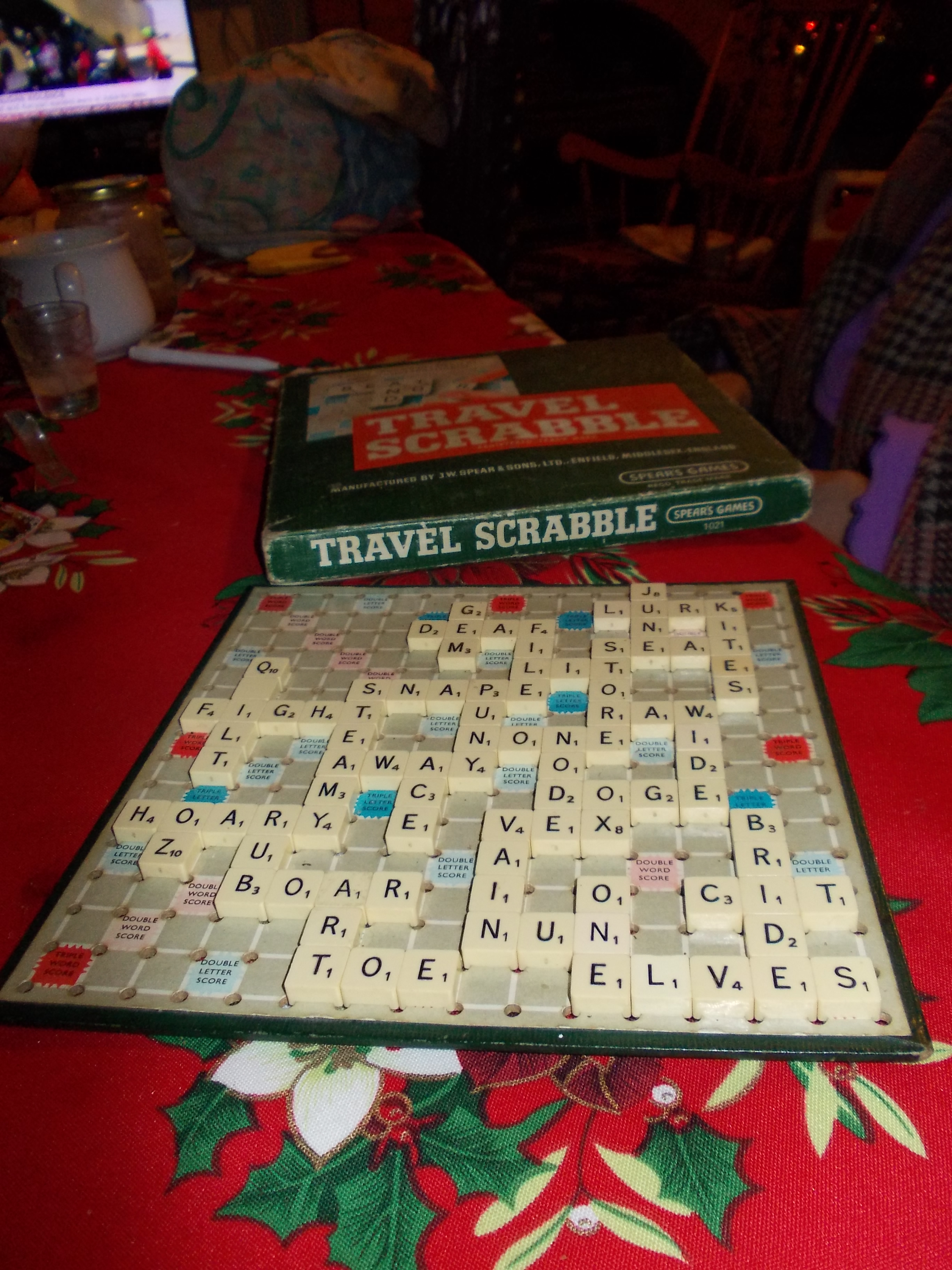
We enjoy “Travel Scrabble” even if not travelling because the letters are well secured to the board and thus don’t tend to fly around. We are not brilliant Scrabble players and the days when a seven-letter word (the maximum length allowed in our version) appears on the board are truly red-letter ones.
12272013 014

Incidentally, “Scrabble” was invented in 1938 by an architect named Alfred Mosher Butts. Butts worked out how many points should be given for each letter by counting how often particular letters are used in the English language. The original game was called “Criss-Crosswords”. But Butts was not a successful salesperson and in 1948 James Brunot, a lawyer, bought the game’s rights. Brunot simplified the rules and renamed the game “Scrabble”.

There is a similar word game called “Scarabeo” which is an Italian variant of “Scrabble” and was created in the late fifties by Aldo Pasetti.

However, an exact Italian version of “Scrabble” has now come out and tournaments in this country are played using Scrabble (with Italian words of course!)

Parenthetically, Pasetti was accused by “Scrabble” of breach of copyright, but was acquitted by Milan’s Court of Appeal in 1961. So now it’s perfectly legal to play the “Scrabble” Italian –style. If there’s a travel version of this game (which surely must have different letter frequencies in Italy) then we’ll buy it for next Christmas!

It would be nice to have a “Scrabble” tournament among aspiring Italian language learners instituted in Bagni di Lucca (already famous for its historical games such as “Biribisso” and also for its summer open-air Burraco tournaments).

The only snag about “Scrabble” (apart from finding the last letters one picks from the bag are X and Z and that there’s no location free on the board in which to place them) is losing the blasted letters. EBay has helped in the past but we did find we were four letters short. How frustrating!

However, if one is bored by the weather there’s nothing to beat a good board game! And that’s what we managed to find at the Diecimo second hand shop and picked up an excellent vintage Scrabble in the deluxe version, the type that can often sell for over euros fifty. Clearly the set must have been left by an English family. (How can they possibly live without a Scrabble set now?)

However, the sheets where one can plot one’s game had a line written, enigmatically, in Italian.

Anyway we did enjoy our Scrabble game later that day and found the game board’s turntable particularly useful.

Ti Riuso will also take items for sale if they are suitable and in a clean condition.. The seller must present his or her ‘documenti’ including fiscal number and the items are duly noted in a database and a receipt issued. The seller can set the price for the item and the mercantino takes a commission. It’s worth investigating if your Italian attic is getting a bit full or if you want to return to enjoy post-Brexit Britain.

Continue reading

Hidden Frescoes in our Valley

Fresco is a typical Italian painting technique which continues to be used to perfection by several practitioners. For example, there’s Julia Mee whose family has spent many years here. Her web site at https://www.juliamee.co.uk/ will explain more about this fascinating art which is now in full creativity in Scotland at Marchmont House:

https://www.facebook.com/marchmonthouse/photos/?tab=album&album_id=1017413621794230&__xts__[0]=68.ARBRcZ0imZsB7sVWx81UhwLwP5GBYOrfsGtXuyBc2qhF3dhG6GnQYkjh3s0kpTGeJhdbS6t_znQMYjsGlRndPu9aSd7edBS2PadBF4DoeRE9xjnBDYuce0Ab4DzCXI7tviJI-xQrlKrPnmh6gbNYi3t-bMIR-XLS7C6vhoy7rq_ULKWKS-mdGz5ASJRtQOz3x5gSCNMD2y9bohY3bR3oaAVyR7RVMeIkk3KNhVAep-u6lWb5fHEWPM8TNB7z_I5qENFkieridZp0tkTdv7vww2-nLK0CVzJQkL1bwXfucm-cMQWXgALvLyFI4MfrAdvc2b2u

‘Fresco’ means ‘fresh’ (since the paint is applied to still wet plaster) and also has connotations of open-air as in ‘al fresco’ for many frescoes are, indeed, painted on outside walls. Highlights of any visits to Italy include looking at some of the magnificent cycle of frescoes this country holds: for example, the Sistine chapel (Michelangelo), Brancacci chapel (Masaccio), the Vatican palace (Raphael), and the Arena chapel (Giotto). What is often not noticed is the fact that frescoes can also decorate palaces, villas and even the most unassuming mansions? We don’t have to go far to discover them here in Bagni di Lucca. Last week we visited a nearby house with a somewhat forbidding inelegant exterior. Stepping inside upon invitation we discovered a multitude of rooms a few of which (on the ‘piano noble’ of the first floor) had some elaborate frescoes as decorative features.

In one room I was enchanted by this series of fine tropical birds.

When were these frescoes painted and by whom?  Their style suggests the turn of the nineteenth century and particularly the ‘Empire style’ introduced by Princess Elisa, Napoleon’s sister, who ruled Lucca. These frescoes were the ‘wall paper’ of the times. They were used to update a formerly undistinguished, even primitive, building into something more aristocratic and sophisticated especially appropriate if the owners had gone up in the world and were aiming for a more stylish way of life. Clearly these rooms could be used as ball-rooms and when there were marriageable daughters in the family show them off in a more enticing way and gain a greater variety of suitors.

But who painted them? Has any significant research been made into these high-end painters and decorators?

In another building, Borgo a Mozzano’s library where I have taught, there are further examples of fine decorative frescoed rooms described in my post at:

https://longoio2.wordpress.com/2016/01/24/a-lovely-library-ceiling-at-borgo-a-mozzano/

Sadly there are several instances where beautiful frescoes are allowed to go to rack and run. Nowhere is this more apparent than the abandoned village of Bugnano just up the road from us.

I describe this desolation further in my post at:

https://longoio.wordpress.com/2014/03/16/abandon-all-hope-all-ye-who-enter-here/

I just wonder how many more frescoed rooms are tucked away in buildings which appear to have nothing special about them. The frescoes are clearly not of the highest art but their exquisite decorative value should not be overlooked especially as they are so typical of a tradition which England’s damp and dreary climate has been largely unable to support.

The Twin Villages of Longoio and Mobbiano

Like twin galactic stars the villages of Longoio and Mobbiano shall ever be associated with one another. There does not appear to be any significant rivalry between the two as often exists between neighbouring villages in our valley (like that between Crasciana and Casabasciana) . Longoio is slightly larger and, until relatively recently, was the only one shown on the road sign to the two villages.

Unlike some of the other settlements in these parts there’s little information in medieval documents  on Longoio and Mobbiano . Longoio is never talked about, unlike Mobbiano which is mentioned for the first time in a parchment dated 983, in which it is recounted that Viscount Fraolmo II, son of Fraolmo I, obtained from the Bishop of Lucca, Teudigrimo, a part of the tithes paid from some lands leased in “Mubiano”.

We do not know exactly when the two villages were founded. According to some historians Mobbiano (perhaps older than Longoio) developed from a Roman farm, founded by a certain Mevius, probably one of the many lands assigned to retired legionaries as a reward for services rendered to the Roman empire.

Mobbiano consists of two main narrow streets running parallel to each other and separated by a steep slope.

Although it has its fair share of inhabited houses Mobbiano  also regrettably has several semi-ruinous buildings which are often hidden under layers of dense foliage.

Here are some further pictures we took the other day while walking about the village which is really more of a hamlet.  The connecting passages between the two streets are really steep! 

Mobbiano has no outstanding monuments but it has its picturesque features including this graceful fountain.

The village has its own car park which was built around last ten years ago.

Longoio and Mobbiano meet up at the charming ‘chiesina della margine’ where a Mass is celebrated every May.

The population of the two villages is stated to be seventy inhabitants but this is perhaps an overestimate – there are more cats in then! This year, in particular, with the pandemic there have been far fewer summer holiday makers which can double the population.

Perhaps the best claim to fame of Mobbiano and Longoio is that they are reckoned to receive a greater amount of sunlight than any other villages in our region of the Controneria. That is clearly a very good reason to continue to live here!