‘Et tu Brute?’


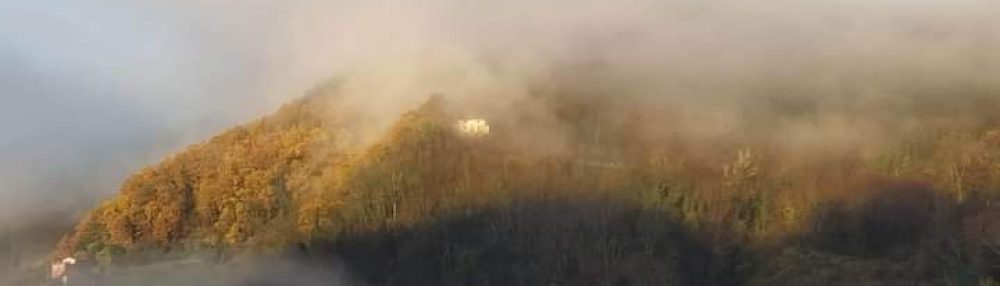
As I wake up to the following gloriously expansive view from my bedroom window with its clear blue Mediterranean sky and autumnally tinged forests it’s easy to momentarily forget that the world is living through some cataclysmic crises: climate change, species extinction, covid-19 for starters, and that so many countries, in addition, are having to face wars whether they be arms or trade ones.


As I write this large areas of our planet are being devastated by fires, by sea level rises, by military destruction and…by a new Kentish lorry park, digging into the idyllic landscape of the North Downs, in preparation for the impending brexit deadline of January first 2021. (To be suggestingly named, according to some wags, the ‘Nigel Farage Memorial Park’).

I just wonder how many New Year’s eve parties will be celebrated at the end of this year what with the strictures imposed by pandemic rules and the growing doubt among believers that what they voted for might have all been a con and that they were sold a pup.

I have sadly come to the view that there is a close relationship between those people who still deny climate change, those who are against any form of vaccination, those who affirm covid-19 is a hoax and those who believe that brexit is the best thing since sliced Hovis. Of course this is not to say that these belief systems completely tally one with the other but there is a far more intense overlap between them than between their opposites.

OK, we have earned the essential privilege, after centuries of feudal oppression and crass totalitarianism, of individual freedom as encapsulated in the Universal Declaration of Human Rights. We have evolved considerably from being the huddled masses exemplified in the hierarchical ideology of so many societies – from the caste system in the Indian sub-continent to the class system still prevalent in the British Isles – towards the individualism which has arisen out of it.

However, if we all continued to behave in a highly individual manner as before – refusing to wear face masks in prescribed areas or failing to differentiate our household waste – then many of us will be in the same position as those inhabitants of German towns, just after World War 2 had ended, who were escorted into the remnants of concentration camps to witness their own country’s version of man’s inhumanity to man on a scale never before seen. I doubt there could have been any holocaust deniers left after these visits to their local extermination camp.

Yes, regretfully there’s also a connection, in my mind, between pandemic deniers and holocaust deniers. Perhaps visits to the local intensive care unit (where I was a denizen earlier this year) might be organized to dispel this belief if health restrictions did not permit it.

In Bagni Di Lucca I have come across people who blatantly remain mask-less in the middle of the Saturday morning market. They don’t even seem to carry one on their arms. I just wonder if they ever step into a store for their shopping; shop-keepers would never let them in for they too are subject to hefty fines for breaking anti-virus regulations. Other people have asked me ‘do you know anyone who has died of Covid-19?’ Sadly I do now and tell them so. They still appear to remain unconvinced, however.

The conspiracy theorists spread far and wide into that dark area of persons known as members of Q-anon who apparently are now considerably influencing the forthcoming US elections.

How does one relate to those who believe in these conspiracy theories? Bertrand Russell said that tolerance is necessary in any human relationship. All well and good but then are we to tolerate FGM, Suttee or legalised lethal injections? The other thing Russell said was ‘confirm the veracity of the facts’. That is clearly more difficult to handle and that’s where conspiracy ideology finds an easy way to worm itself into the collective subconsciousness.

Whatever happens in all this mess one thing is clear. Unless British residents in Bagni Di Lucca confirm their residence permission documents, obtain their Italian medical cards, exchange their UK drivers license for an Italian one and ensure their now European-citizenship-less passports are up to date they are going to find that discovering any brexitian benefits will be as difficult as locating the proverbial needle in a haystack. I just hope they will at least wear their ‘mascherine’ (as sanitary masks are called in Italy.)

Or you could sleep your way through all this…

Who Wants to Be a Millionaire?

Carrying on from my previous post on the benefits of improving one’s language skills by following some italian quiz shows I mentioned that I too have been involved in these often entertaining and educational programmes.

The first time was in 1966 when I was chosen by my school to be part of a team of four contestants in Granada television’s less senior version of ‘University Challenge’, this time called ‘Sixth Form Challenge.’ I don’t quite know how I was chosen as I felt I was not a particularly distinguished pupil at Dulwich College. Furthermore, my school had great reservations about entering a television quiz show and almost refused the invitation to participate in one. I think it was the father, who worked in media, of another pupil who suggested the idea in the first place.

Anyway, we were whisked off to Manchester on my only trip so far to that northern city and were televised on video tape for the TV broadcast which took place in spring 1966.

I don’t remember much about the questions asked except for two of them. One was on Rossini overtures: I had to guess four of them and if anyone knows anything about Rossini overtures then they’ll realise it’s really easy to get them mixed up for one overture’s crescendo sounds so similar to another’s. In retrospect I feel it was a very unfair question to ask a seventeen-year old and I suspect that some sort of machination was behind it. In any case I managed to answer the last question which was about a Britten opera. I blurted out ‘Peter Grimes’, the gong went and we found we had beaten our opponents, Wellington College.

I viewed the broadcast in the company of my family and a gathering of friends at our home in Forest Hill, London. Of course, we had no VHS machines in those days but I managed to record the programme’s sound on a reel-to-reel tape . Goodness knows where that tape has gone now. However, I still have the Shorter Oxford Dictionary which Granada generously donated to the victors. It remains the thickest book on my shelves.

Our quiz-master was not the Bamber Gasgoigne of University Challenge fame but Chris Kelly who has also presented such programmes as ‘Wish you were here…?’ and ‘Clapperboard’.

My second foray into the television quiz world was less successful. It was ‘Mastermind’, famous for its original presenter Magnus Magnusson and his catchphrase: ‘I’ve started so I’ll finish’ which was also the title of Magnusson’s book on the show’s history. I was invited to turn up at the BBC’s television centre in White City and told that I had been privileged to be asked to be there and that I would have to pass a final test before being given a chance to sit on the programme’s menacing black armchair. Unfortunately I failed a question on cricket, not my forte, and so left the interview room without ever having had an opportunity of getting the prized winner’s crystal goblet.

I’ve often thought of joining in pub quizzes but not being a traditional pub goer never have. The most I dabble in quizzes these days is on-Line at Quiz Planet! Any one wish to challenge me or, better, anyone wish to start a bar quiz in Bagni Di Lucca?

The Dead Live Anew at Bagni di Lucca’s Anglican Cemetery

In 1842, the ruler of the duchy of Lucca, Carlo Ludovico di Borbone, granted the English colony of Bagni di Lucca the right to found a protestant cemetery. A place called “al Prato Santo” (‘At the Holy Field’) was chosen on the opposite side of the river Lima and the graveyard was opened in 1844. It was in use until 1953 and there are one hundred and thirty seven individuals who rest there. In 1982, with the end of a legacy destined for maintenance, the cemetery was purchased by the Municipality of Bagni di Lucca. It is now managed by the town’s Michel de Montaigne Foundation and the Lucca Historical Institute.

Among those buried here, often with monuments made by renowned sculptors such as Benjamin Gibson, Giuseppe Norfini and Emilio Duccini, are the sister of the President of the United States of America Stephen Grover Cleveland, the writer ‘Ouida’, Henry and Elizabeth Stisted (the founders of Bagni’s Anglican church)  and the Irish entomologist Alexander Henry Haliday.

For those of us who prefer the romantic view of a cemetery as a place of decay with gravestones decomposing under a jungle of ivy and other creepers, a place haunted by bats and crows, a symbol of life’s ultimate futility and a site of melancholic and solemn reflections it might seem a contradiction to appreciate these ancient tombs restored, oxymoronically, to new life and I have often felt this way. However, I am now resigned to the fact that the aim of Bagni’s De Montaigne cultural association is to restore all the monuments it contains to their pristine glory. This is because in addition, to the names of the graves’ occupants the restoration has given fresh remembrance in the form of those who not only have munificently funded their renovation but also in the fact that several of the sepulchres have received a second dedication to recently deceased inhabitants and visitors to Bagni di Lucca. Thus, some tombs may have a triple dedication: the original occupant, the person who has given funds to restore it and the new dedication to a departed lover of Bagni di Lucca. Some even have a further association as the name of the tomb’s restorer is also mentioned. Sadly, in one case this has meant a fourth remembrance since the restorer in charge of the iron railings of several of the tombs recently died prematurely aged forty.

Last Saturday, 5th September, at the English cemetery of Bagni di Lucca in the aureate sunshine of a late September afternoon, five newly restored funeral monuments were inaugurated, raising the cemetery’s restored monuments to fifty five.

(Prof Marcello Cherubini, director of the De Montaigne Foundation and Bruno Micheletti of the Bagni di Lucca branch of the Historical Institute, the two principal organisers of yesterday’s event)

The renewal of one funeral monument was dedicated to the memory of Tony Bareham, protagonist of the Montaigne Foundation’s international conferences of the and himself a benefactor of the cemetery since he provided funds for the restoration of the writer Louise de la Ramée’s, (better known by her nickname of ‘Ouida’) monument. Bareham dedicated this restoration to the memory of his wife who had died a few years previously. This circumstance shows to perfection how one tomb can receive associations well beyond its inhumed dweller.

Another tomb was reinstated in memory of Umberto Guidugli, a notary who died of Covid-19.  He was a keen visitor to Bagni di Lucca and a supporter and friend of its Montaigne Foundation and the Historical Institute. A third monument was dedicated to all the doctors, nurses, health personnel, pharmacists, volunteers who sacrificed their lives to help those affected by the recent pandemic. Because of this reason, a representative of the Bagni di Lucca committee of the Italian Red Cross was present. Again this shows how supposedly irrelevant monuments from a past and largely forgotten age may be made significant again for our present very troubled age where, once again, we are all suffering under a pandemia as threatening as that ‘Spanish Flu’ of 1918 which killed two of the cemetery’s occupants Nelly Erichsen and Rose Elizabeth Cleveland whose tombs have also been lovingly restored.

Finally, there was the restoration of the Caccia family tomb. Colonel of the Bersaglieri, Mario Caccia was a participant in Italy’s wars of independence and died in Peschiera in 1879. This was a particularly moving moment in the afternoon’s proceedings.

A trumpeter from the famous Italian Bersaglieri troop played the Italian equivalent of the ‘Last Post’ on his trumpet:

Caccia was honoured with the laying on his grave of a small laurel wreath by other bersaglieri all wearing their traditional helmets adorned with black capon feathers.

The proceedings were completed by a delightful concert held in a suitably cooling orchard by the Lima River.

The performers were “Sax off limits”: an ensemble of twenty saxophones from the “G. Puccini” Conservatory of Music of La Spezia. This was the programme:

One of the items, Puccini’s ‘Crisantemi elegy’, has become something of a leitmotiv for Bagni di Lucca’s cemetery. I remember it being played (by a string quartet this time) in the presence of Puccini’s grand-daughter Simonetta who was a keen supporter of the efforts to restore the cemetery and who renewed her love for a town which was equally cherished by her distinguished ancestor.

It was a brave effort to play Beethoven’s potent ‘Coriolan’ overture on saxophones and it was surprisingly well hit off. For me, however, Rossini’s early sonata was a happier choice. There were two very welcome encores: first a trifle of a march called ‘Scossa Elettrica’ by Puccini written to celebrate the centenary of the invention of the galvanic battery:

and second, a Piazzolla tango. As many will know Piazzolla is almost a local lad; see my post at  https://longoio2.wordpress.com/2015/07/02/tango-where-astor-piazzolla-originated-from/ to find out why.


This was an idyllic finale held in the lovely orchard by the banks of the river Lima. No better location could have been chosen since these September days have given us a prolonged summer with really hot days. Sitting in the shade under the fruit trees was clearly the best choice!

As ever in Italy strict Covid-19 regulations were in place for this event. Everyone had to wear  ‘mascherine’ – surgical masks – and no-one was allowed to move their socially-distanced chairs. Italy, in this ghastly on-going situation has set an example for public events which, alas, is all too lacking in many other countries. I remain truly proud of and feel very safe in this country!

(The presentation by the Bersaglieri of the commemorative laurel wreath to Italian independence fighter Mario Caccia)

Summer’s Last Phase

We can always tell when we are reaching the end of summer here in Longoio.  First, there’s an Italian phrase that says the weather changes after ferragosto (August 15th) and, again, it’s proved right since there has already been a sprinkling of rain and today is somewhat overcast. The forecast is for something more torrential to happen to us this coming week-end. Let’s hope it’s not another of those ‘water bombs’ which increasingly characterise the weather here and, indeed, are becoming more common even in the United Kingdom.

The second warning that our summer is entering its final phase is the ‘Del Ciocco’ car rally which was held last Saturday.  Competitors come from all over Europe and there are several British drivers. We walked to the turn-off for our village of Longoio to see and hear the souped-up cars screech and rumble round the sharp bend near the bus stop on their very twisty way to Montefegatesi.

I am reminded that my younger brother, before his untimely death seven years ago, was an appassionato of rallies and served as navigator in them. Indeed, his funeral hearse was none other than an E-type Jag!

The third warning is Bagni di Lucca’s traditional Fiera di San Bartolomeo which makes me think of that play by Ben Jonson. London’s Bartholomew’s Fair, dated back to the 12th century and was held for the last time in 1855.  Bagni’s fair which turns the town centre into a pedestrianised area is also locally known as the ‘Fiera dei cocomeri’ (water melon fair) because of the many water melon stalls (not so many this year, however). It is an occasion for the inhabitants from the surrounding villages to meet up, catch up on the latest gossip and maybe conclude a few deals. Today, the Fiera preserves its social focus and is a pleasant way to meet friends one may not have seen for some time. This year, of course, such social interaction has become ever more poignant because of the pandemic which really hit people here very hard with the strictest rules for social distancing and face mask wearing while the UK was still taking the thing in a somewhat laid back way. The inhabitants have truly suffered serious social deprivation here!

So another summer is flashing past us at an even faster rate than all the previous ones we have enjoyed in this idyllic valley. Such is the transience of life…

Conducting a Bus

John Wagstaff and I go back a long way. We were both pupils at South London’s Dulwich College, often under the same unlucky teachers, and we have always kept in touch since those post-Paleolithic times.

John’s love of the omnibus has been a main theme in his life (apart from his family, of course). He has dedicated his working career, indeed in his youthful words, ‘sacrificed’ it, exclusively to this monarch of the roads. For many years John owned an Exeter number 60 complete with Leyland 0600 diesel engine. His bus collection (viewable to the privileged few upon appointment) is worthy of inclusion in any celebrated transport museum. In 2019, two year after he’d hung up his uniform for the last time, John added another book to the list he’s written (mostly about buses and their crews; for example his volume on the London Country Bus). Titled ‘Are you going straight?’ it’s an autobiography and relates in a perfectly engrossing manner, the threads in which his life has been closely interweaved with that of Flanders’ and Swann’s ‘big six-wheeler, scarlet painted, London transport, diesel engine, ninety-seven horsepower omnibus’.

IMG_20200504_0001

The title ‘Are you going straight?’ refers not to the abandonment of any suspicious undercover activity but to a question ‘Does this bus go straight on down this road?’ often asked by passengers (not ‘customers’ as I hasten to refuse to write in defiance of this unfortunate adoption of a word now used for travellers on public transport.) The question reminded me of my stint as a bus conductor many years ago with Eastern Counties which served Cambridge and its environs. In that situation the question asked, which almost became a mantra, was ‘does this bus go down Mill road?’ I don’t know why everyone seemed to want to go down Mill road, there’s nothing particularly fascinating about it apart from the Fish ‘n Chip shop, but evidently it was a preoccupation for many of those waiting at the bus-stop. In his autobiography, a book enhanced by lively and amusing artwork by Ellis Tomkins and Fenella Cardwell, chapter six is dedicated to the author’s six-week spell as a bus conductor, indeed a lightning one.

Mill_Road,_Cambridge,_England_in_2007

(Mill Road, Cambridge)

The references in John’s chapter to Gibson roll-ticket issuing machines, shift patterns and visits by ticket inspectors, who instilled greater fear in me than in any passengers, brought back several memories of an employment which I still regard as a significant episode in my life. At the time I was a post-graduate research student in social anthropology at the university’s King’s college. Although this might have sounded an enviable situation to be in I was increasingly disheartened by it. A second visit to a remote area of the Indian Himalayas where I was studying a village of the Pahari people was fraught (although I managed to send a letter about the ‘Pahari’ postman to the ‘Beckenham Historian’ which John still edits after more than forty years) and my previous confidence in pursuing an academic career became somewhat eroded. Indeed, fast forwards to three years later and I found myself happily married to my teenage heart-throb Sandra and working in Victoria Station and in the Tower (not as an inmate I hasten to say) as an information clerk with the London Tourist Board. (I should add that I did return to the academic world later on as a lecturer, this time in information technology, in a further education college which was part of Greenwich University).

My experience as a bus conductor taught me many invaluable things. There was the discovery of what a full-time working life really was like and how privileged I was in having a Cambridge college as my Alma Mater.  The hammer-head beams of the Great Hall’s gothic splendour were replaced by the less spectacular shabbiness of the bus-crew’s canteen. Gowns were substituted for employee uniforms crowned by that green-edged badge issued by the Metropolitan Traffic commissioners (alas, no longer dispensed) which still remains one of my proudest possessions. The shift system was, as John observes in his book, a perfect alternative to the nine-to-five job most people have. Afternoons off, morning lie-ins and mini-breaks of three days or more enhanced our work routine besides disciplining me to accurate time-time keeping and dependable alarm-clocks!

(Eastern Counties Bus Garage, Hills Road, Cambridge)

Of anecdotes relating to my time on the buses I can still recall a few: the instance when a new driver from Canada took the wrong turning on his first journey out of Hills Road garage and landed me and some confused passengers in the complicated maze of an industrial estate in Cherry Hinton (from which we did eventually find a way out). Then there were the first occasions when I had to work out my waybill at the end of a tiring shift and found that the figures between tickets issued and fares received still did not tally after the third attempt, causing me to be late and hungry getting home. My breakfast on one occasion, having missed my customary meal before setting out, was the egg boiled in the bus’s radiator which the driver offered me after the steep (for Cambridge shire) ascent up Babraham’s Gog Magog hills.  Above all I remember the amazing camaraderie and sense of humour of the bus crews who, often underpaid and under-appreciated, kept up their spirits.  It made such a change from the somewhat stiff and demeaning behaviour of several College dons in those days.

The buses I conducted were all ‘Bristols’.  The Bristol Tramways and Carriage Company started in 1908. In 1955 this part of the business was separated out as Bristol Commercial Vehicles Limited and finally closed in 1983 when production was moved to its then parent company Leyland. I stand corrected by John Wagstaff’s  comprehensive knowledge of these matters but I suspect that the bus I conducted was the the Bristol Lodekka,  a half-cab, low-height, step-free double-decker bus built by Bristol Commercial Vehicles in England. Of interest to the author of a book which describes his work-experience with London Transport’s Unit for Disabled Passengers it was the first operational production bus design to have no step up from the passenger entrance throughout the lower deck in use for passenger service. For me, however, the Lodekka had one slight disadvantage: I would always have to be present on its rear-door platform to manually open the folding doors and then close them again when the bus continued its route. This meant that there was no time for me to dawdle on the top deck when a bus stop was approached.

Eastern_Counties_NBC_bus_LS126_Bristol_Lodekka_ECW_GNG_125C_in_Cambridge,_Cambridgeshire_15_January_1980

In less digitally proficient times I was called upon to announce the arrival of each bus stop as the vehicle approached it. I remember on one occasion a passenger became irate with me because I had not made clear when the bus stop was reached. I replied that I did announce ‘Norwich Street’.  I mentioned this fact to one of the other conductors on my return to the garage. ‘Many of these passengers only know the names of nearby pubs’ he answered. ‘’Next time say ‘Devonshire Arms’. I remembered this valuable piece of advice and decided to memorize all those pubs near to the bus stops, replacing them in place of the street names, in my announcement to the often bemused passengers.

Sadly a lot of these pubs have since vanished and, together with them, the disreputable pub crawls many of us undergraduates would indulge in.

One of the highlights of my career as a semi-lightning conductor was when I had a route that carried me into the pastoral landscapes of Cambridgeshire. I loved to see the fields, thatched cottages and country churches. It was truly what one conductor quipped to me, ‘if you want a job where you can travel and meet people then become a bus conductor.’

On an early shift I would motorbike down to the Hills Road Garage in pitch darkness and often freezing autumnal cold to be greeted by my work colleagues with warm smiles and a joke or two (often at my expense!).  Happy days indeed!

Despite my own prognostications and to the surprise of several of my peers who were engaged on research in their ivory towers I turned out, according to the testimony of the bus drivers, to be an efficient conductor respecting the route timetable and coordinating to a T with the man at the steering wheel. (No Eastern Counties women drivers yet then…)

I conclude that even if I didn’t become the conductor of the London Symphony orchestras – I still harboured this childhood delusion – I remain entirely satisfied to have become for a memorable period of my life a conductor of ‘Eastern Counties’.


‘Are you going straight?’(ISBN 978-1-5272-3859-6) is published by Scotforth Books. price £14.95


A Load of Hot Air?

It’s now a month ago since we were whisked back from Sri Lanka to the UK and safety. True, it was good to get home in a very difficult situation for there are  still hundreds of Brits stuck in various parts of the globe waiting to get back to their loved ones.

At the time, however, Sandra felt that Sri Lanka was the safer place to be in. I replied that it wasn’t and, besides, that if we caught the virus it would be a totally unfair weight on the local health services which, anyway, wouldn’t be half as well-equipped as our own NHS.

This morning I looked again at the world statistics illustrating those affected by the pandemic and was somewhat surprised. Sandra was indeed right!

The UK has now exceeded the 20,000 limit of deaths from the virus which it thought would contain it. Sri Lanka, instead, has just 7 dead. OK, the population of the UK is 65 million and that of Sri Lanka is about a third of that at 21 million. In this case, however, either the UK should have had 21 dead or Sri Lanka should have had a thousand times more deaths than its actual figures.

What does this mean? Clearly there are other factors involved, one of which is the point that those returning to the UK are still not being properly checked, that the first UK deaths were reported two weeks before Sri Lanka’s first victim and, most importantly, that the figures in the two countries may not accurately reflect the real situation.

Nevertheless, I cannot help feeling that, as the nation with the fifth highest number of deaths from Covid-19, there is going to be a need for unravelling loads of explanations and investigations when the pandemic terminates (if it ever really going to end entirely)….

Meanwhile our beloved leader is back in no 10 after his spell in ICU and jollifying up the nation with his unique brand of rhetorically enhanced humour, his expansive bonhomie and his unperturbed sang froid. How long further are we going to believe him?

I conclude with a further load of hot air, this time from the festival of hot air balloons held annually in the autumn at the Villa Mansi. I discovered these photographs of mine dating from 2005. Could that be really have been that many years ago!


Liberation Day?

Today, April 25th is liberation day in Italy and is a national holiday commemorating the end of Nazi occupation during World War II and the role played by the Resistance known as ‘I partigiani’. April 25th also happens to be Anzac Day which marks the anniversary of the first campaign that led to major casualties for Australian and New Zealand forces during the First World War, especially at Gallipoli when over 130,000 men died in action.

It’s ironic that both anniversaries occur on a day which for most of us is the antithesis of liberation.  Never since the WWII have we had liberty so curtailed throughout the world. True, it’s for an essential cause, like the last war: we are fighting against an unseen enemy and still do not yet have the correct armament in the form of a vaccine to launch an offensive against it. We can, at the very most, defend ourselves from increasing onslaughts by self-isolation, social distancing and lock-down. It still remains, however, a very odd and sad situation.

This year Italy, Australia and New Zealand celebrate the significance of April 25th has for them with low-key events because of the pandemic crisis. People will stand on their balconies or driveways in all three countries to commemorate those who died in the cause of liberty. There will be no parades or marching bands, no gun salutes, no fly-pasts – just the respectful silence of us all and the hope for better days to come.

Bagni di Lucca will have an equally low-key commemoration unlike those held in serener times as the one I describe at https://longoio3.com/2018/04/28/bagni-di-luccas-commemoration-of-national-liberation-day/

In response to some requests and to the importance of ‘il giorno della liberazione’ for Italy I’m re-posting the following story I wrote after visiting the British War cemetery just outside Florence on the road to Pontassieve near Compiobbi, while on my motorbiking tour of Tuscany on my Transalp.

In the story I’ve changed the names of some geographical locations, but the narrative I related then is absolutely true


THE LAST TRUMPETER

Agroponte is a town easily missed by those travellers en route to the more seductive beauties of the upper Arno valley. Deprived of a large part of its mediaeval centre in desperate fighting during the final months of the last world war and surrounded by a circle of decaying industrial suburbs, complete with derelict cement works and rusting mills, the town does not readily invite the fine arts tourist into its womb. Yet it possesses a certain charm, occupying a dramatic position just above where the river Mambro, narrowed at this point by steeply rising gneissian slopes, noisily negotiates a virtual right angle, re-setting its course towards the gentler plains of Arezzo’s region.

I had parked my V-twin motorcycle on an irregularly paved street in the centre and was waking up to an early August morning in the lower Apennines drinking a cafe corretto, (that is, corrected by a drop of grappa or eau-de-vie at a pavement bar.) En route to the higher evergreen-clad slopes of the main range of hills, I was keen to escape the suffocating heat of an Italian mid-summer noon and the even worse prospect of culture pilgrims’ coach-loads zombying into the Arabian temperatures of Florence’s renaissance squares.

True, the town of Agroponte was not wildly appealing but it had a lively atmosphere, and the farmers’ vans coming with their zucchini and aubergines into the main market square enhanced the tight-knit sociability of a provincial centre. The natives appeared most friendly towards me.

After digesting a delicious egg and cream pastry I returned to my means of transport and revved up the motor into a gentle feline purr. I began biking towards the main road, passing through a town gate with one tower remaining, just noticing by the side of my eyes a magnificent old bridge leaping over the tributary feeding into the Mambro, which because of its venerable age and uncertain structural condition, was now ignominiously consigned to pedestrian use only.

The narrow highway soon led past vine-drooped stone walls and modest houses festooned with vividly crimson geraniums. The traffic was still light and I could hear the rush of the river through the secure padding of my crash helmet.

I increased the throttle. The machine was performing well. The road was clear ahead. My body felt revived.

Suddenly, I noticed an almost English-green expanse of lawn ahead, on the right between the road and the river. Seeing the emerald grass bespeckled by little white stones I realized it was a war cemetery.

For four months after the liberation of Florence the Eighth army had made little progress through the wild northern Apennines into the industrial heartland of the Po Valley. This was partly because it had been starved of resources and ammunition now dedicated to the D-day engendered thrust through France (it had even called itself the “Forgotten army”), partly, too, because of the Fuhrer’s orders to his largely schoolboy troops to “fight to the last man and never surrender”.  Consequently, more men fell in action during those last few frantic months than in the rest of the campaign put together. I decided to stop for a visit, more out of feelings of homesickness for an English-looking turf, so welcome after all that scrubby brown-dried collection of lawns Italians in summer still insist in calling municipal parks.

The cemetery was quite small and immaculately kept. Between each simple War office regulation headstone, plainly marked with the name, age and rank of the fallen soldier, was planted an enchantingly perfumed miniature rose bush. I was stunned by how young some of them were when they fell. Elegantly topiaried hedges surrounded the expanse, in the centre of which rose a cross, which would not have been out of place in a Home Counties Parish churchyard, to the memory of those dead soldiers who had no grave and no name.

After reading some entries calligrafied in the Book of Remembrance kept in a little brick cupolaed gazebo I sat down on a wooden bench and somewhat irreverently began rolling a cigarette. As I watched the clouds of liquorice-paper perfumed smoke ascend into the air like an oblation to Arcadian Gods I was startled by the sudden appearance of an immaculately pin-stripe suited man, hatted with a well-dimpled Homburg, and carrying a brilliantly polished attaché case under his left arm, striding confidently towards the central memorial cross area.

He seemed so self-possessed and intent on his progress towards the cemetery’s axis that I had no wish to interrupt him, not even to wish “Buongiorno”. I tried, instead, to remain unnoticed on my bench near the manicured hedge. Clearly, this medium-built late-middle-aged man with a neatly cut greying moustache was not the cemetery’s gardener. He was much too smartly dressed for that. His couturiered appearance also seemed inappropriate for any administrative role in the cemetery unless it were at some official function? Who was he and what was he doing here?

I looked at him all the way down the gravelled path to the central area and was glad that he still had not noticed my presence. The man then halted before the octagonal Carrara marble pedestal and briefly stood still, as if in contemplation.

And then he unzipped his briefcase and took from it a silver trumpet, raised it to his lips and started playing in limpid and incisive tones. It was an aria from Verdi’s Don Carlos, Act three, where the Count contemplates retiring to a monastery.

I heard in silence, seduced by the clear argentine tones of the valved instrument intoning against a rushing background of the river fast flowing over the rapids and the buzzing of an occasional scooter passing by.

Other numbers followed: a sentimental Neapolitan ballad, a military march with a very jaunty polonaise-like rhythm and, wonder of wonders, the exiles’ chorus from Nabucco. The unknown trumpeter and the instrument merged into one, audience and orchestra, action and landscape, coalescing into the rising heat of the day, the obfuscating sky, and the lambent sunlight.

Then the solo concert stopped as suddenly as it had started. With equal precision the trumpeter replaced his instrument in his briefcase, and turned away from the cross to return.

As he began to walk towards the entrance I plucked up the courage to come out of my secretive arbour and approach the trumpeter.

“Good morning” I announced.

“Good morning to you,” he replied, without an eyelid of surprise, as if he had been expecting me all this time. “Are you a forestiero? Welcome to Agroponte. Perhaps you are English? Ah the great British Empire! Where has it gone?”

He said this with an infectious smile and without a hint of malice.

“Why yes, I am British.” I confirmed

“And which town in England were you born?”

“London, Lewisham SE13 to be exact.”

“London. Ah London, what a great city. My cousin has lived there and he has told me all about it: the fog and the Houses of Parliament, Her Majesty and the cricket. You know, your country has taught us democracy, and taught Mussolini!”

We walked in silence for a while. The gravel crunched dryly under our feet.

“What a fine place to play the trumpet; it’s so peaceful here, so quiet” I commented. “Is that why you have chosen this place?”

“Partly, yes; I do not disturb the neighbours, that are true. But I really come here to play to the soldiers.”

“To play to the soldiers?”  I tried not to sound too surprised.

“Yes, to play to the soldiers.”

“That’s fine, that’s a really fine thing to do.” I said, trying, in my mind to justify his action. “And how often do you come here to play?”

“I try to come here to play every morning around 10 o’clock. But, unfortunately, it is not always possible and the soldiers have to do without me. You know how it is: there are commissions to do in the town, then there’s shopping with the wife, and sometimes I catch a cold and then my lungs refuse to produce enough air for the trumpet. I don’t like to give of my second best. It would be disappointing for the soldiers.”

“You play remarkably well. Was that last piece from Rigoletto?”

“Yes, bravo. It’s from Act Two, you know when the Duke tries to find where Rigoletto has hidden the daughter he is in so much love with. But, you should know I have been playing with the Agroponte Municipal Town Band for over forty years now. Not always the trumpet, mind you. I’ve had to play on the ophicleide (what an instrument!) or stand in for the cornettist if they were indisposed or otherwise not available. After all these years I would expect to be proficient, although, sadly, that is sometimes not the case with some of my colleagues.”

The principal aim of traditional Italian town bands is to make a festive sound. They always, in my experience manage to produce the second and sometimes even succeed in the first. Clearly, with a trumpeter like this man the Agroponte Municipal band must be a cut above average.

“Do you just play to English soldiers?” I asked.

“Well,” he answered, “the Germans kicked me and many like me about very badly. It was a rough time with them around I tell you. And the Italians didn’t do so badly at kicking me. And, between you and me, the British sometimes kicked me around too. But it doesn’t matter anymore now does it?”

I heard him in silence as he went on. “Of course, I like to play to the British soldiers most of all. But I do find the time to play to the Italian soldiers too and once a month, if I can, I go to the biggest war cemetery there is this side of the Apennines – the German one they were only permitted to build five years ago – and even play a little to them. But not Wagner!”

We talked a little more about the heat of the summer weather and the lack of rain, of course, and then how well I found myself in the country and how long I intended to stay. We were just about to step through the cemetery gates when I felt impelled to ask my trumpeter the question that had bugged me all the time I had been in his sight and his company.

“Do you really believe the soldiers can hear your trumpet?”

“But of course they can hear it, of course they can.”

The day was now warming up fast. With cordial promises of another meeting, perhaps an invitation to the bar for a cappuccino we parted. I ignited the V-twin and began my sinuous escape from the growing heat of the plains on the twisting B road up above the foaming river, the serenaded soldiers lying in their beautiful green and the industrious market, towards the resin-scented pine forests of the upper Emilian Apennines.



A Plague upon One’s Reading List

The valley of the lepers in the epic 1959 version of ‘Ben Hur’ starring Charlton Heston has to be one of the most poignant scenes in the film. Judah Ben Hur’s sister Tirzah and mother Miriam hide themselves in a cave in the company of other afflicted beings and are not allowed to meet Ben Hur though he can see a little of what the disease has done to disfigure their faces. Such was the custom at the time (and still is): social distancing and isolation.

This scene sticks in my mind today when we are in the midst of one of the greatest pandemics the world has known. However, the difference between leprosy and Covid-19 is that leprosy is caused by a bacteria and Covid-19, instead, by a virus. Both diseases, nevertheless, can be spread by mucosal secretions, both private parts, coughs and sneezes (which traditionally spread diseases) and both affect the respiratory tract. But Covid-19 is far more contagious than leprosy and that’s the really frightening thing about it.

During the time I’ve spent in the East I have come across sad leper beggars, especially in Calcutta and it’s a never to be forgotten sight to see these ragged disfigured living ghosts.

We are all potential lepers today. Indeed, we are living in our own private lepers’ valley and when we walk down the high street we try to avoid each other ‘social distancing’ ourselves. Are we sidestepping each other because we fear infection or because we do not wish to infect others? It’s for both reasons, in fact.

Like leprosy in former times there is as yet no known cure for Covid-19. This ignorance of the pandemic’s causes, the reason why it afflicts different people in different ways – from a slight infection to a horror-inducing respiratory trauma where patients have pleaded to their doctor to let them die instead and attempt to rip off their life-support oxygen masks from their faces – is truly disturbing…more atrocious than any horror movie Hollywood could have made. Even more disturbing are the claims made by the orange one, the first citizen of a country that now has the highest casualties from the disease (at 50,243 over a quarter of the planet’s deaths) that injection of disinfectant into one’s lungs could improve matters!

In these quasi-apocalyptic times it may be useful to turn to literature on the theme of plague.  There are several reading lists on the web which one may pursue; the question is does one really want to read a novel set in plague times or an academic treatise discussing the plague when one tried one’s hardest to seek refuge from such trepidations?

For me the answer is yes. I do want to know how this subject has been treated by different authors as it might truly help one to face not only the physical reality of the disease but also (and for more people even more devastatingly) its mental consequences in terms of stress, depression and psychosis).

This is my little reading list. First are the books that I’ve read.

  1. The Decameron. Giovanni Boccaccio. A young company group of seven young women and three young men shelter in a secluded villa just outside Florence to escape the Black Death and socially distance themselves from the plague that is rampaging through their city.  They amuse themselves by telling stories to each other.

2. The Plague. Albert Camus. Today’s best seller on the subject and not without reason. I read it in the excellent translation by Robin Buss, a work colleague when I was a lecturer in London. A must-read!

3. Journal of the plague year. Daniel Defoe. A racy account of London’s Great Plague of 1665 written from a doctor’s viewpoint by the author of ‘Robinson Crusoe’.

4. The Betrothed. Alessandro Manzoni. The chapters dealing with the plague in this seminal Italian historical novel set on the seventeenth century were recently referred to by Pope Francis.

The following are the novels I’ve put on my reading list:

  1. The plague tales: Ann Benson
  2. Ears of wonder: Geraldine Brooks
  3. The hot zone:  Richard Preston
  4. The stand: Stephen King
  5. The great influenza:  John Barry
  6. Station eleven: Emily St. John Mandel
  7. And the band played on.:  Randy Shilts


We are indeed living in post-mediaeval times and each one of us is surviving in their own sepulchral tomb. Let us be prepared to await our fate with dignity whether the scythe  be natural or unnatural.

The Best Place to be in during a Pandemic?

In normal times I do a fair bit of commuting between two countries, the UK where I was born and Italy where, because of my parents’ mixed marriage and my own, I have residence, relatives and friends.

One question I ask myself is, finding myself constricted in the UK for the duration of the health crisis, would I have preferred to be in the same situation in Italy? The answer is a very difficult one. In practical terms, regarding the severity of the implementation of government Covid-19 regulations, I think it’s better for me here. In theoretical terms, however, how the government is acting in the crisis then I think Italy would have been the better option.

The Italian government has clearly dealt much more promptly and severely with the crisis than the UK. For example, I hear from friends in Florence and Rome that every step outside one’s house has to be justified and accompanied by a self-certification form detailing one’s personal details and the reason for making the journey. They have told me of the frequent presence of surveillance helicopters (c.f. Orwell’s ‘1984’ Thought Police helicopters flying past peoples’ windows) and the use of drones. Every day one is likely to hear warnings from police car loudhailers to ‘stare a casa’ (stay at home). Moreover, the ‘necessary’ journeys have to be made within one’s own commune or borough. A friend from Bagni di Lucca on his way to a well-known discount store was stopped and warned as the store was located in the adjacent commune of Borgo a Mozzano. He was informed that the next time he tried to do the same journey he would be fined. (Sometimes these fines can approach well over a thousand Euros). Of course, one must always wear a commune-supplied sanitary mask when exiting from one’s house. Failure to wear one will attract yet another fine.

At least one of our Italian relatives has been penalized heavily for not having the required self-certification form on them and engaging in ‘unnecessary’ journeys. i.e. journeys that are not directed to the nearest food store or pharmacy. More shop categories are now, however, beginning to open up. In particular, children’s clothing (after all children do grow!) and bookshops (absolutely necessary to avoid total boredom. BTW, how are you progressing with your reading of the complete works of Dostoevsky?).

What is particularly sad about the Italian situation is that if you are a city dweller the chances are that, like the majority of those in cities, you are living in a flat with, at the most, a balcony which might catch that Mediterranean sun at odd spots during the day. It’s only the luckier people that can afford anything like a separate house and garden. However, if you live in the country, in a small town or village then you may be much better off. In Bagni di Lucca many dwellings have an accessible garden, even a small one.  If you live in one of the villages surrounding Bagni then you are even luckier and may have your house surrounded by a garden or orto (allotment) and, in many cases, an ample stretch of orchard and meadow.

Of course, having a house surrounded by land means that time can be spent gardening and, for men if there is a shed, seek refuge from the rest of the household and engage in one’s own activities and hobbies.

(Where I’m at: the British ‘semi’ provides a life-line for many of the inhabitants of these islands). 

In the UK to-date there has not been implementation of such strict rules. Here we have no helicopters snooping on people’s activities, drones have been criticized and discouraged and there are no police cars circulating the streets with vociferous warnings hailing from megaphones. Indeed, entry into parks (for daily exercise only) has been conclusively sanctioned, not that admission to all parks was prohibited previously (see my post at https://longoio3.com/2020/04/20/a-walk-along-the-brent-river/). I’m reliably informed that Regent’s park was full of sunbathers last week-end in the spate of the lovely weather the capital continues to have. We are not restricted to shopping for food and medicines in Brent but can freely access food stores in Hillingdon, Barnet or any other London borough. Bus services are certainly reduced and the part of the bus nearest to the driver is (inconsistently, it must be said) cordoned off but there is no prohibition in using public transport for any journey. It’s certainly more free and easy in the capital. The absence of police is startling. Perhaps it’s because we are all supposed to be responsible citizens and able to impose lockdown and social distancing by ourselves without a hitch or incurring an arrest.

In terms of the effectiveness of the government’s response to the Covid-19 pandemic then clearly Italy is the safer place to be in; the response of the UK government to the health crisis has been somewhat delayed. The recent article in the authoritative UK newspaper ‘Sunday Times’ gives it to us straight:

“Britain was in a poor state of readiness for a pandemic. Emergency stockpiles of PPE had severely dwindled and gone out of date after becoming a low priority in the years of austerity cuts. The training to prepare key workers for a pandemic had been put on hold for two years while contingency planning was diverted to deal with a possible no-deal Brexit.’

The UK has apparently sleep-walked into disaster. I cannot disagree with this view and was aware of it at least from the time of my post at

https://longoio3.com/2020/03/23/delayed-by-curfew/

Indeed, prime minister Signor Conte, who is firmly handling the crisis in Italy, did warn the UK prime minister of what would happen to the ex ‘Regina dei mari’ (queen of the seas) if strong measures did not replace dithering ‘government advice’. Our PM, meanwhile,  was too busy shaking hands with corona virus patients at the time.

So to sum up:

Practically, I’m better off in the UK where I’m staying in semi-detached, can go to any food store I like and access public parks and public transport.

Theoretically, I’m better off in Italy where a government has handled the situation with determination and strictness and has, at last, flattened the curve, something which has yet to happen in Brexitland.

Milling around in Lucchio

We first encountered the concept of alternative energy some years ago when we visited the Centre for Alternative Technology near Machynlleth in mid-Wales.  Here one can find Europe’s steepest water-balanced cliff railway and a fascinating panoply of machines powered by wind, water and the Sun.

The Lima valley, where we have a house, has a long history of water mills. Unfortunately there are very few of them left in working order today: I can only think of one at Pieve Fosciana and another at Fabbriche di Vallico.

The stratospheric village of Lucchio in the Lima valley has its houses perilously hung on a steep cliff, almost defying the laws of gravity. Indeed, an old saying remarks that the hens of Lucchio have to wear knickers else their eggs would immediately roll down to the valley floor!

Lucchio is crowned by the ruins of its castle which was once used as an outpost defending Lucca’s frontier against its warlike neighbour Pistoia. The views from the castle are quite spectacular.

Every summer for several years there has been a very entertaining and instructive tour of Lucchio’s water mills by Graziano Serafini, a local man whose many achievements include beating the draisine world record in 2016.

What is a draisine? Better known in the UK as the hobby-horse it’s a primitive bicycle invented by Baron Karl Von Drais in 1817. Made of wood with, as yet, no pedals to turn the wheel it’s pushed along by one’s legs. Graziano Serafini broke the Guinness world record for one mile with a copy of the draisine built by him; he dedicated the event to the memory of his son Massimo, who had sadly died three years previously. The proceeds were generously donated to a children’s charity in Lucca.

Graziano Serafini is an expert on wind and water mills, particularly those of Lucchio. Passionate about industrial archeology, he has constructed a series of scale models, showing the mills’ interiors with their system of gears and stone grinders.

In the Bagni di Lucca area, the eighteen main tributaries feeding into the Lima were for long the main force in operating factories, silk factories, paper mills, and flour and chestnut mills.

I have attended Graziano’s tour of the Lucchio mills on a number of occasions but none were as striking to me as the first time I joined his mill explorations group in the summer of 2005. We delved deep into the valley floor and from the undergrowth emerged Lucchio’s ancient mills – testimonies of a time when the environment was treated with rather greater respects by people.

Here are some photographs from that tour:

Graziano also pointed out the ridge where the remains of Lucchio’s only wind-powered mill are sited:

DSCN6914