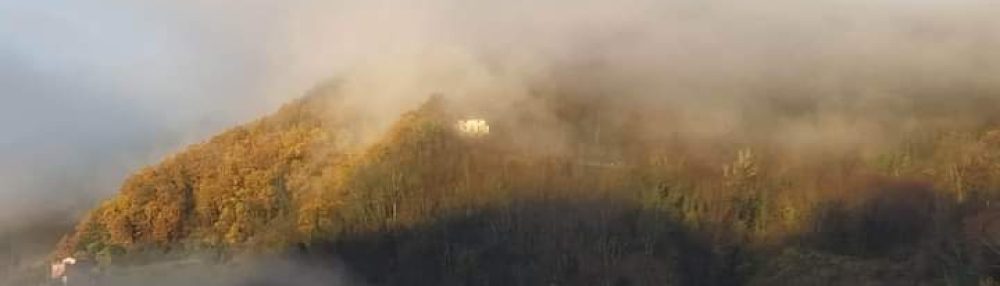
The aim on the last of the walks organised by the Comune of Bagni di Lucca was to get to the top of the town’s volcanic hill, the source of its medically beneficent hot springs, beginning from Ponte a Serraglio and then descending towards Villa.

We started from the garden of Villa Fiori; the first part of our walk covered sights that we’d already seen on a previous walk, this time organized by the Michel de Montaigne foundation and described here: https://longoio3.com/2020/07/29/how-pardini-beautified-ponte-a-serraglio/. These included Europe’s first purpose-built casino and the Bernabò baths, hopefully to be shortly opened to the public.


We took the footpath leading up to the ‘Terme’ Varraud, Bagni di Lucca’s main spa, named after the Frenchman who refurbished it in the last century.
The Terme comprise the original buildings which Napoleon’s sister, Elisa, princess of Lucca and Piombino used for her own therapy. The interiors were once prettily frescoed but unfortunately in the 1960’s – an era notorious for its insensitivity to heritage buildings, the decorations were largely destroyed or covered over by cement. A few details, however, remain, including this lovely set of bird representations and landscapes.


It was in this space that the original casino and its ballroom were situated; the takings of the gaming tables were used to subsidise thermal treatment for the poorer classes who could ill afford them. It’s nice to know that the casino originated not so much for profit but for philanthropy.

Virgilio, our guide, has been nicknamed the ‘prince’ of this demesne. Not only is he barman of the Terme but he is probably the most knowledgeable person on its history: anything Virgilio doesn’t know about the Terme is si mply not worth knowing.
Virgilio gave us a lively description of what it was like for high society when they disported themselves in the baths here during the nineteenth century. (Notice that the Terme were already open to all regardless of colour or creed).

Regrettably, the ‘grottine’, the naturally heated caves within the establishment, cannot at present be used because of the health crisis but the spa offers other facilities: mud baths and hydrotherapy (which my wife is currently availing herself of) among them.
We continued to the top of the hill where there is a hamlet appropriately called ‘Colle’.

There is also a building known as ‘Il Paretaio’ which means ‘bird trap’. Here there was once a scheme to erect a monument to the memory of the German poet Heine who loved Bagni di Lucca (particularly one of its women, a ballerina) and wrote extensively about it in his travelogue on Italy.

There’s a somewhat dodgy road going down from here to Villa but we took a much more romantic way: the ’via dell’amore’ or lover’s path, favoured by the likes of Byron and Shelley. I was amazed I’d never previously discovered this beautiful walk down to villa with its cool shades and stone benches. Anyway I’ll certainly add it to my favourite walks around Bagni.


Eventually we reached the old, upper part of the town which consists of a collection of noble mansions arranged around a central square. I’d already visited some of these previously: the Burlamacchi house, for example and the Casa Mansi which was once the former director of the British Institute of Florence, Ian Greenlees’, residence next to which until 2018 (when he died aged almost 102) lived Boccaccio authority, Sam Stych, friend of Greenlees and our friend too.


On one side of the piazzetta is the Bagno alla Villa which although refurbished, is still waiting for someone to administer and open it to the public.


Virgilio is chamberlain to the Vicaria della Val di Lima, a historical re-enactment society which has done much to enliven the atmosphere of Bagni di Lucca with its pageants and crossbow competitions. Its headquarters are in the sixteenth century villa Buonvisi, once the holiday residence of a noble Luccan family. The villa subsequently passed to the rich Scottish financier John Webb whose friend Lord Byron stayed here.


It’s lovely how the Vicaria have lavished care and brightened up the villa with its displays of flags, costumes and arms. Bagni di Lucca has some extraordinary but regrettably unused buildings and Villa Buonvisi is a great example of how they can be employed for the benefit of all those persons living in or visiting Bagni di Lucca.

Our visit ended with a look at the centre of town with its theatre, the Teatro Academico, and the suspension footbridge across the Lima. Here we parted from the main group who were booked for a meal at the nearby Tana Del Ghiro (‘Dormouse den’) restaurant. We had, however, previously booked with friends near Pescaglia so thanked Virgilio for a truly enjoyable walk which let us see familiar sight (and some new ones…) with a fresh pair of eyes.

These walks have been a highlight of this summer at Bagni di Lucca and I really look forwards to seeing them repeated next year when hopefully the wearing of masks will be a distant recollection!


