Of Vines and Olives

It’s not been the easiest of times for us two – indeed for all of us; a personal health crisis at the start of the year merged with the world health crisis brought by covid19. Even more disturbing is how time’s winged chariot seems to be pulled by ever faster steeds.

Difficulties in getting back to Italy have meant that we don’t have very much to show for in our field. Yet there are two crops which will ever survive – two items which sum up so much of Italy for me: grapes and olives.

Our vines climbing up the annexe to our house have been truly prodigious this year. Yet we have just been picking on them as a sort of dessert: we’ve never gone into wine-making although we have contributed to friends’ vendemmie (grape harvests).

When I was a kid and had already been on a couple of trips from the UK to Italy I tried to find the main reason why two European countries could have such differences between them. I suddenly blurted out ‘Italy has wine!’ ‘That’s right’, confirmed my mum. Of course, today England has some good vine growing areas particularly in Kent and Sussex but my childhood revelation continues to have some truth in it. Wine remains an essential tradition of Italian life in the way that it is not in the UK.

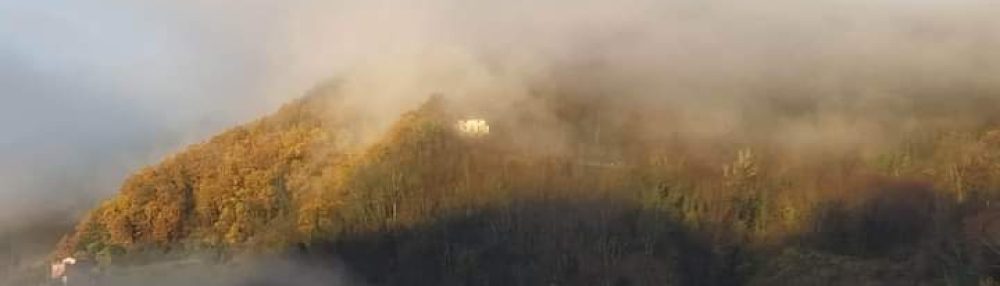
As for Olives several of those saplings I first planted in our field over ten years have matured into fine trees and carry their fruit with abundance this year. This is particularly heartening as it needs ten kilos of olives to produce one litre of oil.What more could one wish to have: a deep blue sky and truly warm sun around mid-day and one’s own little supply of olive trees while all around the warmth of late autumn colours embrace and the lenticular clouds above fascinate with their patterns.

It takes very little to make one happy in this world. Truly the best things in life are free – or rather they are impregnated with freedom, far away from those horrible restraints that the world (and oneself) is constantly trying to impose upon life’s essential being, particularly during this year. Liberty is there, truly, for the gathering, for the choosing….

It’s that time again in our part of the world: olive-picking time. In Longoio we are near the top height for growing olives (and vines) – 1750 feet. This year at least we’ve got something worth picking in our miniscule grove of twenty-odd trees.

If those of you living in northern climes think all this is irrelevant think again. There are now olive groves in southern England (see http://www.bbc.com/news/uk-england-kent-18551076 ) and, indeed, some London streets are lined with them (ever been down Islington’s Fife terrace?). Whether the fruit will be as succulent as that coming from the deep south of Europe is another matter of course…

Plant you own little olive tree and wait and see. The olive is a sacred tree redolent of peace and harmony and everything that can be said to be positive in our disquieting times. We’ll be back during the following weeks to collecting the fruit from this sacred tree whose oil was used to anoint kings and athletes in ancient Greece and which remains holy to this day for so many of life’s ceremonies.

At the Limits of Limano

Autumn, together with Spring, is our favourite time for walks. The summer heat has worn off and, particularly after the solstice of September 21 nature begins to assume a distinctively multi-coloured mantle: the chestnut trees ripen their fruits and the forest floors are dotted with a variety of mushrooms. Here’s a platter of mushrooms we managed to find the other day. Congratulations to my wife for her keen eye in locating the often elusive porcini (ceps).

It’s also a good time to revisit the various villages which comprise our comune of Bagni di Lucca

A few days ago we found ourselves in Limano on the northern side of the Lima River. It’s a delightfully peaceful place spread between two hills with a main square dividing its two halves.

First mentioned in a document of 893 AD as a village under the jurisdiction of Vico Pancellorum it became a feud of the Suffredinghi family and passed under Lucca’s rule in 1200.

We walked up Limano’s north hill and found ourselves before a chapel with a very well-kept garden and some amazingly good stone-work.

This is the oratory of Our Lady of Grace.  Dating from 1684 it is built in local limestone using material recovered from the old parish church which had been abandoned because of a landslide. I suspect this is why the stonework is so good; it may date from the eleventh century at the full height of the Romanesque style. The oratory is accessed through a portico supported by four columns and is covered with slate stone plates.

Inside, the effigy of the Madonna delle Grazie, the venerated patron saint of the town of Limano, is preserved.

We returned to the main square where, on the first of August, near the sixteenth century fountain, a festa with traditional country dancing takes place here.

The participants of the “Festa in Piazza Gave” sing and dance in characteristic costume, marking the occasion when shepherds traditionally came down from the mountain pastures to sell lambs.

In the latter half of the twentieth century the festival declined, but has happily been revived by the “Limano Nostro” association. I’ve said more about these festivities in my post at

https://longoio2.wordpress.com/2016/08/03/country-dancing-in-limanos-piazza-gave/

Limano’s southern hill is steeper than its northern neighbour and proceeds past the parish church of San Martino built in 1776 and renovated in 1908. Unfortunately the church was again closed during our visit but I am told the choir’s decoration, the work of Arturo Chelini, is worth looking at. Maybe next time?

At the top of the hill are the remains of the castle. Most of what’s left of it is incorporated into existing houses but there’s an area where a covered passage gives one a good idea of the former castle’s defences.

It’s near here that a friend has recently purchased a house with great views.

The hills were clothed with heavy mist and it began to rain, the first rain we’ve had for weeks. Autumn has clearly come! The following night came the big tempest – the night was alight with electric flashes and at one point the thunder shook the foundations of our house like an earthquake. I think that as much as the pure blue skies and the sunshine I would miss these dramatically operatic Italian storms if I returned to live in England!

Benvenuti!

We are back in Longoio at last. We were meant to be here in March but something called covid19 came along and we had to miss the bus…or rather the plane. Finally, after various cancellations we managed to get O’Leary to transport us to Pisa. The journey, despite our fears, was quite safe with a whole seat row to ourselves.

Landing in Italy we were immediately set face-to-face, or rather mask-to-mask, with a clearer and more distinctive approach to the health crisis. So many more people, officials and public, were donning masks, hand sanitisers were placed everywhere and public information notices were prominently displayed. I, somehow, felt safer although I think anyone would feel the same after leaving the worst affected borough in London, Brent, with over two thousand deaths so far.

The Italian summer does help. The temperature difference from our place in the UK and our place in Italy approached 20 degrees! Mediterranean cafe society, with its open air arrangement of socially distanced tables and chairs, is a palliative too.

We took the train from Pisa di Bagni di Lucca where our Panda 4 x 4 was parked. Trusty as ever it started, after lying idle for over four months, at the first turn of the ignition. Of course, I had disconnected the battery before leaving Italy in February.

We found our house in very reasonable shape. No major storm had damaged the roof and no surrounding trees were down. Most of our geraniums were again flourishing although the lawn left something to be desired; rain had been lacking.


Most important of all we found our quintet of cats, Carlotta, Cheekie, Corneglia, Nerina and our latest arrival Archie in excellent form and still able to remember us! This happy fact was clearly due to the efforts of two friends, one from Guzzano and the other from Longoio, who visited, cuddled and, most importantly, fed our feline family.
It’s been hot, though not intolerably so, since our arrival three weeks ago.


However, there has recently been one day when the heavens wreaked their wrath upon over us with the strength of a breached sky-dam: a typical ‘bomba d’acqua’ or water bomb, as they are called here, worryingly reflecting the alterations in weather patterns today. This is what I said about it:

“As I write a terrible storm is pouring its vengeance upon the normally blue skies of an Italian summer. The wind is angry upon the hill our little village is poised. The rain is pelting down at a rattling machine gun rate. It turns in an instance into hail. Hail just when the season is heading towards its warmest holiday patch,’ferragosto August the fifteenth. The whole earth is rumbling continuously. It’s almost like an earthquake (we’ve had a few of those here too…).

DSCN1064

There’s no respite. The soil breaks asunder. The birds and cicadas are no longer heard in this pandemonium of the elements. Like searchlights in a concentration camp flashes of lightning follow the incessant noise reverberating round and round our usually peaceful and verdant valley. If any wonder at the violence of the storm sequence in Vivaldi’s Summer from his ‘Four Seasons’ then here is the proof. The heavens are terrifying. The wind is blowing the branches and transforming them into the hands of supplicating victims begging for mercy. When will it end? When will the catastrophic interlude end?

DSCN1073~2

When will we have our festive sunny season back? Why now! In an instant the irritated giants whose gnashing scared both the living and the dead have retreated. The clouds are parting to reveal a timid pallid blue and are shedding their menacing dark grey pallour. We can at last see and relive the harmony and the heat of this country’s summer without temerity, without dodging the lighting flashes, without hiding, like our cats, into the comforting folds of a bed. Yes this is Italy: a country that breeds extremes, that justifies them. For for every beam of golden light clearing its way through the azure skies there is the warning of the elements, For every invitation to love and caresses there is the terror of darkness, and violence breeds in the very heart in this land of fables and desires.”

DSCN0997~2


Shepherds’ Delight

A new footpath, the ‘alta via dei pastori’ (the shepherds’ high way), was officially inaugurated at San Cassiano di Controni last Saturday in the presence of a considerable audience. Speeches were made by various key figures in the project including Aldo Lanini of ‘Pegaso trekking’, Roberto Ragghianti of Jurassic Mountain Bikes association, David Bonaventuri, photographer, and Bagni’s Mayor Michelini. Although the Italian habit of delivering a host of speeches inaugurating events can become tiresome I have to say that this time the speeches were very informative and gave an excellent picture of the considerable project which has been finally realised.


The noticeboard at the start of the footpath was then unveiled. It’s in both Italian and English (translated by Paul Anthony Davies, professional photographer and major participant in several projects at San Cassiano where he resides). As you can see from the map the footpath is an ‘anello’, or a ring route, which is best done in a clockwise direction. Most of us know the way to the top of the Prato Fiorito – the lovely whale-backed mountain lording it over Bagni di Lucca and the Controneria – from Foce al Lago, where the Cross has recently been excellently restored by local firm, Fontanelli. 1However, the new shepherds’’ highway shows a different aspect of the mountain from the usual picture one has of it as opening out on extensive turfed expanses. In fact, the Prato Fiorito has large tracts of rugged dolomitic rock formation with some very alpine flora indeed.


Today, an inordinate amount of rain has prevented us, not only from tackling the Prato Fiorito but also from attending the ‘Palio dei Micci’ at Querceta, one of Tuscany’s major events; a pageantry of mediaeval and renaissance costumes with flag-waving acrobatics from the ‘sbandieratori’ announcing the six-circuit race of the ‘micci’, local dialect term for donkeys. Indeed, the Palio is an elaborate Italian take on the traditional English ‘donkey derby’. Regrettably, the rain washed away one full year of preparations and we could only enjoy the Palio dei micci by viewing the film made by our local station, NOI TV, last year.

Here it is:

The good news is that the Palio dei Micci was only postponed and it will take place next Sunday from 10.00 with the main race at 16.00.

A week of improved weather is promised and, I am sure, we will decide to explore those sections of the Alta via dei pastori’ which we have not yet traversed. A future post will illustrate our trek, no doubt.

In the meanwhile you can read all about the Prato Fiorito, its satanic rites and its inspiration for Shelley in my posts  at:

https://longoio.wordpress.com/2013/06/22/bewitching-flowering-meadow/

https://longoio.wordpress.com/2013/07/01/druids-witches-hot-coals-and-a-tug-of-war/

https://longoio.wordpress.com/2013/06/07/the-elysian-fields-of-prato-fiorito/

https://longoio2.wordpress.com/2015/07/07/witches-sabbath/

https://longoio2.wordpress.com/2016/05/08/a-perfect-shelleyan-day/

https://longoio2.wordpress.com/2016/05/17/if-there-is-a-heaven-it-is-here/

https://longoio2.wordpress.com/2017/05/18/elysium-on-earth/

https://longoio3.com/2018/02/17/an-icy-walk-in-the-appennines/

https://longoio3.com/2018/05/18/bagni-di-luccas-elysian-fields/

https://longoio3.com/2018/06/24/did-lord-byron-vandalise-our-prato-fiorito/

https://longoio3.com/2019/05/01/the-shepherds-high-way/

image000402

We are certainly not going to miss out on the dazzling display of jonquils which are due out this month!

image000235

Of Christmas Trees and Christmas Cribs

The Italian politician Giorgia Meloni recently issued a video in which she proclaims herself a ‘presepista’ (a Christmas crib supporter) rather than an ‘alberista’ (or Christmas tree supporter). Giorgia goes on to say that there should be no excuses for multi-ethnic schools banning Christmas cribs on the ground that they might ‘offend’ those pupils who have not been brought up in the Roman Catholic tradition.

Although I have absolutely no sympathy with Meloni’s political views – she is a founder member of the very right-wing ‘Fratelli d’Italia’ – I do agree with her on this point. Italy is a culture built upon two thousand years of Christian, specifically Catholic, tradition. Whether one believes in the Virgin birth or not is quite irrelevant. To outlaw the Christmas crib in schools is like defying values, customs, credence, mores, and the fabric of western civilization itself which have made Italy what it is today, for better or worse.

In the largely Protestant north, where the making of a Christmas crib is not nearly as prevalent as in the Catholic south of Europe, such a ban would be tantamount to prohibiting Nativity plays.

Fanatics could extend this further and consider excluding performances of ‘The Messiah’ because not all choir members and audiences are practising Christians or indeed, the presentation of any of the great sung Masses by the likes of Palestrina, Bach, Mozart and Beethoven.

The fact is that all these traditions, art-works, performances, presentations, rituals form an essential, often unconsciously practised, part of our way of life where we live on this beautiful, but sadly abused, blue planet.

I am reminded of the uproar caused by the renaming of Christmas time as ‘Winterval’ by Birmingham council some years ago. In the community college I taught at as a lecturer the principal decided that the presence of the Christmas tree should be abolished from the foyer as it might offend people of other cultures. Ironically, the first person to complain about this ban at my college was the receptionist who was Indian-Hindu and the Christmas tree was soon returned to its rightful place!

Integration in today’s world means respect for each community’s positive traditions. Indeed, it is these positive traditions which show us the light to guide us the way to a more tolerant, free and open-minded world.

So it was two thousand years ago when a great star led the Wise Men to the birth of a baby in a manger in a town which, so sadly today, needs tolerance, love and hope.

BTW If you still haven’t been to a Christmas crib in our area, whether living or even mechanical, there’s still a chance. For more details check out the ‘Valley of the Christmas Cribs’ FB page at:

https://www.facebook.com/valledeipresepi/

PS I believe, at home, in both the Christmas tree and the Christmas crib. Carlotta agrees!

Home movie follows:

Finally, may we take this opportunity to wish you wherever you are, however you are, whatever you believe in…

Buon Natale e Felice Anno Nuovo!

Merry Christmas and a Happy New Year!


Living One’s Christmas

One December day has followed another with ever more gloriously blue skies. However, we are now due for a change with night temperatures down to minus 4 and the real possibility of snow during the day.  So let’s stock up our larder with all the Christmas goodies that are coming our way including panforte, panettone, and loads of chocolate. Let us also remember to buy something more to donate to those in need (both of the two-legged and four-legged variety.)

Fornoli square  has the right idea:


And Tuodi has too.

Image00002

There will, no doubt, be other collection points:

Also at Tuodi (which is on the way from Fornoli to Fornaci di Barga) there are ecologically minded discounts on food which are near their sell-by date. It’s crazy to think that in many instances over half the food on sale in supermarkets eventually finds its way to land-fill sites!

Image00001

Don’t forget these two unmissable events.

The first is the traditional Bagni di Lucca Christmas Concert at the library (former Anglican Church) which is this 13th December. There are still a few places left (booking is essential) and there will be an entrance donation of euros five which will go to the restoration of the Bagni di Lucca protestant cemetery.


The second is yet another living crib. This time it’s at Ghivizzano. I can vouch for the excellence of this Christmas nativity!


Hope you’ve got your Christmas together. Ours is getting there thanks to Carlotta…


Suspense in Val di Lima…

Recently I was asked by friends for suitable places and activities for their three year old grandchild’s forthcoming visit.

Of course, the big event in our area for children of all ages is the ‘paese dei balocchi’, running on the week-end from 22 to 23 of this month, in which Bagni di Lucca gets transformed into a giant toytown for children of all ages, with treasure hunts, the fairy’s parlour, face painting, street bands and theatre, the invisible man and so forth.

il-paese-22-settembre981510449.jpg
Unfortunately, the little one was unable to attend Toyland, and so I settled on the standard list of Collodi’s Pinocchio Park, Pistoia zoo, the playground at Villa and, generally, just enjoying the special natural ambience of our area.

One place was mentioned and the other day I checked out the suitability of taking a three year old across one of the world’s longest pedestrian suspension bridges. (The longest, incidentally, is the 494 metre Charles Kuonen bridge opened in Switzerland in 2017).

The ‘ponte sospeso delle ferriere’ (suspension bridge of the iron foundries) is a pedestrian walkway that connects the two sides of the Lima torrent between Mammiano Basso and Popiglio in the municipality of San Marcello Piteglio.

It rests on four steel cables and measures 227 metres in length, 36 meters maximum height above the river bed and and is 80 cm wide. In 1990 it was included in the Guinness Book of Records as “the longest pedestrian suspension bridge in the world”. That is, until the Swiss got in on the act…

dscn2448_11889746503.jpg

Inaugurated in June 1923, the bridge was built following the design of ​​Vincenzo Douglas Scotti, Count of San Giorgio della Scala, and director of the Mammiano Basso steel mill. It allowed worker from Popiglio, on the other side of the Lima valley, to get the factories without having to walk a further five miles to reach the workplace.

Count Vincenzo Douglas Scotti (of Scottish ancestry) commissioned Filiberto Ducceschi, who was responsible for the construction of the cables, while the masonry and support work were entrusted to Cesare Vannucci.

Work began in 1920 with the help of some thirty workers, who anchored the cables. At this point it was possible to create a pedestrian walkway, consisting of planks and metal nets hinged to the supporting structure, which connected the two opposite banks of the Lima river without any intermediate support.

dscn2451_1-128071945.jpg

However, after the mills closed down the bridge took on a new function as a thrilling tourist attraction. It has undergone important maintenance and consolidation over the years, the latest being in 2004, which have made the bridge more stable and resistant through the complete replacement of cables, side bolts, walkways and protections, with stronger and lighter material.

Spectacular LED Bridge lighting was inaugurated in 2014.

My approach to the bridge was enhanced by an elegantly laid garden path:


The bridge did sway a bit but I think this was due more to a group of excited young children than any climatological condition!

As for the bridge’s suitability for three year olds: no problem. The youngest traverser of the bridge we met was just two and a half years old!