Bagni in Carshalton: A South London Echo of Tuscany

There are unexpected connections between places that appear, at first sight, to have little in common. One such connection links the green suburbs of South London with the historic Tuscan spa town of Bagni di Lucca, where I have lived for many years.

The link was discovered not through grand historical events, but through water, gardens and the shared idea that a beautiful landscape can provide an escape from the pressures of everyday life.

During London’s Open House weekend, I spent a memorable afternoon exploring Carshalton, a historic village-like corner of South London whose springs, ponds and elegant eighteenth-century landscape revealed a surprising resemblance to my adopted home in Tuscany.

Among the treasures of the Carshalton estate are the water tower and the remarkable eighteenth-century “bagnio”, or plunge bath, created by John Fellowes, a wealthy merchant who made and later lost a fortune during the South Sea Bubble of 1720. The estate also contains an orangery, a Gothic-style hermitage, a picturesque bridge, a village pond and charming cottages.

(Plunge baths of Carshalton and Bagni di Lucca compared).

The bagnio immediately brought memories of Bagni di Lucca. The Italian town’s fame has always been based on its thermal waters, which attracted visitors from across Europe, including many British travellers during the eighteenth and nineteenth centuries. Carshalton’s springs, however, provide a very different bathing experience: the water is naturally supplied but considerably colder than the warm thermal waters of Tuscany.

One wonders how eighteenth-century visitors, perhaps returning from their Grand Tours of Italy, regarded this more modest English version of a bathing retreat. Did they appreciate the refreshing waters of Carshalton after experiencing the famous spas of Europe? Or did they simply come for the social pleasures that such estates offered — conversation, cards, music and good company?

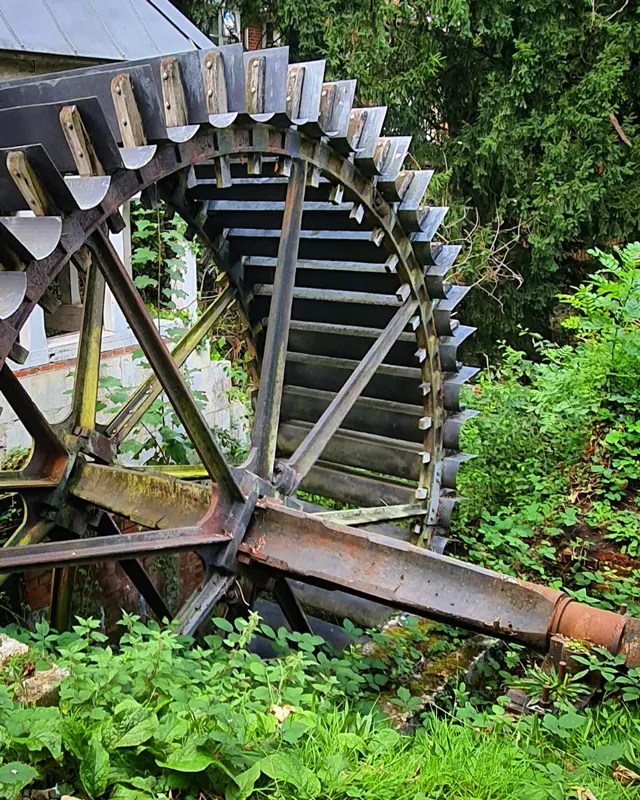
One of the most fascinating details of the Carshalton bagnio is the old water wheel which once supplied the bath. It is a reminder that behind the elegance of these pleasure gardens there was a practical engineering system designed to make leisure possible.
The surrounding landscape was carefully created for enjoyment. The lake was based on an earlier formal canal designed by the landscape architect Charles Bridgeman, while the Gothic hermitage reflected the eighteenth-century taste for picturesque “ruins” and romantic garden features. Whether or not a hermit ever lived there is uncertain, but the building later took on a different character when it became associated with the Catholic schools occupying the estate.

The bridge, too, is a charming illusion — a “sham bridge” which functions as a dam rather than a crossing over flowing water. Yet its purpose is not practicality but beauty, adding to the atmosphere of the place.

The survival of these features owes much to the dedication of local volunteers who have helped preserve Carshalton’s unique heritage. Today the water tower and its rooms continue to provide a setting for events and even period film productions, allowing new generations to experience a small corner of eighteenth-century leisure.

Carshalton and Bagni di Lucca are separated by hundreds of miles, different landscapes and very different histories. One is a South London village shaped by springs and gardens; the other is a Tuscan spa town surrounded by mountains and thermal waters. Yet both express the same idea: that water, nature and beauty can transform a place into somewhere special.

Perhaps that is why, while walking beside the ponds of Carshalton, I felt a surprising familiarity. For a moment, South London seemed to contain a small echo of Tuscany — a little “Bagni” of its own.

(Entrance to Carshalton Baths and Bagni di Lucca Bernabo bath).

***

If you enjoyed this post, please consider clicking the Like button or leaving a comment. It lets me know that my writing is reaching people.

Eclipsing


All the fuss about the (in Italy and the UK partisl) solar eclipse yesterday got me thinking about eclipses generally — and, more particularly, about how many total solar eclipses I have actually witnessed during my lifetime.
The answer is rather disappointing.
I was born on 8 August 1948, and in all those 78 years I have actually witnessed only one total solar eclipse.That was the famous one in England on 11 August 1999 three days after my 51st birthday.
I went all the way down to Land’s End by motorbike, expecting to witness one of the great spectacles of nature.


And I saw virtually nothing.
It was completely under cloud. All I really saw was the light changing and the sky becoming strangely dark before returning to normal. It was still impressive to experience the middle of the day suddenly becoming something quite different, but my wife, Sandra, who had sensibly stayed in London, had a much better experience. She actually saw the eclipse and told me afterwards that it was absolutely stunning especially as she viewed it using the special telescope our neighbours had.
Still, my journey to Cornwall wasn’t entirely wasted. I met an old friend from school and university at his place near Tallerton, and I also managed to visit Jane Austen’s house. So I got something out of the expedition, even if the eclipse itself remained hidden behind the Cornish clouds.
There was, of course, another total eclipse during my lifetime which was visible from Italy, on 15 February 1961. I was in England at school at Dulwich College.
It was, however, a partial eclipse in England, and I do remember being warned about it at morning assembly. We were told not to look directly at the Sun, even during a partial eclipse, because we could damage our eyes. Perhaps it was because it occurred so early in the morning that it was not so immediately noticeable but 95% of the sun was covered by the moon in south-east London, where I lived at the time.

In 2015 I witnessed a partial eclipse in my part of italy. It started at 9.23 am reached its maximum coverage of the sun, which was 60.1%, at 10.31 and ended at 11.43. The local astronomical society of Lucca set up a telescope on the city walls from which this picture was taken:

eclissex200_800_800


A primary-school friend of mine, talking about yesterday’s eclipse, said that she was going to watch it from her beach hut, using a colander and a piece of blank paper to project the image of the Sun. Yesterday, however, was not a great eclipse for us here. There had been a violent storm and a great deal of rain, which was actually very welcome, but the clouds subsequently covered the sky.
There was another problem. The Sun was already quite low in the sky. I’ve always thought that if you’re going to have an eclipse, the best time to have it is at high noon not just before sunset! The magic is in the contrast between brilliant daylight and the sudden transformation of the landscape.
And this is what makes eclipses so fascinating.
For ancient peoples, an eclipse must have been absolutely terrifying. The Sun was the great certainty of existence. Every morning it rose and every evening it set. And suddenly, for no apparent reason, it disappeared.
Today we know exactly what is happening. We can calculate an eclipse centuries in advance. But knowing what is going to happen doesn’t necessarily make it less extraordinary. I first leaned how eclipses both solar and moon work from collecting my Brooke Bond PG tips cards.


There is something deeply unsettling about seeing the natural order of things temporarily suspended.
I remember one of those wonderful adventure films in which the intrepid European explorer finds himself in the middle of Africa, surrounded by hostile natives who are threatening to put him into a cooking pot. He knows from his astronomical calculations that an eclipse is about to occur.
So he announces that he is God and that he is going to cover the Sun.
And, sure enough, at precisely the predicted moment, the Sun disappears.
Suddenly the explorer is no longer the helpless foreigner surrounded by cannibals. He has become a supernatural being with the power to extinguish the Sun itself.
It’s a wonderful cinematic idea — and it is based on something that really happened. Christopher Columbus famously used his knowledge of a predicted lunar eclipse in 1504 to frighten the indigenous people of Jamaica. Knowledge of astronomy becomes a form of power.
But there is another film in which the eclipse has a much more profound significance: Michelangelo Antonioni’s extraordinary L’Eclisse.


Antonioni means rather more to me than simply being a great film director, because I have a personal connection with him through another of his films, Blow-Up.
When I was working at Woolwich College, I used to go to the park opposite the college — Maryon Park. The first time I went there I experienced a very strong sense of déjà vu. I had never been there before, but I knew I had seen it.
Then I realised: I had seen it in a film.
I asked the park keeper, because they still had park keepers in those days, and he told me that Michelangelo Antonioni had been there and had filmed Blow-Up in the park.
And suddenly the pieces fell into place.
There were the steps where Vanessa Redgrave had walked down. And over there was the place where the mysterious body had supposedly been found.


Antonioni had made some changes, of course. He had put up false façades and altered various things for the film. But this was unmistakably the park from Blow-Up.
It was an extraordinary discovery — to find yourself physically standing inside a film that you had watched.
And it makes me see L’Eclisse in a slightly different way.
In L’Eclisse, Antonioni uses the disappearance of the Sun behind the Moon as a metaphor for a society undergoing enormous change.
Italy in the early 1960s was moving away from the traditional, patriarchal, Catholic society of the past – a society where my then teenage wife was remonstrated for riding a moped as being unladylike – towards something much more modern, individualistic and socially liberated. The old certainties were beginning to disappear.
And the same kind of transformation was taking place in Britain.
The respectable, rather buttoned-up Britain of bowler hats, businessmen and commuters was giving way to the extraordinary social revolution of the 1960s — the young people, the sexual revolution, flower power, new music, new fashions and a completely different attitude towards society.
And Antonioni was perfectly placed to capture this kind of transformation.
In L’Eclisse, something happens to the Sun.
In Blow-Up, something happens to a body.
In both films, something that should be there suddenly becomes uncertain, mysterious and almost impossible to grasp.
In Blow-Up, the photographer believes he has discovered a murder in the park. He enlarges his photographs again and again, trying to discover the truth. But the more he enlarges the photograph, the less certain reality becomes.
The body itself seems to disappear.
And in L’Eclisse, the eclipse similarly takes something perfectly familiar — the Sun — and makes it suddenly strange and unknowable.
This is perhaps what makes Antonioni such a great director. He wasn’t simply making films about individual people. He was making films about societies in the process of changing, and about what happens to human beings when the world around them changes faster than they can understand.
And he continued this exploration in Zabriskie Point, his extraordinary excursion into America and the counterculture of the late 1960s.
So perhaps there is a connection between my rather disappointing experience at Land’s End in 1999 and my fascination with Antonioni.
I went to see an eclipse and found that the most important thing was what I couldn’t see.
And years earlier, in Maryon Park, Antonioni had made a film about a man who thinks he has seen something — a murder — and then finds that the more closely he looks, the more uncertain everything becomes.
In both cases, the missing thing becomes more important than the thing that is actually there.
Perhaps that is what an eclipse really represents.
It isn’t simply the Moon passing in front of the Sun.
It is the temporary disappearance of something we thought was permanent.
And perhaps that is why eclipses have fascinated human beings for thousands of years — and why they have fascinated artists and filmmakers too.
The world changes.
The old certainties disappear.
And for a moment we are left looking at the space where something used to be.

The above photo of yesterdays eclipse was taken by Aldo Lanini’s expedition to Monte Matanna in nearby Garfagnana. Acknowledgements to Aldo for allowing me to reproduce it here.

***


If you enjoyed this post, please consider clicking the Like button or leaving a comment. It lets me know that my writing is reaching people.

Rothko: The Experience of Colour


Rothko said that a painting is not just the visual representation of an experience, or even a record of an experience. A painting is the experience itself.
I had never really thought of Rothko as anything more than a bit of a dabbler in colour. I knew the paintings, of course, and I knew the name, but somehow I had never really got Rothko. Clearly, there was much more to him than that. There certainly was.
And so, during our little stay in Florence, we managed to catch the last few days of the exhibition devoted to this artist. And I have to say, I came out of it thinking: what an absolute artist he was.
He really did make you experience what he painted.
And it was all to do with colour. Colour and colour.
After all, if there is no colour, there is no painting. That is the basic thing.
I still couldn’t quite decide whether Rothko was a minimalist painter or whether that was completely the wrong way of looking at him. But frankly, it didn’t matter. I thoroughly enjoyed the exhibition. And it was a very enjoyable exhibition, because it took you right through from the beginnings to the end, and you could actually see how this extraordinary artist developed from his pre-war works.


And I began to realise what an incredible person he was.
He came from a Russian-Jewish family. His parents escaped from a period of terrible hardship and came to America. And then, at some stage in his life, Rothko decided that he wanted to become a painter and an artist.
But he wasn’t somebody who had gone through the normal artistic discipline. He didn’t attend an art college. He didn’t have some great academic training behind him.
He more or less did it himself.
And he developed this incredible fixation with painting.
That fixation was already there in his earlier work, when he was painting urban scenes and the world around him. And some of those early paintings I found very interesting. There was something almost Delaunay-like about them. Robert Delaunay, I mean. I suspect that he may well have come across Delaunay at some point.
But then it all happened after the war.
That was when Rothko really began to find his true oeuvre, if that’s the right word. He began to paint these extraordinary paintings which we now immediately recognise as Rothko.
And people call them abstractions.
I’m not sure they are.
There are no people in them. There are no landscapes. There isn’t anything that you can actually identify as a particular object. But I don’t think they are simply abstract paintings.
They are experiential paintings.
The whole object is that you can only really appreciate a Rothko by standing in front of it. You have to stop thinking about everything else. You almost have to clear your mind.
It’s almost like meditation.
And then you enter this amazing universe of colour that he presents you with.
And what amazed me was that the colour actually seemed to move.
In the earlier paintings, with all those wonderful reds and oranges and yellows, particularly the yellows, I could actually see the colour moving in front of me. It was almost like a symphony.


It really was a symphony.
Each colour was separate, absolutely separate, and yet somehow it belonged to the colour next to it. There were these edges, these borders, almost as if one colour was tagged on to the next.
And it was incredible.
Then you moved on from that rather bright period — almost a happy period, I would say — into the development of the greens and the blues.


And suddenly it became more serious.
The green and blue entered into the paintings and it became much more of a dialectic between colour and space.
Because there is a lot of space in Rothko.
And that was another thing I found so fascinating: the spatial aspect of his paintings.
The painting almost became an architecture of colour.
And I think that is where his interest in murals becomes so important. He began thinking about paintings on a much larger scale, paintings that would surround you and become an environment rather than simply something hanging on a wall.
And then, of course, there is Italy.
Rothko became very interested in Italian art. He was particularly fascinated by Fra Angelico and the paintings at San Marco in Florence. And he felt a real kinship with Michelangelo.
Especially, I think, with Michelangelo’s Laurentian Library.
There is something very strange about that architecture. The windows are cut off from the normal light, and yet there is light. There is light in the space.
And somehow Rothko understood that.
He could take something that came from Michelangelo and turn it into something which, on the surface, looked completely different.
But then, I suppose, that is what artists do.
We’re all influenced by other artists. We see something in somebody else and, in our own little way, we take it and produce our own interpretation.
Rothko’s interpretation was phenomenal.
And then we came to the final part of the exhibition.
And this was where it became very emotional for me.
Rothko’s life had been blighted by depression, alcoholism and health problems. And by the end, the paintings had become very different.
The last paintings, particularly those with the grey bordering onto the black, were extraordinarily powerful.
I just sat in front of them.
And I was completely bowled over.


There was something about them which went beyond the actual painting. You weren’t simply looking at grey and black. You were somehow experiencing something.
And that brought me back to what Rothko had said in the first place.
A painting isn’t a representation of an experience.
It is the experience itself.
I think I finally understood that.
And then came the shock.
I hadn’t realised that Rothko had taken his own life.
I knew that he had suffered from depression, but I hadn’t really understood the extent of it. And discovering that at the end of this extraordinary journey through his paintings was a very big shock.
But then, perhaps, I could understand why.
I have known people who have been destroyed by depression. Rothko was, in the end, destroyed by it too.
And yet he produced all this extraordinary work.
And he died so young.
He was only 66. And for somebody of our age, 66 seems terribly young. He died more than half a century ago, and yet here we are, standing in front of his paintings in Florence, and they still have the power to affect us.
That, for me, is extraordinary.
I went into the exhibition thinking that Rothko was perhaps somebody who painted large coloured rectangles.
I came out thinking that he was one of the most extraordinary painters I had ever encountered.
Because he didn’t simply give us colour.
He gave us the experience of colour.
He gave us space, composition, light and darkness. He gave us paint itself in its most fundamental and minimalist form.
And somehow, from those very simple ingredients, he created something enormous.
I really am so pleased that we managed to experience those last few days of the Rothko exhibition in Florence.
And full praise to the organisers, because it was beautifully put together. It took you right through his life and his development, and allowed you to see how he arrived at those final, extraordinary paintings.
I didn’t think I understood Rothko.
Perhaps I still don’t.
But I experienced him.
And I’m very glad I did.

***
If you enjoyed this post, please consider clicking the Like button or leaving a comment. It lets me know that my writing is reaching people.

From Himalayan Gods to Italian Saints


There are some experiences in life which you don’t fully understand when they happen. They simply lodge themselves somewhere in your memory, and years — sometimes decades — later, something happens which suddenly makes them fall into place.
For me, one of those experiences happened in the summer of 1974, in the Himalayas.
I was twenty-six years old and had travelled to a remote village called Jabbal with three other people: Eva Skalla, Romilly Gregory and Peter Sutherland. We were there to make a film about village life.
At the time, I had no idea that the experience would remain with me for more than fifty years. Nor could I have imagined that Peter, the quiet Englishman of about my own age who was travelling with us, would eventually become an anthropologist and spend much of his academic career studying the very religious world we were encountering.
And I certainly never imagined that, after eventually settling in Tuscany, I would one day look at the little villages around Bagni di Lucca and think:
This is strangely familiar.
Not the religion. Not the gods. Not the theology.
Something deeper: the relationship between a community, its sacred figure and its land.


Jabbal, 1974
Jabbal was a very remote place, high in the Pabbar Valley of Himachal Pradesh, around 8,000 feet above sea level. In those days it was several hours’ walk from the nearest road.
For a young Englishman in his twenties, it was an extraordinary place to find oneself.
We had gone there to make a film. I don’t remember thinking of ourselves as anthropologists. We were simply interested in people and in trying to record something of their lives. We carried our equipment into a world which seemed impossibly distant from Britain.
The houses, the landscape, the people and the customs were all unfamiliar.


But what has stayed with me most strongly is not a particular house or landscape.
It is the gods.


The devtas
In the Western Himalayas, villages traditionally have their own local deities, known as devtas.
I remember seeing them carried in great palanquins. The palanquin was supported on poles carried by men, and around the central structure were masks and other sacred objects.
There was something extraordinary about the sight. The deity wasn’t sitting quietly inside a temple. It was being brought out into the world.


And then there were the encounters between different devtas.
I remember seeing two palanquins come together, with the men carrying them beginning to push and jostle. To someone from Britain, it was almost surreal.
Why were they doing this?
Was it a game? A ritual? Some ancient form of theatre?
At the time, I didn’t know. I certainly didn’t have the anthropological vocabulary to explain it.
I simply knew that something important was happening. At that stage Peter was not yet the anthropologist he would later become; his early professional background was connected with architecture and architectural photography.
Like people often do, we eventually went our separate ways and I lost touch with the details of his career.
Then, many years later, I discovered what Peter had become.
He had studied anthropology at Oxford and written an enormous doctoral thesis, Travelling Gods and Government by Deity, about the Western Himalayas.
And suddenly the memory of those palanquins came back to me.
Peter used the phrase devta kā rāj — “government by the deity.”
It was an extraordinary phrase because it suggested that what we had witnessed in Jabbal was not simply religion.
The devta was not merely a god to whom people prayed. The deity could have authority over the community, become involved in disputes and decisions, and have attendants, institutions, territory and relationships with other gods.
The village was, in a sense, the god’s kingdom.
And suddenly those palanquins seemed much less mysterious.


The meeting of the gods.
One devta was carried into the presence of another. The two palanquins came together. The bearers pushed and jostled.
What if I hadn’t been watching two religious objects being carried around?
What if I had been watching two communities meeting through their gods?
The god wasn’t simply an object of worship. The god represented a community and its territory.
The meeting of gods could therefore reflect the relationship between the communities themselves.
The gods were, in a sense, the political actors.


Fast-forward several decades.
I eventually came to live in Tuscany, in the mountains around Bagni di Lucca. Here I encountered something which at first seemed completely unrelated.


The Italian village.
Every little village has its church. Many have their patron saint, their particular Madonna, their feast day and their traditions passed down through generations.
The saint is not simply a saint.
The villagers speak of their saint.
Their Madonna. Their church. Their festa.
And I began to realise how powerful this sense of ownership and belonging could be.
Take a typical village festa.
The church is decorated. People return to the village. Families who have moved away come back for the occasion. There is food, music and conversation.
Then the statue comes out.
Men carry the saint through the streets.
The sacred figure leaves the church and enters the territory of the village. For a few hours, the whole community gathers around it.
It is certainly a religious ceremony. But it is also the village declaring itself.

And this was where I began to see the strange connection with Jabbal.
In both worlds, a sacred figure is closely associated with a particular community and a particular place. In both, the figure is brought out during festivals and physically carried through the landscape by members of the community.
But there is a crucial difference.


The patron and the sovereign
The Italian saint is a patron.
The Himalayan devta can be a ruler.
That distinction is enormously important.
If a Tuscan village has San Rocco as its patron, the Catholic understanding is that San Rocco is a saint in Heaven who intercedes with God on behalf of the community. The saint protects the village and is loved and honoured.
But he isn’t normally regarded as its political ruler.
The Himalayan devta can be something quite different.
Devta kā rāj — government by deity — suggests that the god can actually exercise authority. The deity can be involved in decisions and disputes and in relationships between communities. The god has a territory and can have political as well as religious significance.
Put very simply:
The Italian saint is a patron.
The Himalayan devta can be a sovereign.


The bearers
The more I thought about this, the more the men carrying the palanquins came back to me.
I have watched Italian processions in which men carry the statue of a saint through the streets. They are not simply transporting a heavy object. They are performing a communal act: carrying their saint through their own village.
But the Himalayan version takes this a step further.
The movement of the devta’s palanquin can be understood as expressing the deity’s own will. The people carry the god, but the god can also be understood as acting through the people.
That makes the ceremony much more unpredictable.
Perhaps it also helps explain those extraordinary moments I saw in 1974 when two palanquins seemed to struggle against one another.
If the devta is a political and territorial power, then the confrontation between two devtas is potentially a confrontation between two sacred communities.
It is almost as though the villages themselves have come face to face.


“Our”
There is another small word which connects the two worlds:
our.
Our saint.
Our Madonna.
Our church.
Our festa.
Our village.
And, in the Himalayas:
Our devta.
It is a small word, but it says a great deal. The sacred figure becomes a focus for belonging. It tells people that they are part of a particular community and that the community has a particular place.
The festival renews that relationship. People return, the procession takes place, the sacred figure comes out and the village gathers.
The community sees itself.
What I was really seeing in Jabbal
When I look back now, I realise that in 1974 I was probably looking at something much more profound than I understood at the time.
I thought we were making a film about a remote Himalayan village.
And we were.
But we were also witnessing a system in which religion, politics, geography and community were almost impossible to separate.
The god was part of the social order. The god belonged to the land. The people belonged to the god. The relationship was continually renewed through ritual.
Peter later gave this a scholarly language:
Government by deity.
At the time, all I had was the experience itself — the mountains, the village, the people, the palanquins, the masks and the extraordinary physical movement of the gods.
And the feeling that I was watching something which mattered enormously to the people around me, even if I didn’t understand why.


Fifty years later
What makes all this particularly strange for me is that I now live in another landscape where the relationship between village and sacred figure is still very much alive.
In the Tuscan mountains, little villages still have their churches, patron saints, Madonnas and festas. There are processions and statues carried through the streets. Families return for festivals, and the village briefly gathers around something that belongs to all of them.
There is still that powerful sense of: “This is ours”.
So I have ended up, rather unexpectedly, with a personal comparison between two worlds which I never imagined would have anything to do with each other.
In 1974 I was walking through the Himalayas with a young man who would eventually become an anthropologist of the devtas.
Decades later I found myself living among the saints of the Tuscan villages.


And now, looking backwards, I see something which I completely failed to see at the time.
The religions are different.
The histories are different.
The theology is different.
But perhaps the human need is remarkably similar.
A village is not simply a collection of houses. It is a community with a history, a territory and memories. It has its festivals, its traditions and, very often, a sacred figure around which these things gather.
In the Himalayas, that figure can be a devta who rules.
In Tuscany, it is more likely to be a saint who protects.
But both can become the sacred heart of a village.
And perhaps that is why the memory of Jabbal has suddenly become so vivid to me again.
I was there in 1974. I saw the gods being carried. I saw them meet. I saw the men struggle with the poles.
But I didn’t really understand what I was seeing.


Now, after all these years, and after living among the villages of Tuscany, I think I have begun to understand.
The god is not simply in the temple.
The saint is not simply in the church.
The sacred figure belongs to the place.
And when villagers carry their god or their saint through the streets, they are doing something more profound than conducting a religious procession.
They are carrying the identity of their community with them.
They are saying:
This is our village.
This is our land.
And this is our sacred figure.

Finishing His (and our) Supper

I’m not going to go into the details of the painting itself. We all know it. We all love it.

Charles Nicholl, an old contemporary of mine at Cambridge, has written a whole book about Leonardo da Vinci and has some fascinating insights into the artist and his work. And we have, in fact, been encountering Leonardo for quite a long time.

We’ve walked through the hills around Vinci, which is almost obligatory if you have any interest in Leonardo. Last year, when we were in the beautiful Eastern European city of Kraków, we saw his Lady with an Ermine. We’ve encountered Leonardo in London, too. And then there was France, where Leonardo spent the final years of his life as the protégé of the King of France and where he eventually died.

So, Vinci here, Vinci there, Vinci everywhere.

But to have the Last Supper actually standing before us was something else altogether.

And, strangely enough, it brought me right back to those childhood days when I could simply walk into the refectory with my great-aunt, my grandmother and other friends and relatives.

“Let’s go and see the Last Supper.”

And off we went.

For them, however, it wasn’t simply a question of going to see a great painting. It was a religious experience.

That, I think, is one of the remarkable things about the Last Supper. You can approach it on so many different levels. There is the aesthetic level, the artistic level, the historical level — and, of course, the religious one.

There is also something fascinating about the history of the room itself.

Opposite Leonardo’s Last Supper is another important fresco, the Crucifixion, painted by Donato Montorfano. The contrast between the two is striking. The Crucifixion belongs very much to the tradition of the elaborate late-Gothic and early-Renaissance fresco, full of figures and detail and activity.

Leonardo, by contrast, simplified everything.

He brought the whole composition into perspective, organised the figures around the vanishing point and concentrated the drama on Christ and the Apostles. Instead of filling the scene with decorative incident, he created an extraordinary sense of order and psychological tension. He depicts the exact moment when Christ says “Truly I tell you, one of you will betray me.”.

But then you notice something else.

At the edge of the Crucifixion there is a jagged scar.

The refectory was bombed during the Second World War.

Just think about that for a moment.

A bomb was dropped on a building containing what is probably the most famous mural painting in the world.

This is the cruelty of war.

We are constantly horrified when we hear about the Taliban or ISIS destroying ancient monuments and works of art — the Bamiyan Buddhas, Palmyra and countless other examples. And rightly so.

But we have to be honest with ourselves.

We have done exactly the same thing.

Sometimes it has been through deliberate destruction, sometimes through neglect, sometimes through religious fanaticism, and sometimes through the sheer destructive folly of war.

We saw another particularly painful example in Padua.

We had gone there, like so many visitors, to see Giotto’s extraordinary frescoes in the Scrovegni Chapel. We had had to plan the visit well in advance because access is so carefully controlled.

But next door, in the Church of the Eremitani, was another masterpiece — Mantegna’s great fresco cycle.

Or, rather, what remains of it.

The church was bombed in 1944, and much of Mantegna’s work was destroyed. Fragments of the frescoes survived, and I remember hearing that these pieces were still being preserved and studied, with the hope that one day technology might allow them to be digitally reconstructed.

Perhaps computers will eventually be able to put the pieces back together.

But no computer can put back what was actually lost.

And this is why I think we should be rather careful about condemning other cultures for destroying the artistic heritage of the past.

We have been remarkably good at destroying our own.

Think of Britain during the Reformation.

The destruction was not confined to cathedrals, monasteries and convents. What was inside them was destroyed too. Books were burned. Statues were smashed. Frescoes were hacked away.

We had once had some of the greatest traditions of medieval art in Europe. Opus Anglicanum, the extraordinary English tradition of medieval embroidery, is one example; so much of this heritage has disappeared.

Gone.

Gone.

Gone.

Anyway, back to Leonardo.

We had our fifteen minutes.

And they were wonderful fifteen minutes.

Absolutely wonderful.

People moved through rather quickly, but for me the time passed at exactly the right speed. I had waited all those years, after all, and suddenly there it was.

Leonardo’s Last Supper.

Then reality returned.

We had to work out how to get back.

Eventually we made our way to Rogoredo. Milano Rogoredo is particularly useful when travelling through Milan because it is on the main north-south railway route. If your train terminates in Milan, you generally end up at the great monument that is Milano Centrale — my “Babylonian Central Station”. But if you’re travelling through Milan as part of the wider European network, Rogoredo can be a much more convenient stopping point.

And, of course, there is the Metro connection.

Once again, however, we had to work things out.

We realised that we had arrived a little early and that there was actually an earlier train to Florence. So why not try to get on that one?

This is one of the things I rather like about travelling in Italy. There is often a certain flexibility.

We explained the situation, and an Italian couple helped us. In the end, we were allowed onto the train.

And what a difference it made.

It was much faster than the train we had originally expected to take. There were only two stops between Milan and Florence: Reggio Emilia and Bologna.

Then we crossed the Apennines.

We didn’t take the old mountain route, which climbed laboriously over the Apennines. Instead, we went through the great high-speed tunnels beneath them.

The contrast with the old railway is extraordinary. Rather than laboriously climbing over the mountains, the modern railway simply goes underneath them.

It is an astonishing piece of engineering.

And, eventually, we emerged on the other side and continued towards Florence.

But then came what was probably the most difficult part of the whole journey.

Getting home from Florence station.

Florence was busy with yet more tram-line construction, buses were being diverted, roads were closed and everything seemed to be in a state of permanent reconstruction.

So we asked people.

We consulted the information on my phone.

We used a bit of AI.

And, eventually, we found our way home.

By then we were footsore, exhausted and unbelievably hot.

And I thought to myself:

“Is this really how I’m going to spend my birthday?”

But when I woke up the next morning, I realised something.

No.

I wouldn’t have missed it for anything.

The heat, the delays, the Metro, the diversions, the endless walking, the confusion about trains — all of that was irrelevant compared with those fifteen minutes standing in front of Leonardo.

I would just prefer to have the experience next time in slightly more civilised climatic conditions.

So we slept soundly, and woke up with another little treasure to add to our archive of travel memories.

And, after all, another birthday treat.

Not a bad way to turn seventy-eight.

***

If you enjoyed this post, please consider clicking the Like button or leaving a comment. It lets me know that my writing is reaching people.

Back to Leonardo’s Last Supper

There was a time when you could simply walk into Leonardo’s Last Supper. When I was a child, I spent six months in Milan with my Italian grandparents while our new-build London house was being finished, and I would sometimes go to see it with my grandmother or her friend Anna Wolfesberger. In those happy times one could just turn up, walk in, and more often than not there was hardly anyone else . It felt like stepping into a quiet church and suddenly finding yourself in front of something extraordinary.

That world has completely disappeared. And Milan has changed. Formerly regarded by visitors as just a business and industrial centre it has now become one of Italy’s major tourist meccas rivalling Florence and Rome. This is in large part due to Expo 2015 we also visited. One now has to book a precise time slot to visit Da Vinci’s Last Supper as one now has to for so many of the world’s  cultural treasures.  So I decided we would do it properly and I would take Sandra to see it, choosing my birthday, 8 August, for the visit.

I should have remembered what Milan is like in August: hot, heavy, and draining. Still, we thought we would manage.

We set off from Florence, only to find our Frecciarossa train was running 45 minutes late and still no departure time. A railway official suggested we switch to the Intercity, which we did, and we arrived in Milan only slightly behind schedule but using the same tickets.

Milano Centrale station is a vast Fascist-era building that combines a neo-babilonian monumentality with Art Deco detail. Once criticised, it is now rightly admired.

Outside stands the slim Pirellone skyscraper, designed by Gio Ponti with engineering by Pier Luigi Nervi — a building I remember seeing rise, and one connected to Sandra’s earlier career as an interpreter for the great company involved.

From there came the Metro. In my childhood it did not exist, but today it is indispensable.

We eventually reached the Duomo, where Sandra indulged in the traditional ritual in the Galleria Vittorio Emanuele II: spinning one’s right heel on the bull mosaic’s testicles for good luck and a return to Milan. I joined in, though in the heat I wasn’t entirely convinced I wanted to return unless it was winter.

We passed through the Galleria, now crowded and lined with luxury shops, and sprayed ourself with Chanel.no 5 on the way from the appropriate luxury boutique.

We then explored the Duomo cathedral square, before heading towards Santa Maria delle Grazie. Detours and road closures made the route confusing, but someone we met at a café and who turned out to be a very personable off-duty tourist guide finally pointed us in the right direction.

We arrived with about half an hour to spare.

Everything with regards to Leonardo’s Last Supper known in Italian as Il Cenacolo is strictly timed now. We waited outside with an ice cream and a coffee, watching the minutes carefully, and were admitted exactly on schedule.

Before seeing Leonardo’s painting, we entered Santa Maria delle Grazie itself – the Cenacolo is in the refectory of the Dominican convent attached to the church — a remarkable church poised between Gothic and Renaissance, with Bramante’s dome as its centrepiece.

Then, after the heat, the delays, and the waiting, we finally stood in front of Leonardo da Vinci’s Last Supper.

It is an intensely moving experience, not only because of the painting itself, but because of its fragility and the extraordinary fact of its survival. Much of what is visible is still debated by scholars, though that is not really the point.

The point is simply that it is there.

Leonardo was there.

And for those fifteen minutes, so were we.

***

If you enjoyed this post, please consider clicking the Like button or leaving a comment. It lets me know that my writing is reaching people.

***

Ritorno all’Ultima Cena di Leonardo

C’era un tempo in cui si poteva semplicemente entrare a vedere l’Ultima Cena di Leonardo. Da bambino, avevo trascorso sei mesi a Milano con i miei nonni italiani mentre la nostra nuova casa a Londra veniva ultimata, e a volte andavo a vederla con mia nonna o con la sua amica Anna Wolfesberger. In quei tempi felici bastava presentarsi, entrare e, il più delle volte, non c’era quasi nessuno. Era come entrare in una chiesa silenziosa e trovarsi improvvisamente di fronte a qualcosa di straordinario.

Quel mondo è completamente scomparso. E Milano è cambiata. Un tempo considerata dai visitatori solo un centro commerciale e industriale, ora è diventata una delle principali mete turistiche italiane, rivaleggiando con Firenze e Roma. Questo è dovuto in gran parte all’Expo 2015, che abbiamo visitato anche noi. Ora bisogna prenotare una fascia oraria precisa per visitare l’Ultima Cena di Leonardo da Vinci, come ormai è necessario fare per molti altri tesori culturali del mondo. Così decisi che avremmo fatto le cose per bene e che avrei portato Sandra a vederla, scegliendo come data il mio compleanno, l’8 agosto.

Avrei dovuto ricordarmi com’è Milano ad agosto: calda, afosa e snervante. Eppure, pensavamo di farcela.

Partimmo da Firenze, solo per scoprire che il nostro treno Frecciarossa era in ritardo di 45 minuti e che non c’era ancora un orario di partenza. Un addetto delle ferrovie ci suggerì di cambiare e prendere l’Intercity, cosa che facemmo, e arrivammo a Milano con un leggero ritardo, ma con gli stessi biglietti.

La stazione di Milano Centrale è un imponente edificio di epoca fascista che combina una monumentalità neobabilonese con dettagli Art Déco. Un tempo criticata, ora è giustamente ammirata.

Fuori si erge l’elegante grattacielo Pirellone, progettato da Gio Ponti con l’ingegneria di Pier Luigi Nervi: un edificio che ricordo di aver visto sorgere e che è legato alla precedente carriera di Sandra come interprete per la grande azienda coinvolta.

Da lì abbiamo preso la metropolitana. Nella mia infanzia non esisteva, ma oggi è indispensabile.

Alla fine siamo arrivati ​​al Duomo, dove Sandra si è abbandonata al tradizionale rituale nella Galleria Vittorio Emanuele II: far girare il tallone destro sui testicoli del mosaico del toro per buona fortuna e per un ritorno a Milano. Mi sono unita anch’io, anche se con quel caldo non ero del tutto convinta di voler tornare a meno che non fosse inverno.

Abbiamo attraversato la Galleria, ora affollata e fiancheggiata da negozi di lusso, e ci siamo spruzzate di Chanel n. 5 all’uscita, dopo essere uscite dall’apposita boutique di lusso.

Abbiamo quindi esplorato la piazza del Duomo, prima di dirigerci verso Santa Maria delle Grazie. Deviazioni e chiusure stradali hanno reso il percorso un po’ complicato, ma una persona incontrata in un bar, che si è rivelata essere una guida turistica fuori servizio molto gentile, ci ha finalmente indicato la giusta direzione.

Siamo arrivati ​​con circa mezz’ora di anticipo.

Tutto ciò che riguarda l’Ultima Cena di Leonardo, nota in italiano come Cenacolo, è ormai rigorosamente cronometrato. Abbiamo aspettato fuori con un gelato e un caffè, tenendo d’occhio i minuti, e siamo entrati esattamente all’orario previsto.

Prima di ammirare il dipinto di Leonardo, siamo entrati nella chiesa di Santa Maria delle Grazie: il Cenacolo si trova nel refettorio del convento domenicano annesso alla chiesa, una chiesa straordinaria in bilico tra gotico e rinascimentale, con la cupola del Bramante come elemento centrale.

Poi, dopo il caldo, i ritardi e l’attesa, ci siamo finalmente trovati di fronte all’Ultima Cena di Leonardo da Vinci.

È un’esperienza profondamente toccante, non solo per il dipinto in sé, ma anche per la sua fragilità e per lo straordinario fatto che sia sopravvissuto. Gran parte di ciò che è visibile è ancora oggetto di dibattito tra gli studiosi, ma non è questo il punto.

Il punto è semplicemente che è lì.

Leonardo era lì.

E per quei quindici minuti, lo eravamo anche noi.

Italian Hospital 3: Part Three – Faith, Family and Farewell


The Italian Hospital was much more than a place of medicine. It possessed a distinctive spiritual and human character that set it apart from many other hospitals.
I remember its chapel and the atmosphere it created. Even the waiting room felt unusual, with seats resembling church pews. It gave the impression that people came not only for medical treatment but also for comfort, reassurance and hope.


The religious sisters were central to the hospital’s identity. I especially remember Sister Federica, one of the devoted women who cared for the institution. Their day began with prayer in the chapel, reminding everyone that caring for the sick was not merely a profession but a vocation.


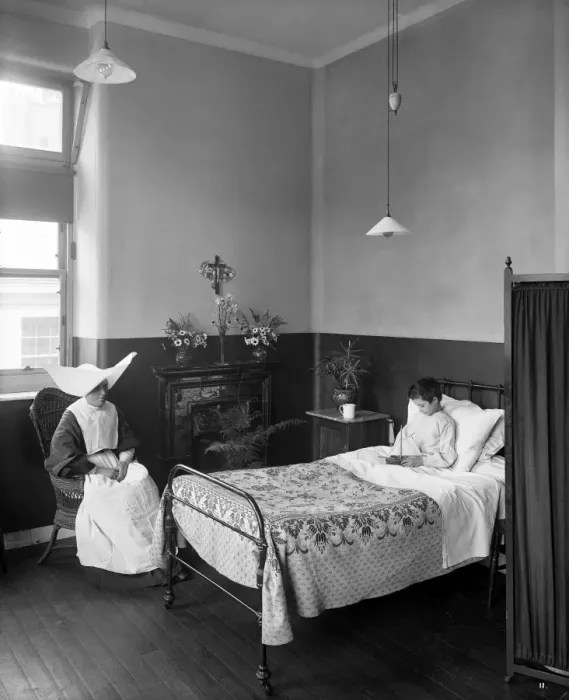
Before their time, the hospital had been served by the Daughters of Charity of St Vincent de Paul, recognised by their distinctive white cornette headdresses. They represented a long tradition of Catholic nursing in which professional care was inseparable from compassion.
Their presence gave the hospital a unique character. Patients were treated not simply as medical cases but as people deserving dignity, kindness and understanding.


One of my most remarkable family memories concerns my grandmother, my mother’s mother. Born in Turin, the first capital of unified Italy and the city of the House of Savoy, she was admitted to the Italian Hospital during the 1950s or 1960s, before her death in 1970.
While she was a patient, she received an unexpected visitor: Umberto II, the last King of Italy.
This was far more than a royal visit. My grandmother and the King shared a common history rooted in Turin, the House of Savoy and the Italy that existed before the Republic. For a woman who had spent most of her life under the monarchy and who was deeply religious, the meeting must have carried profound personal meaning.
During their conversation, Umberto apparently confided certain private thoughts to her and asked that she keep them to herself.
I never discovered what he said, and perhaps that mystery is part of the story’s enduring fascination. What remains is the memory of two people united by a shared city, a shared history and a vanished world.


The Italian Hospital also enjoyed close links with another important institution: the Italian Institute.
The two organisations complemented one another. The Hospital cared for the physical wellbeing of London’s Italian community, while the Institute nurtured its language, culture and educational life.
Here my own story takes an unexpected turn.
My mother devoted herself to the Italian Hospital. Years later, I married Sandra, whose father served as Secretary General of the Italian Institute.
The son of a woman closely associated with the Hospital married the daughter of a man closely associated with the Institute. Looking back, it almost seems as though our paths had been prepared long before we met. Our relationship grew from the shared cultural life of London’s Italian community.
The Italian Institute became an important part of our lives and, above all, it was where Sandra and I first met.
For that reason, it was deeply sad when the Institute left its historic home. The organisation continued, but the old building had witnessed countless lectures, concerts, friendships and personal memories. Some places possess a spirit that cannot easily be transferred elsewhere.
The same sense of loss accompanied the closure of the Italian Hospital in 1990.
By then the world had changed. Italian immigrants were increasingly integrated into British society, more people spoke English, and the National Health Service had evolved. A separate Italian hospital was no longer considered necessary.
Yet nobody in its earlier years imagined that such an institution would ever disappear.
Although the Hospital closed, the building itself continued its tradition of care through its association with Great Ormond Street Hospital. A place that had served the Italian community for more than a century went on helping children and families facing serious medical challenges.
In that sense, the spirit of the building survived. Its specifically Italian identity had gone, but its essential purpose—compassion, care and service—remained.
The chapel was deconsecrated. The sisters departed. The organ found another home. More than a century of Italian memories gave way to a new chapter.
Many years later I returned to Queen Square. I never had the courage to go back inside the old Hospital. Some places are so closely bound to our deepest memories that they are difficult to revisit.
Instead, I walked through Queen Square Gardens, where a charming statue of a cat brought back memories of the area and everything it had once represented.


The Italian Hospital gave me something that has remained with me throughout my life. Long before I settled in Italy, it introduced me to Italian culture and showed me how Italian and British traditions could enrich one another.
It gave my mother an opportunity to serve others. It gave me friendships and memories. Through it, my family became connected with doctors, patients, religious sisters, immigrants, artists and even a former king.
Above all, it taught me that culture does not live only in museums, books or official histories. It lives in people—in conversations, shared meals, acts of kindness and friendships that cross national boundaries.
The building has changed, and the institutions have changed, but the spirit of the Italian Hospital—the spirit of care, community and friendship between Italy and Britain—endures.
For those of us whose lives it touched, it will always remain a little piece of Italy in the heart of London.

If you enjoyed this post, please consider clicking the Like button or leaving a comment. It lets me know that my writing is reaching people.

The Italian Hospital 2: Doctors, Friendships and Memories


Among the many Italian doctors who passed through the hospital, one who remains particularly memorable to me was Gino Chiesa.
He was not only a talented young doctor but also a man of wide cultural interests, with a genuine appreciation of architecture, history, music and English life. He embodied the spirit of the Italian Hospital by building bridges between Italy and Britain rather than seeing them as opposites. Proud of his own country, he was equally fascinated by Britain’s traditions and history. He introduced me to Pergolesi’s works and enjoyed quoting a phrase describing English Gothic cathedrals as ‘comfortably spread out’, distinguishing them from the French strict stratospheric ones.
Later, during visits to Italy, Gino introduced me to Turin and its surroundings. Through him we experienced not only the beauty of the region but also the warmth of Italian family life. Sharing meals with his family reinforced something I would come to value deeply: the generosity and hospitality that have always characterised my relationship with Italy.


Another unforgettable figure was Dr Elio (Federico Domenico) Montuschi.


Originally from Bologna, he combined intelligence, warmth and great personal charm. Professionally, he became a respected physician and cardiologist in Britain, making important contributions to cardiovascular medicine, particularly in hypertension and vascular disease. His research reflected the highest standards of his profession.
Yet it is the man rather than the doctor whom I remember most vividly. He combined professional authority with genuine humanity and enjoyed conversation, friendship and good food as much as medicine itself. I remember particularly a concert I attended with him and my mum: it featured the great Chilean pianist Claudio Arrau playing the two Brahms concerti.
Like many Bolognese, he held strong political convictions and engaged enthusiastically with wider social issues. To me he represented the richness of Italian life: deeply attached to his origins while fully engaged with the modern world.
He regularly visited our home, where he clearly appreciated the Anglo-Italian atmosphere and hospitality. Those gatherings reminded me that culture is often preserved in ordinary moments—a shared meal, a conversation or a cherished memory can keep alive a homeland even when one lives far from it.
Dr Montuschi also represented another important role of the Italian Hospital. It was not simply a place for treating patients but also for supporting young Italian doctors who came to Britain to train, exchange ideas and build lasting friendships.
Looking back, I realise how remarkable the Italian Hospital really was. It brought together elderly immigrants, young doctors, volunteers such as my mother and members of London’s Italian community. It recognised that healing involves more than medicine; people also need language, familiarity, kindness and human contact.
For my mother it strengthened her lifelong connection with Italy while allowing her to help others. For patients it offered understanding. For young doctors it provided a bridge between two medical traditions. For people like Gino Chiesa and Dr Montuschi it allowed professional life and cultural identity to flourish together.
For me it was one of the first places where Italy ceased to be simply a country on a map. It became a world of friendships, conversations and lasting memories.
The closure of the Italian Hospital was therefore far more than the loss of a medical institution. London lost a unique part of its social history—a place where generations of Italians had found care, companionship and a sense of home.
Buildings may disappear, but the memories they create endure. For me, the Italian Hospital in Queen Square will always remain a little piece of Italy in London.

×××

If you enjoyed this post, please consider clicking the Like button or leaving a comment. It lets me know that my writing is reaching people.

The Pegreffi Quartet at the Adolfo Betti Memorial concert


There are evenings when a small town reveals itself as a place of great culture. This is exactly what happens every summer in Bagni di Lucca, where the chamber music concerts organised as part of Virtuoso & Belcanto and the Adolfo Betti Memorial bring musicians of international standing to this historic Tuscan setting.
I had the pleasure of attending the concert by the Pegreffi Quartet:

Emma Parmigiani First violin
Inesa Baltatescu Second violin
Emanuele Ruggero Viola
Lorenza Baldo Violoncello

They were the winners of this year’s Adolfo Betti quartet competition and I was again struck by the exceptional quality of the performers at these concerts. It is remarkable to think that in a town of this size one can experience performances marked by the same professionalism, refinement and intensity that one would expect in the famous concert halls of Europe. Incidentally the Pegreffi Quartet is called that because it pays tribute to Elisa Pegreffi (1922–2016), the great Italian violinist who was the second violinist of the renowned Quartetto Italiano. I have several of the Quartetto Italiano’s LP’s in my collection and they remain among my favourite quartet recordings. Theory Beethoven combines German studiousness with italian lyricism in a wonderful meld.


The evening’s programme offered a fascinating journey through three very different musical worlds. It opened with Haydn, who established the string quartet as one of the supreme forms of classical expression, with his characteristic elegance, balance and perfection of structure.
The audience was then taken into a very different sound world with Stravinsky’s Three Pieces for String Quartet specially written in 1914 for the Flonzaley Quartet, the ensemble of which Adolfo Betti was the first violinist. This short but revolutionary work revealed Stravinsky’s extraordinary imagination and his ability to transform the possibilities of the string quartet. Its inclusion in a concert dedicated to Betti created a particularly meaningful historical connection.
The evening concluded with Mendelssohn’s m String Quartet No. 2 in A minor, Op. 13. It is difficult not to marvel at the fact that such a mature and deeply expressive work was written when Mendelssohn was only eighteen years old. His achievement recalls the astonishing brilliance of his earlier Octet, composed at just sixteen, a masterpiece that already displayed the imagination, technical command and emotional understanding of a fully mature composer. Few musicians in history have shown such extraordinary gifts at such a young age — placing Mendelssohn among the greatest musical prodigies, alongside Mozart.

Throughout the concert, the Pegreffi Quartet demonstrated remarkable unity and sensitivity.. They were not merely performing notes on a page; they were bringing to life three distinct musical voices, separated by time but united by genius.


The enthusiastic response of the audience showed once again how important these events have become for Bagni di Lucca. These concerts are now eagerly awaited moments in the cultural life of the town, bringing together residents, visitors and music lovers in a shared appreciation of great art.
Evenings like this remind us that great music is not the exclusive property of major cities. It can flourish anywhere — even in a small Tuscan town where history, beauty and culture come together in a truly unique atmosphere.

This is my list of all the Betti quartet winners since 2018. (The competition started in 1997). I have also made a link to any posts I have written about the winners


2018 Elmire Quartet
2019 Leonkoro Quartet

https://longoio3.com/2018/08/04/a-great-quartet-in-the-making/
2020—
2021 Ãtma Quartet https://longoio3.com/2021/07/31/a-very-polished-evening-of-music-at-bagni/
2022 Cong Quartet
2023 Kanus Quartet https://longoio3.com/2023/07/30/a-little-night-music/
2024 Doré Quartet
2025 Arola Quartet https://longoio3.com/2025/08/03/from-flonzaley-to-arola/
2026 Pegreffi Quartet


If you enjoyed this post, please consider clicking the Like button or leaving a comment. It lets me know that my writing is reaching people.

Italian Hospital 1: A Little Piece of Italy in London


Some buildings are more than bricks and mortar. They become part of our personal history. They become places where memories, friendships and cultures meet. For me, one such place was the Italian Hospital in Queen Square, London.
Although the hospital itself has now closed as a working institution, its influence on my life remains very strong. It was one of the places that first gave me a real connection with Italy—not just as a country, but as a living culture of people, traditions, food, friendship and generosity.
Looking back today, I realise that the Italian Hospital represented something quite rare. It was not simply a medical establishment. It was a place where Italian immigrants could find familiarity in a foreign country, where the Italian language could be spoken freely, where people who had left their homeland could rediscover a sense of community, and where British and Italian traditions came together.
The Italian Hospital had a remarkable history. It was founded in 1884 through the vision and generosity of Giovanni Battista Ortelli, an Italian businessman dealing with spectacles and scientific optical equipment and a benefactor in London who recognised the needs of the growing Italian community. Like many immigrants, Italians arriving in Britain often faced difficulties: a new language, unfamiliar customs, financial problems and the loneliness that comes with leaving family and friends behind. The hospital’s opening merited this article in The Graphic


Ortelli understood that medical care was not only about treating illness. People needed to be treated in an environment where they felt understood and respected. His aim was to create a place where Italians living in Britain could receive medical attention while remaining connected to their own language and culture.
From its beginnings, therefore, the Italian Hospital was more than a hospital. It became a home away from home for generations of Italians in London.
The building itself reflected the importance of the institution. Designed in the Victorian period by the architect Charles Henry Worley, it was both practical and elegant, combining the requirements of a modern hospital with a sense of dignity and welcome. It was not simply a functional building; it was a statement of confidence by the Italian community in London and a symbol of their contribution to British society.


Its location in Queen Square was also significant. The area was already associated with medicine, research and healthcare, and the Italian Hospital became part of that important medical tradition while maintaining its own distinctive identity.
My own connection with the hospital came through my mother, Dr Vera Pettitt.
My mother was Italian, originally from Milan. She married an Englishman, Harvey Pettitt, and moved to London. Like many Italians who came to Britain, she looked for ways to maintain her connection with Italy while also helping others who shared that background.
During the 1950s she became involved with the Italian Hospital as a volunteer.
She was never paid for her work. She gave her time because she believed in helping people. In particular, she helped Italians who were experiencing mental health difficulties—people who were sometimes facing not only illness but also the additional problems of living in a foreign country, dealing with language barriers, loneliness and the challenge of adapting to a new life.
Her reward was not financial. It was the satisfaction of knowing that she was part of a community and that she was helping people who might otherwise have felt isolated.
There was, however, another pleasure associated with the hospital: the wonderful Italian meals.
Because the Italian Hospital was not simply somewhere that people visited when they were sick. It was a meeting place. It was a little piece of Italy in the middle of London.
I remember going there to meet my mother. I remember walking through the entrance and seeing the rooms where people gathered. On the left was a room where doctors could meet and discuss their work, and beyond that was the dining room where tables were prepared for meals.
Those meals were an important part of the hospital’s character. Doctors, nurses, visitors and members of the Italian community would sit together, eat Italian food and talk. In a very Italian way, the meal itself became a form of friendship.
Food has always been one of the great links between people. It crosses language, nationality and background. At the Italian Hospital, a shared lunch created a connection between people who might otherwise never have met.
The hospital attracted many young Italian doctors who came to Britain to continue their training and gain professional experience. It became a bridge between Italian medicine and British medicine, allowing young doctors to learn from another healthcare system while remaining connected to their own culture.
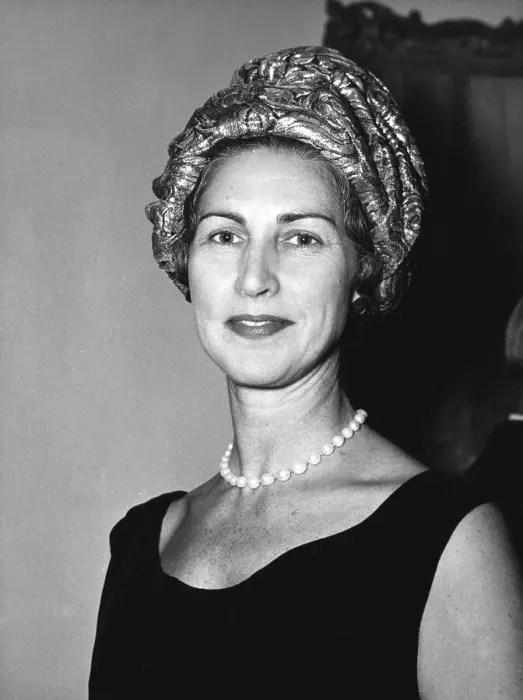
The hospital was also at the centre of a wider social life. One of its most important annual events was the Italian Hospital Dinner and Dance organised by the hospital’s league of friends and held at the Dorchester Hotel in Park Lane. Carla Thorneycroft was a leading figure in the League of Friends which raised money to support the hospital, organising balls, concerts, bazaars, film shows and other fundraising events. She was the Italian-born wife of the British politician and industrialist Peter Thorneycroft and was born Carla Maria Concetta Francesca Malagola Cappi in Paris in 1914, into an Italian aristocratic family, and later became known as Lady Thorneycroft.


I have several memories of these elegant occasions. On one particular evening, I met a very nice young woman from Stanmore. She was a sweet and charming girl, and we enjoyed each other’s company during the evening. Afterwards, I rode all the way to Stanmore from.south London on my little Honda 50 to visit her and her family.
Sadly, there was one problem: she was already engaged to somebody else. So although we had enjoyed meeting each other, nothing further could develop. Nevertheless, it remains one of those pleasant memories that life occasionally gives us and which stay with us for many years.
Another Dinner and Dance, in fact the last one I attended, was after I had married my wife, Sandra. We had the same table, with two Italian doctors sitting on the other side. What surprised me was that they did not exchange a single word with us throughout the evening. I have often wondered whether they were simply reserved people or whether they assumed that we preferred to be left alone. Whatever the reason, it remains one of those small, curious incidents that become part of one’s memories.


That same evening is also memorable because the once-famous Italian lawyer Del Giudice, while coming down the grand staircase with his wife, tripped and fell. Fortunately, he recovered his balance and no serious harm was done, but it caused a moment of excitement among the guests.
The Dinner and Dance played a vital role in supporting the hospital. It helped raise money and brought the community together. Looking back, it is sad that many people did not fully appreciate at the time how important these efforts were in keeping the hospital alive.
The dedication of supporters such as Mr and Mrs Thorneycroft, who worked tirelessly on behalf of the hospital’s fund, deserves to be remembered. Despite their efforts and those of many others, the Italian Hospital eventually closed in 1990.
For those who knew it, this was not simply the closure of a building. It was the end of a unique institution—a place that had cared not only for the health of London’s Italians, but also for their friendships, their traditions and their sense of belonging.

***

If you enjoyed this post, please consider clicking the Like button or leaving a comment. It lets me know that my writing is reaching people.