Of Vines and Olives

It’s not been the easiest of times for us two – indeed for all of us; a personal health crisis at the start of the year merged with the world health crisis brought by covid19. Even more disturbing is how time’s winged chariot seems to be pulled by ever faster steeds.

Difficulties in getting back to Italy have meant that we don’t have very much to show for in our field. Yet there are two crops which will ever survive – two items which sum up so much of Italy for me: grapes and olives.

Our vines climbing up the annexe to our house have been truly prodigious this year. Yet we have just been picking on them as a sort of dessert: we’ve never gone into wine-making although we have contributed to friends’ vendemmie (grape harvests).

When I was a kid and had already been on a couple of trips from the UK to Italy I tried to find the main reason why two European countries could have such differences between them. I suddenly blurted out ‘Italy has wine!’ ‘That’s right’, confirmed my mum. Of course, today England has some good vine growing areas particularly in Kent and Sussex but my childhood revelation continues to have some truth in it. Wine remains an essential tradition of Italian life in the way that it is not in the UK.

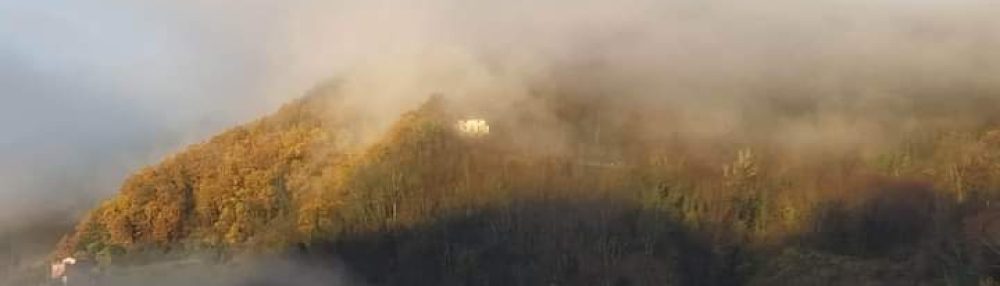
As for Olives several of those saplings I first planted in our field over ten years have matured into fine trees and carry their fruit with abundance this year. This is particularly heartening as it needs ten kilos of olives to produce one litre of oil.What more could one wish to have: a deep blue sky and truly warm sun around mid-day and one’s own little supply of olive trees while all around the warmth of late autumn colours embrace and the lenticular clouds above fascinate with their patterns.

It takes very little to make one happy in this world. Truly the best things in life are free – or rather they are impregnated with freedom, far away from those horrible restraints that the world (and oneself) is constantly trying to impose upon life’s essential being, particularly during this year. Liberty is there, truly, for the gathering, for the choosing….

It’s that time again in our part of the world: olive-picking time. In Longoio we are near the top height for growing olives (and vines) – 1750 feet. This year at least we’ve got something worth picking in our miniscule grove of twenty-odd trees.

If those of you living in northern climes think all this is irrelevant think again. There are now olive groves in southern England (see http://www.bbc.com/news/uk-england-kent-18551076 ) and, indeed, some London streets are lined with them (ever been down Islington’s Fife terrace?). Whether the fruit will be as succulent as that coming from the deep south of Europe is another matter of course…

Plant you own little olive tree and wait and see. The olive is a sacred tree redolent of peace and harmony and everything that can be said to be positive in our disquieting times. We’ll be back during the following weeks to collecting the fruit from this sacred tree whose oil was used to anoint kings and athletes in ancient Greece and which remains holy to this day for so many of life’s ceremonies.

Hidden Frescoes in our Valley

Fresco is a typical Italian painting technique which continues to be used to perfection by several practitioners. For example, there’s Julia Mee whose family has spent many years here. Her web site at https://www.juliamee.co.uk/ will explain more about this fascinating art which is now in full creativity in Scotland at Marchmont House:

https://www.facebook.com/marchmonthouse/photos/?tab=album&album_id=1017413621794230&__xts__[0]=68.ARBRcZ0imZsB7sVWx81UhwLwP5GBYOrfsGtXuyBc2qhF3dhG6GnQYkjh3s0kpTGeJhdbS6t_znQMYjsGlRndPu9aSd7edBS2PadBF4DoeRE9xjnBDYuce0Ab4DzCXI7tviJI-xQrlKrPnmh6gbNYi3t-bMIR-XLS7C6vhoy7rq_ULKWKS-mdGz5ASJRtQOz3x5gSCNMD2y9bohY3bR3oaAVyR7RVMeIkk3KNhVAep-u6lWb5fHEWPM8TNB7z_I5qENFkieridZp0tkTdv7vww2-nLK0CVzJQkL1bwXfucm-cMQWXgALvLyFI4MfrAdvc2b2u

‘Fresco’ means ‘fresh’ (since the paint is applied to still wet plaster) and also has connotations of open-air as in ‘al fresco’ for many frescoes are, indeed, painted on outside walls. Highlights of any visits to Italy include looking at some of the magnificent cycle of frescoes this country holds: for example, the Sistine chapel (Michelangelo), Brancacci chapel (Masaccio), the Vatican palace (Raphael), and the Arena chapel (Giotto). What is often not noticed is the fact that frescoes can also decorate palaces, villas and even the most unassuming mansions? We don’t have to go far to discover them here in Bagni di Lucca. Last week we visited a nearby house with a somewhat forbidding inelegant exterior. Stepping inside upon invitation we discovered a multitude of rooms a few of which (on the ‘piano noble’ of the first floor) had some elaborate frescoes as decorative features.

In one room I was enchanted by this series of fine tropical birds.

When were these frescoes painted and by whom?  Their style suggests the turn of the nineteenth century and particularly the ‘Empire style’ introduced by Princess Elisa, Napoleon’s sister, who ruled Lucca. These frescoes were the ‘wall paper’ of the times. They were used to update a formerly undistinguished, even primitive, building into something more aristocratic and sophisticated especially appropriate if the owners had gone up in the world and were aiming for a more stylish way of life. Clearly these rooms could be used as ball-rooms and when there were marriageable daughters in the family show them off in a more enticing way and gain a greater variety of suitors.

But who painted them? Has any significant research been made into these high-end painters and decorators?

In another building, Borgo a Mozzano’s library where I have taught, there are further examples of fine decorative frescoed rooms described in my post at:

https://longoio2.wordpress.com/2016/01/24/a-lovely-library-ceiling-at-borgo-a-mozzano/

Sadly there are several instances where beautiful frescoes are allowed to go to rack and run. Nowhere is this more apparent than the abandoned village of Bugnano just up the road from us.

I describe this desolation further in my post at:

https://longoio.wordpress.com/2014/03/16/abandon-all-hope-all-ye-who-enter-here/

I just wonder how many more frescoed rooms are tucked away in buildings which appear to have nothing special about them. The frescoes are clearly not of the highest art but their exquisite decorative value should not be overlooked especially as they are so typical of a tradition which England’s damp and dreary climate has been largely unable to support.

The Twin Villages of Longoio and Mobbiano

Like twin galactic stars the villages of Longoio and Mobbiano shall ever be associated with one another. There does not appear to be any significant rivalry between the two as often exists between neighbouring villages in our valley (like that between Crasciana and Casabasciana) . Longoio is slightly larger and, until relatively recently, was the only one shown on the road sign to the two villages.

Unlike some of the other settlements in these parts there’s little information in medieval documents  on Longoio and Mobbiano . Longoio is never talked about, unlike Mobbiano which is mentioned for the first time in a parchment dated 983, in which it is recounted that Viscount Fraolmo II, son of Fraolmo I, obtained from the Bishop of Lucca, Teudigrimo, a part of the tithes paid from some lands leased in “Mubiano”.

We do not know exactly when the two villages were founded. According to some historians Mobbiano (perhaps older than Longoio) developed from a Roman farm, founded by a certain Mevius, probably one of the many lands assigned to retired legionaries as a reward for services rendered to the Roman empire.

Mobbiano consists of two main narrow streets running parallel to each other and separated by a steep slope.

Although it has its fair share of inhabited houses Mobbiano  also regrettably has several semi-ruinous buildings which are often hidden under layers of dense foliage.

Here are some further pictures we took the other day while walking about the village which is really more of a hamlet.  The connecting passages between the two streets are really steep! 

Mobbiano has no outstanding monuments but it has its picturesque features including this graceful fountain.

The village has its own car park which was built around last ten years ago.

Longoio and Mobbiano meet up at the charming ‘chiesina della margine’ where a Mass is celebrated every May.

The population of the two villages is stated to be seventy inhabitants but this is perhaps an overestimate – there are more cats in then! This year, in particular, with the pandemic there have been far fewer summer holiday makers which can double the population.

Perhaps the best claim to fame of Mobbiano and Longoio is that they are reckoned to receive a greater amount of sunlight than any other villages in our region of the Controneria. That is clearly a very good reason to continue to live here!

At the Limits of Limano

Autumn, together with Spring, is our favourite time for walks. The summer heat has worn off and, particularly after the solstice of September 21 nature begins to assume a distinctively multi-coloured mantle: the chestnut trees ripen their fruits and the forest floors are dotted with a variety of mushrooms. Here’s a platter of mushrooms we managed to find the other day. Congratulations to my wife for her keen eye in locating the often elusive porcini (ceps).

It’s also a good time to revisit the various villages which comprise our comune of Bagni di Lucca

A few days ago we found ourselves in Limano on the northern side of the Lima River. It’s a delightfully peaceful place spread between two hills with a main square dividing its two halves.

First mentioned in a document of 893 AD as a village under the jurisdiction of Vico Pancellorum it became a feud of the Suffredinghi family and passed under Lucca’s rule in 1200.

We walked up Limano’s north hill and found ourselves before a chapel with a very well-kept garden and some amazingly good stone-work.

This is the oratory of Our Lady of Grace.  Dating from 1684 it is built in local limestone using material recovered from the old parish church which had been abandoned because of a landslide. I suspect this is why the stonework is so good; it may date from the eleventh century at the full height of the Romanesque style. The oratory is accessed through a portico supported by four columns and is covered with slate stone plates.

Inside, the effigy of the Madonna delle Grazie, the venerated patron saint of the town of Limano, is preserved.

We returned to the main square where, on the first of August, near the sixteenth century fountain, a festa with traditional country dancing takes place here.

The participants of the “Festa in Piazza Gave” sing and dance in characteristic costume, marking the occasion when shepherds traditionally came down from the mountain pastures to sell lambs.

In the latter half of the twentieth century the festival declined, but has happily been revived by the “Limano Nostro” association. I’ve said more about these festivities in my post at

https://longoio2.wordpress.com/2016/08/03/country-dancing-in-limanos-piazza-gave/

Limano’s southern hill is steeper than its northern neighbour and proceeds past the parish church of San Martino built in 1776 and renovated in 1908. Unfortunately the church was again closed during our visit but I am told the choir’s decoration, the work of Arturo Chelini, is worth looking at. Maybe next time?

At the top of the hill are the remains of the castle. Most of what’s left of it is incorporated into existing houses but there’s an area where a covered passage gives one a good idea of the former castle’s defences.

It’s near here that a friend has recently purchased a house with great views.

The hills were clothed with heavy mist and it began to rain, the first rain we’ve had for weeks. Autumn has clearly come! The following night came the big tempest – the night was alight with electric flashes and at one point the thunder shook the foundations of our house like an earthquake. I think that as much as the pure blue skies and the sunshine I would miss these dramatically operatic Italian storms if I returned to live in England!

Suspense about Tibetan Bridges

The sign ‘Al ponte Tibetano’ (‘To the Tibetan bridge’) entices one to expect a vertiginous rope affair cast over a fathomless abyss, reminiscent of a scene from that Powell and Pressburger film ‘Black Narcissus’.

In fact, when one comes across these bridges in our part of the world they turn out to be suspension bridges for walkers and, instead of ropes cast across a chasm, they are supported by steel cables.

I’ve described the most spectacular of these suspension bridges, the one spanning the Lima River near Mammiano at:

https://longoio.wordpress.com/2013/05/26/suspense/

There’s another one I’ve written about at Vagli di Sotto in my posts at:

https://longoio2.wordpress.com/2016/10/10/a-tibetan-bridge-in-the-garfagnana/

and

https://longoio3.com/2017/10/11/vagli-lakes-circular-walk/

However, I hadn’t quite realised that Bagni di Lucca has its own ‘Tibetan bridge’. It’s near the Pian di Fiume village rescued from oblivion and turned into an ‘agriturismo’, or country holiday resort, by our resident chemist and former mayor Massimo Betti.

The bridge spans the Lima about a couple of kilometres outside Bagni on the way to Abetone on the Brennero road and we crossed it a couple of days ago. It offers delightful views over the river which at this point also provides good bathing opportunities.

The first modern suspension bridge was built by Thomas Telford in 1826 and crosses the Menai straits in Wales connectingYnys Mon (Anglesey) with the mainland. Nottolini, the Luccan architect and engineer, visited Britain specially to study Telford’s methods and returned to build the iconic chain suspension bridge known as ‘il ponte delle Catene’ at Fornoli. I’ve written about this pioneering bridge in my post at:

https://longoio3.com/2018/09/20/bridging-a-much-needed-gap/

There is a smaller version of the bridge, for pedestrians only connecting the Circolo dei Forestieri square with the Brennero road.

I love bridges of all types but the suspension ones are my favourite!

Bagni di Lucca’s Doctor Vito with ‘A Space for You’.

The animal medical centre at Ponte dell’Ania where I have taken stray cats for free neutering, has moved to Gallicano and its former premises are now a centre for alternative and holistic medicine.

The centre is called ‘Uno spazio per te’ (a space for you) and this is its programme for 2020:

A couple of evenings ago we attended a seminar on psychosomatic medicine given by our family doctor and iconic Bagni di Lucca personality Doctor Vito Valentino

Vito combines learning with fun and vividness. His talks are almost like theatrical monologues and he manages to make his audience easily aware of things they might not even have considered.

Psychosomatic medicine has been around since at least ancient Greek times and the saying ‘a healthy mind in a healthy body’ encapsulates the essence of what it’s all about. The problem today is that with all its specialisms the field of medicine has become so dissected that doctors of physical treatment may ignore the knowledge of psychological therapies and vice versa. In fact, all states of health and well-being depend on a complex interaction between mind and body. To give a very basic example: walking is encouraged as a means of improving both psychic and physical health. Too many people today just don’t do enough walking. Since taking this aspect of our well-being more vitally I have tried to keep up my daily intake to a minimum of ten thousand paces using my phone’s pedometer app to monitor this. I have found that my own periods of feeling low seem to coincide with those days where I am just ‘lying about’ and do a minimum of steps. Of course, this also adds a physical aspect in that one accumulates weight and most of us get somewhat upset when we pile on our kilos!

Vito clearly distinguished between external and internal self. Our external self is what everyone else notes about us: our appearance and our behaviour. This become public property and in many cases almost depersonalises us since in so many social situations we only act out our interaction with others using a constructed persona. Furthermore, we may even become intimidated by the apparent ‘possession’ of others into our private person.

The truly private ‘self’ is our interior being which no-one but us can have any really deep knowledge of. Indeed, we often become very upset when others create an image of our inner self which is at complete variance to the one we know and believe to be ourselves. It’s here that the trouble starts. When the inner self becomes confused with the outer self then personality disorders really start forming themselves. Only if one has complete faith in one’s own inner being can one vanquish those daemons of the outer world – daemons which can be embodied by people who, through their own delights or, rather, their insufficiencies, enjoy placing their fabricated image of our inner selves tormenting us no end.

This aspect is, of course, well represented in ‘natural’ cultures i.e. those societies which have not entirely capitulated to western concepts of economic prosperity, artificial reality, somatic pharmaceuticals and psychological pseudo-jargon. The witch-doctor may release a person from possession by the soul of another as equally entrap that person into an image of their inner selves completely at odds from the  one they truly know to be themselves.

This situation happened to me in an instance when a particular person did, indeed, attempt to ‘possess’ me. The physiological effect of this was to make me suffer a painful attack of shingles – an event which re-occurred until I had rid myself of the ‘possessed’ spirit – one of the closest situations I have ever had of experiencing powerful psychosomatic symptoms.

Vito illustrated his talk with various objects, including a set of spheres, and interspersed his ideas with a variety of points one of which relates to a Native American tribe who were wondering whether it was going to be a hard winter or not. They consulted the wise man of the mountains who said that indeed it was going to be one of the hardest winters on record, upon which they went to the forest and started chopping down loads of trees for firewood. Later on they returned to the wise man of the mountains and asked him ‘are you still sure it’s going to be a very severe winter?’ ‘Yes it is’ he answered. ‘But how do you know?’ ‘Because when I look down on the forest I see lots of people manically felling trees for firewood…’

To one side of the chair where Doctor Vito sat was a notice proclaiming: ‘Vis Sanatrix Naturae’, meaning ‘the healing strength of nature.’ I’m sure that Wordsworth had this in mind when he penned those immortal lines:

Let Nature be your teacher…

 One impulse from a vernal wood

May teach you more of man,

Of moral evil and of good,

Than all the sages can.


There are many other activities covering a panoply of themes listed on the centre’s programme.

For further information do consult ‘Uno spazio per te’ facebook page at

https://www.facebook.com/ASD-Uno-Spazio-per-Te-155262395135360/


The Dead Live Anew at Bagni di Lucca’s Anglican Cemetery

In 1842, the ruler of the duchy of Lucca, Carlo Ludovico di Borbone, granted the English colony of Bagni di Lucca the right to found a protestant cemetery. A place called “al Prato Santo” (‘At the Holy Field’) was chosen on the opposite side of the river Lima and the graveyard was opened in 1844. It was in use until 1953 and there are one hundred and thirty seven individuals who rest there. In 1982, with the end of a legacy destined for maintenance, the cemetery was purchased by the Municipality of Bagni di Lucca. It is now managed by the town’s Michel de Montaigne Foundation and the Lucca Historical Institute.

Among those buried here, often with monuments made by renowned sculptors such as Benjamin Gibson, Giuseppe Norfini and Emilio Duccini, are the sister of the President of the United States of America Stephen Grover Cleveland, the writer ‘Ouida’, Henry and Elizabeth Stisted (the founders of Bagni’s Anglican church)  and the Irish entomologist Alexander Henry Haliday.

For those of us who prefer the romantic view of a cemetery as a place of decay with gravestones decomposing under a jungle of ivy and other creepers, a place haunted by bats and crows, a symbol of life’s ultimate futility and a site of melancholic and solemn reflections it might seem a contradiction to appreciate these ancient tombs restored, oxymoronically, to new life and I have often felt this way. However, I am now resigned to the fact that the aim of Bagni’s De Montaigne cultural association is to restore all the monuments it contains to their pristine glory. This is because in addition, to the names of the graves’ occupants the restoration has given fresh remembrance in the form of those who not only have munificently funded their renovation but also in the fact that several of the sepulchres have received a second dedication to recently deceased inhabitants and visitors to Bagni di Lucca. Thus, some tombs may have a triple dedication: the original occupant, the person who has given funds to restore it and the new dedication to a departed lover of Bagni di Lucca. Some even have a further association as the name of the tomb’s restorer is also mentioned. Sadly, in one case this has meant a fourth remembrance since the restorer in charge of the iron railings of several of the tombs recently died prematurely aged forty.

Last Saturday, 5th September, at the English cemetery of Bagni di Lucca in the aureate sunshine of a late September afternoon, five newly restored funeral monuments were inaugurated, raising the cemetery’s restored monuments to fifty five.

(Prof Marcello Cherubini, director of the De Montaigne Foundation and Bruno Micheletti of the Bagni di Lucca branch of the Historical Institute, the two principal organisers of yesterday’s event)

The renewal of one funeral monument was dedicated to the memory of Tony Bareham, protagonist of the Montaigne Foundation’s international conferences of the and himself a benefactor of the cemetery since he provided funds for the restoration of the writer Louise de la Ramée’s, (better known by her nickname of ‘Ouida’) monument. Bareham dedicated this restoration to the memory of his wife who had died a few years previously. This circumstance shows to perfection how one tomb can receive associations well beyond its inhumed dweller.

Another tomb was reinstated in memory of Umberto Guidugli, a notary who died of Covid-19.  He was a keen visitor to Bagni di Lucca and a supporter and friend of its Montaigne Foundation and the Historical Institute. A third monument was dedicated to all the doctors, nurses, health personnel, pharmacists, volunteers who sacrificed their lives to help those affected by the recent pandemic. Because of this reason, a representative of the Bagni di Lucca committee of the Italian Red Cross was present. Again this shows how supposedly irrelevant monuments from a past and largely forgotten age may be made significant again for our present very troubled age where, once again, we are all suffering under a pandemia as threatening as that ‘Spanish Flu’ of 1918 which killed two of the cemetery’s occupants Nelly Erichsen and Rose Elizabeth Cleveland whose tombs have also been lovingly restored.

Finally, there was the restoration of the Caccia family tomb. Colonel of the Bersaglieri, Mario Caccia was a participant in Italy’s wars of independence and died in Peschiera in 1879. This was a particularly moving moment in the afternoon’s proceedings.

A trumpeter from the famous Italian Bersaglieri troop played the Italian equivalent of the ‘Last Post’ on his trumpet:

Caccia was honoured with the laying on his grave of a small laurel wreath by other bersaglieri all wearing their traditional helmets adorned with black capon feathers.

The proceedings were completed by a delightful concert held in a suitably cooling orchard by the Lima River.

The performers were “Sax off limits”: an ensemble of twenty saxophones from the “G. Puccini” Conservatory of Music of La Spezia. This was the programme:

One of the items, Puccini’s ‘Crisantemi elegy’, has become something of a leitmotiv for Bagni di Lucca’s cemetery. I remember it being played (by a string quartet this time) in the presence of Puccini’s grand-daughter Simonetta who was a keen supporter of the efforts to restore the cemetery and who renewed her love for a town which was equally cherished by her distinguished ancestor.

It was a brave effort to play Beethoven’s potent ‘Coriolan’ overture on saxophones and it was surprisingly well hit off. For me, however, Rossini’s early sonata was a happier choice. There were two very welcome encores: first a trifle of a march called ‘Scossa Elettrica’ by Puccini written to celebrate the centenary of the invention of the galvanic battery:

and second, a Piazzolla tango. As many will know Piazzolla is almost a local lad; see my post at  https://longoio2.wordpress.com/2015/07/02/tango-where-astor-piazzolla-originated-from/ to find out why.


This was an idyllic finale held in the lovely orchard by the banks of the river Lima. No better location could have been chosen since these September days have given us a prolonged summer with really hot days. Sitting in the shade under the fruit trees was clearly the best choice!

As ever in Italy strict Covid-19 regulations were in place for this event. Everyone had to wear  ‘mascherine’ – surgical masks – and no-one was allowed to move their socially-distanced chairs. Italy, in this ghastly on-going situation has set an example for public events which, alas, is all too lacking in many other countries. I remain truly proud of and feel very safe in this country!

(The presentation by the Bersaglieri of the commemorative laurel wreath to Italian independence fighter Mario Caccia)

Summer’s Last Phase

We can always tell when we are reaching the end of summer here in Longoio.  First, there’s an Italian phrase that says the weather changes after ferragosto (August 15th) and, again, it’s proved right since there has already been a sprinkling of rain and today is somewhat overcast. The forecast is for something more torrential to happen to us this coming week-end. Let’s hope it’s not another of those ‘water bombs’ which increasingly characterise the weather here and, indeed, are becoming more common even in the United Kingdom.

The second warning that our summer is entering its final phase is the ‘Del Ciocco’ car rally which was held last Saturday.  Competitors come from all over Europe and there are several British drivers. We walked to the turn-off for our village of Longoio to see and hear the souped-up cars screech and rumble round the sharp bend near the bus stop on their very twisty way to Montefegatesi.

I am reminded that my younger brother, before his untimely death seven years ago, was an appassionato of rallies and served as navigator in them. Indeed, his funeral hearse was none other than an E-type Jag!

The third warning is Bagni di Lucca’s traditional Fiera di San Bartolomeo which makes me think of that play by Ben Jonson. London’s Bartholomew’s Fair, dated back to the 12th century and was held for the last time in 1855.  Bagni’s fair which turns the town centre into a pedestrianised area is also locally known as the ‘Fiera dei cocomeri’ (water melon fair) because of the many water melon stalls (not so many this year, however). It is an occasion for the inhabitants from the surrounding villages to meet up, catch up on the latest gossip and maybe conclude a few deals. Today, the Fiera preserves its social focus and is a pleasant way to meet friends one may not have seen for some time. This year, of course, such social interaction has become ever more poignant because of the pandemic which really hit people here very hard with the strictest rules for social distancing and face mask wearing while the UK was still taking the thing in a somewhat laid back way. The inhabitants have truly suffered serious social deprivation here!

So another summer is flashing past us at an even faster rate than all the previous ones we have enjoyed in this idyllic valley. Such is the transience of life…

A Public Hanging at Casabasciana

On July 18th this summer some villagers found him around 5.30 in the morning as they were walking to the car park to go to work. A man in his mid-fifties, from the United Kingdom, had hanged himself from a tree in the square of Casabasciana, the village in the mountains surrounding Bagni di Lucca.

It was a truly desperate action on which the carabinieri, alerted by the 118 emergency number after the first rescuers had arrived on the spot, are now trying to shed some light

For the casualty, who had moved to Casabasciana around twenty years ago, however, there was nothing more to be done: the rescue was completely useless. A terrible scene unfolded in front of those who had triggered the alarm call. Unfortunately, the desperate attempt to save his life was quite useless.

Who was this man? Evidently he had once led a happy life in his new home in the delightful village of Casabasciana. Then tragedy struck. His pregnant wife not only died in childbirth but the unborn daughter died as well with her. Friends rallied round to help the man in a heartrending situation. For a while he accepted their help but increasingly he became more and more reclusive until he refused to open his house to anyone from outside. At the same time he still accepted friendship from dogs and cats.

A second tragedy ensued from this. For when the authorities and volunteers entered the man’s house they found a scene of absolute horror and degradation. It wasn’t just the fleas that attacked them and many of the homes in Casabasciana. The situation of abolute squalor that emerged in a house in the town, which required a deep disinfestation by our refuse services BASE S.r.l, also involved some pet animals, which were found in poor condition and have since been looked after by the volunteers of the Arca della valle association.

“When our association was alerted to a situation of extreme difficulty” – explain the volunteers – “a terrible scenario appeared before our eyes. About twenty skinny, hairless cats full of fleas and utterly terrified were carried out by us from the house in question. Together with the cats on the street we also found billions of hungry fleas that attacked us as soon as we arrived”.

“The house” – the account continues –“was  full of carcasses of dead animals (at the moment the estimate is about twenty corpses including cats and dogs) and dirty beyond belief. It is now being subjected to serious disinfestation and cleaning while the cats wander terrified and hungry inside the village unable to be caught because  of their feral nature. Volunteers Monia, Patrizia, Vanessa and Fabrizia managed to catch eleven cats that will be subjected to all the necessary treatments and will be sterilized. The situation will continue to be monitored.”

For days now, the hygiene problem in this already difficult situation arising from the Covid-19 pandemic has continued to hit Casabasciana. Mayor Michelini visited the village to check up on the progress of the cleaning and sanitizing intervention. Accompanying him was also the environmental councillor to see how the flea infestation could be controlled.

“We are now at the end of the work to remove the accumulated waste” – said Mayor Michelini – “and on the first morning of Thursday BASE, our refuse collection company will provide for the complete disinfestation of the streets affected by the phenomenon. I hope that the long-standing hygiene problem will be definitively eliminated forever “.

“I want to thank” – continued the mayor – “all the inhabitants of Casabasciana and the visitors to the village for their patience and endurance shown in this hygiene emergency which, regrettably, also had such  a tragic end. I thank the BASE company that has handled the problem with commitment and professionalism bringing it to completion, and the municipal officers and the local police for the support and assistance they have given me “.

However, the Arca della Valle said that they were disappointed the mayor didn’t mention them.

The president of the Arca Della Valle Association, Francesco Purini, replied to the statements of Bagni di Lucca mayor Paolo Michelini, regarding the inspection of the municipality pending the health emergency in Casabasciana.

“After the timely intervention of our girls from Arca della Valle – he says -, we are saddened by the fact that the mayor Michelini has not in the least mentioned the work performed flawlessly by our volunteers, highlighting this intervention which we believe has arrived with some delay. As president I would like to thank the volunteers of the Ark of the Valley, in particular Monia, Vanessa, Patrizia and Fabrizia for the excellent work they have done in Casabasciana especially with the removal of over twenty dog and cat decomposing carcasses and the help given to malnourished cats that had been locked up in the abandoned house. The Arca della Valle volunteers has also been able to capture and sterilize some cats in very bad conditions.”

I have discussed this both tragic and horrific story with various people in the know. The most obvious question I asked was why this situation was not discovered earlier. Why did the man, who clearly had psychological problems, developed after the awful death of his wife and daughter, fail to receive any meaningful help?. The answer to this one is that at the start he did get assistance from friends, relative and social services but then gradually excluded them to the extent that he barred the door of his house against anyone who tried to gain admittance. In that case why was not a court order issued by the health authorities for his house to be searched?

If the scenes of decomposition and decay were so ghastly then there would have been evidence of this in the stench arising from the unfortunate man’s house. Surely there would have been complaints arising from neighbours?

And how did the man get his provisions? Surely he would have gone to the shop, (Casabasciana has its own local shop). Socially, people would have asked him questions out of curiosity. How were the cats fed, for example?

Mystery upon mystery accrues. One thing is certain, however. It doesn’t matter whether one lives in a tower block on a failing inner city housing estate or if one lives in a house in a tiny mountain village of less than two hundred inhabitants; it is still possible to be entirely neglected by people and die in abject conditions of dreadfulness. We hear stories of dead bodies found in council flats months after death. At least in this particular case the body was found a few hours later hanging from a tree in the village’s main square. There again one requires a certain amount of effort to hang oneself and there will be some inevitable noise and commotion during the night: getting the rope to sling correctly over a branch of the tree, confirming that the noose slips easily round the neck and is positioned to correctly break one’s back bone, ensuring that the death will not be protracted and agonised by cries of pain.

This whole episode has greatly shocked and saddened us and all those people who have been told about it. Why did it happen? Indifference? Unwillingness to interfere in other people’s business? Fear of reprisals or attacks?

I just don’t know. Can humans be that indifferent?

This is, however, the fourth time than the image of a hanged person has returned to haunt me.

The first is that of the preserved tree trunk in nearby Montefegatesi where a partisan was strung up by the Nazi authorities during World War 2.  Then there was the pizzeria owner by the Ponte delle Catene where we regularly ate. Another was that of Sergio Fini, one of my students and a friend. He was a poet and an artist who loved to draw trees and write poems about them. He hung himself on a beam in his house at Fornaci di Barga. And the fourth was this Englishman who had clearly come to Italy full of happiness and hope with his beloved in the wish to start a new life in this beautiful country but who so tragically and pointlessly finished up by stringing a noose round his neck and ending in utter squalor not only his life but the lives of those innocent animals who had trusted him.

The black dog is truly a fearsome beast to face as my post at https://longoio2.wordpress.com/2015/10/28/the-black-dog/ has pointed out!
Photographing Life under Covid-19

A  photographic exhibition documenting local life under Covid-19 and organised by the L’Ora Blu’ (the blue hour), continues near the Borghesi restaurant in Bagni di Lucca Villa’s high street, Viale Umberto.

The ‘Blue hour’ is a phrase used in photography to indicate those particular moments just before dawn and twilight which allow particular contrast effects not otherwise obtainable as light is here characterized by a colder temperature and lower energy level, resulting in subjects with numerous shadows, and de-saturated colours.

The L’Ora Blu photographic group, which is curated by Marco Barsanti, was born after the first photography course organized by the Michel De Montaigne Foundation of Bagni di Lucca. Sharing a common passion has stimulated meetings to talk about photography and improve technique and composition.

We now live in a masked, socially distanced society. It’s surely gone on too long (like a Wagner opera, as one wit proclaimed), and the pictures taken by a group of local photographers amply illustrate this fact:  the especially vulnerable elderly who after a life that has experienced the ravages of war and deprivation have now to face another trial:

And the park benches neatly laid out with socially distancing X’s telling people not to sit there as if they were musical chairs :

With several other photographs the exhibition develops the contemporary theme, that strange refrain of our time which few of us would have foreseen, accustomed as we have been to other threats like global warming and Islamism terrorism.

Now the danger comes from an invisible enemy about which little is known but which can affect anyone of any age, of any status and of any provenance with equal force.

In the midst of this pandemic there remain several people I know who place the real danger in the fear of catching the virus rather than the virus itself. True, as Franklin Delano Roosevelt famously said “the only thing we have to fear is fear itself”. However, we all know what happened to those heads of state who shrugged off the fear, underestimating it and advised the nation to ‘take it on the chin’, while shaking hands with Covid-19 infected patients.

The fact is that it is easy to hypothesise that the pandemic is merely an increasingly totalitarian government’s ploy to place all its citizens under their control. There appears to be not too much difference between Orwellian thought-crime and the supposed conspiracy theorists.

So again another ideology steps in to divide us from erstwhile friends. Those who have not yet been lost to the brexitian cult are now in danger of being swept up in yet another dubious theory: that relating to Covid-19. No, of course, they will say all the figures are incorrect. This person did not die from the virus but from something else; the scenes in hospital intensive care departments have been greatly exaggerated, and if people actually believe that the virus exists then it must have been produced artificially by a frankensteinian laboratory, a certain person’s ‘chinese virus’. Meanwhile, the second wave lurks like a winter tsunami

However, I too, have been now touched by the death of a friend or relative victim of the horror: a school-mate, fellow scout and musician lost to the imperceptible menace. At least I have the memory of his stay with us in Longoio, the time we spent in each other’s company and the places we visited (including the re-opening of Puccini’s birth-house in Lucca) to treasure. How many more memories must we gather prematurely before this thing is finally defeated?

Like the Black Death, the Great Plague of Italy of 1630, London’s of 1665, and the cholera epidemics of the nineteenth century something positive may come out of all this. Perhaps will it be a book like Boccaccio’s ‘Decameron’, an immortal collection of stories related to each other by a group of young noble Florentines quarantined in a country villa away from the plague afflicting their home town at the time. Perhaps it will be like Albert Camus’ ‘The Plague’ based on similar experiences when living in Algeria. Or perhaps it may reflect those terrifying pages in one of Italy’s greatest writers, Alessandro Manzoni’s, novel ‘I Promessi Sposi’, (The betrothed) when describing the great plague that afflicted Milan and northern Italy in much the same way as the present peril is still continuing to menace.

On Italian television statistics relating to the ‘crisi corona’ are spewed out on a daily basis much like the weather forecast. New regulations are introduced to control the spikes. When will we ever return to normalcy I wonder?  At least the British Museum will shortly re-open thanks in large part to the sterling cleaning efforts of its Italian heritage preventative conservator and dust expert Fabiana Portoni. Now there’s some hope!

Meanwhile the ‘Ora Blu’ photographic course, which should have started in September, has had to be postponed because of the health emergency. For further details about when it will start please email

gruppofotografico.lorablu@gmail.com

or contact Isabella on 339 2982359.