From London to La Costa (and Lucca and Beyond) Part Three

From London to La Costa (and Lucca and Beyond) Part Three

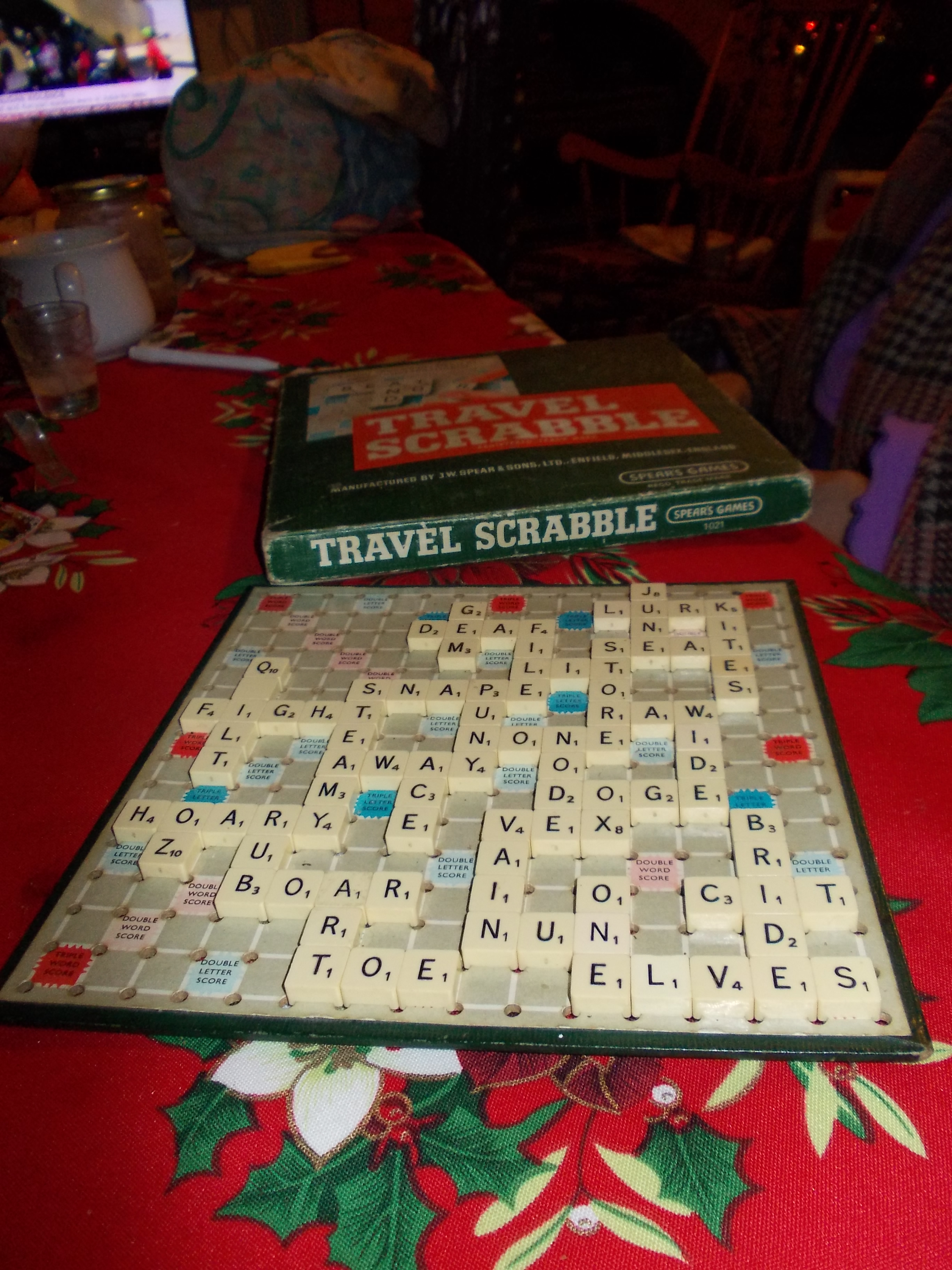
Scribble About Scrabble

Here are snaps of some of the items on sale. Don’t miss out on the tents outside which are a prime source for exercise bikes, among other items!

Apart from one or two days of respite it has been weather for the ducks. It’s the sort of weather to read, watch Netflix or, to avoid the worst symptoms of cabin fever, play what in Italy are called ”giochi sociali” – i.e. games where you don’t have to exercise prehensile thumbs and avoid conversation to play.( Incidentally  in Italy this year, giochi sociali have outsold all those games consoles).

Our favourite is “Scrabble” and, of course, chess. When particularly mentally lazy we enjoy Chinese chequers too.

We enjoy “Travel Scrabble” even if not travelling because the letters are well secured to the board and thus don’t tend to fly around. We are not brilliant Scrabble players and the days when a seven-letter word (the maximum length allowed in our version) appears on the board are truly red-letter ones.

12272013 014

Incidentally, “Scrabble” was invented in 1938 by an architect named Alfred Mosher Butts. Butts worked out how many points should be given for each letter by counting how often particular letters are used in the English language. The original game was called “Criss-Crosswords”. But Butts was not a successful salesperson and in 1948 James Brunot, a lawyer, bought the game’s rights. Brunot simplified the rules and renamed the game “Scrabble”.

There is a similar word game called “Scarabeo” which is an Italian variant of “Scrabble” and was created in the late fifties by Aldo Pasetti.

However, an exact Italian version of “Scrabble” has now come out and tournaments in this country are played using Scrabble (with Italian words of course!)

Parenthetically, Pasetti was accused by “Scrabble” of breach of copyright, but was acquitted by Milan’s Court of Appeal in 1961. So now it’s perfectly legal to play the “Scrabble” Italian –style. If there’s a travel version of this game (which surely must have different letter frequencies in Italy) then we’ll buy it for next Christmas!

It would be nice to have a “Scrabble” tournament among aspiring Italian language learners instituted in Bagni di Lucca (already famous for its historical games such as “Biribisso” and also for its summer open-air Burraco tournaments).

The only snag about “Scrabble” (apart from finding the last letters one picks from the bag are X and Z and that there’s no location free on the board in which to place them) is losing the blasted letters. EBay has helped in the past but we did find we were four letters short. How frustrating!

However, if one is bored by the weather there’s nothing to beat a good board game! And that’s what we managed to find at the Diecimo second hand shop and picked up an excellent vintage Scrabble in the deluxe version, the type that can often sell for over euros fifty. Clearly the set must have been left by an English family. (How can they possibly live without a Scrabble set now?)

However, the sheets where one can plot one’s game had a line written, enigmatically, in Italian.

Anyway we did enjoy our Scrabble game later that day and found the game board’s turntable particularly useful.

Ti Riuso will also take items for sale if they are suitable and in a clean condition.. The seller must present his or her ‘documenti’ including fiscal number and the items are duly noted in a database and a receipt issued. The seller can set the price for the item and the mercantino takes a commission. It’s worth investigating if your Italian attic is getting a bit full or if you want to return to enjoy post-Brexit Britain.

Continue reading

Elia

The following was written as a funeral address for Elia, my wife’s mother when she died last year. I would like to remember this remarkable woman on the first anniversary of her death by publishing that address in this post.

(Elia in Saint James’ Park London)

When Elia, celebrated her ninety-eighth birthday on June 10th this year, with her daughter Alexandra and me, her son-in-law at home we imagined that there would be an even more beautiful party in two years’ time when Elia would have been one hundred years old.

Sadly this was not to be. However, we should instead be grateful that Elia has led a life full of so many accomplishments and events and lived in good health until near the end. Elia’s eyesight, for example, was near perfect – she could see the number of the bus coming before I ever could – and never needed to wear glasses.

On Tuesday afternoon, 25th June, the lady who gave birth to Alexandra, my wife for over forty-two years now, finally flew to heaven with her guardian angel, to become one with the eternal love of her Creator.

Born in Italy’s Venice region in 1921, less than three years after World War one ended, Elia grew up in a farming community during difficult times. Among her activities were looking after silk worms, feeding them with mulberry leaves, and growing tobacco.

In 1936 Elia became an employee of Colussi, the biscuit manufacturers. It was in that same year that a devastating earthquake hit her area of north Italy, an experience which she described to me in its terrifying details.

Regrettably, another disaster, this time man-made, hit shortly afterwards when World War two broke out. Elia confessed to me that she hoped we would never know the hunger and poverty that her community experienced during those dreadful times.

Elia also worked in Sardinia for her uncle at a hotel in Iglesias –a place Sandra and I visited during our own trip to that beautiful island.

Elia inherited her father’s spirit of adventure: he had travelled to America and helped build New York’s Brooklyn Bridge. Elia’s own adventurous spirit took her to a post-war UK with her cousins and where she worked as a Nanny. They lived in a cottage near the Duke of Norfolk’s castle at Arundel. It was in these idyllic country surroundings that Elia met Dino. It was love at first sight – a love so strong that again, this Easter, Elia visited Dino’s last resting place near his birthplace of Florence.

Alexandra was born from that love in 1948 and, with wondrous coincidence, when we married, on the 7th day of the 7th month of 1977 at Caxton Hall, it was the same registrar who had married Sandra’s parents who married us!

In London the Italian Institute had been set up to restore amicable relations between formerly war-torn countries and to spread love of Italy, its language and its culture in the UK.

Both very industrious persons, Elia and Dino worked as an indefatigable team at the Italian Institute. Dino became Secretary-General and Elia not only was telephonist and receptionist but also set up a canteen  where she showed great initiative in cooking delicious pasta dishes and cakes for English people at a time when the delights of Italian cuisine were still very little known in the UK.

Elia was always pleased to show her Italian friends and relatives around London and its surroundings and her hospitality was legendary. She loved to travel and even in May this year, aged 97, flew to Italy. Elia passionately loved her garden which she kept as elegant as a living room. She did wonderful flower arrangements at the Italian Institute and her garden display there won a prize from Westminster City Council.

Through her work Elia met many distinguished persons and with all of them felt perfectly at ease and made them feel at ease too. She could always hold her own in conversation with people from all walks of life.

Elia loved animals and for many years her and Dino’s constant companion was the whippet Lord Rupert and Cheeky the tortoiseshell cat.

Elia was an avid reader; she knew all the novels of Jane Austen in Italian and English and had a shelf-full of her favourite author, Catherine Cookson, whose novels where heroines meet difficult situations must have had considerable resonance with Elia’s own experiences.

Elia also loved music. She enjoyed singing to herself and her favourite piece was the chorus from Verdi’s ‘Nabucco’ which you heard at the beginning of this celebration.

Elia was a perfectionist in everything she did. Brilliant in sewing, making curtains, quilts she was a veritable make-do-and-mend person whose example is once more followed in this consumer society.

Elia’s life is an example, to all those lucky people who have known her, of a pioneering woman of her time: a modern lady in another age. She is a memory that will always remain fresh, like her complexion that always seemed filled with youthful sunshine.

We feel proud to have helped Elia enjoy her life till the end and we celebrate her sudden departure into a new world safe from harm and surrounded by her loved ones with joy and sadness in equal measure.

Like her daughter, my wife Alexandra, I shall miss you Elia. It’s not only going to be a goodbye but also an au revoir till we meet again. May you rest in Heavenly Bliss and Peace and enjoy a well-deserved repose. With Alexandra I love you Elia and always will.

(Near Westminster Bridge London)

Liberation Day?

Today, April 25th is liberation day in Italy and is a national holiday commemorating the end of Nazi occupation during World War II and the role played by the Resistance known as ‘I partigiani’. April 25th also happens to be Anzac Day which marks the anniversary of the first campaign that led to major casualties for Australian and New Zealand forces during the First World War, especially at Gallipoli when over 130,000 men died in action.

It’s ironic that both anniversaries occur on a day which for most of us is the antithesis of liberation.  Never since the WWII have we had liberty so curtailed throughout the world. True, it’s for an essential cause, like the last war: we are fighting against an unseen enemy and still do not yet have the correct armament in the form of a vaccine to launch an offensive against it. We can, at the very most, defend ourselves from increasing onslaughts by self-isolation, social distancing and lock-down. It still remains, however, a very odd and sad situation.

This year Italy, Australia and New Zealand celebrate the significance of April 25th has for them with low-key events because of the pandemic crisis. People will stand on their balconies or driveways in all three countries to commemorate those who died in the cause of liberty. There will be no parades or marching bands, no gun salutes, no fly-pasts – just the respectful silence of us all and the hope for better days to come.

Bagni di Lucca will have an equally low-key commemoration unlike those held in serener times as the one I describe at https://longoio3.com/2018/04/28/bagni-di-luccas-commemoration-of-national-liberation-day/

In response to some requests and to the importance of ‘il giorno della liberazione’ for Italy I’m re-posting the following story I wrote after visiting the British War cemetery just outside Florence on the road to Pontassieve near Compiobbi, while on my motorbiking tour of Tuscany on my Transalp.

In the story I’ve changed the names of some geographical locations, but the narrative I related then is absolutely true


THE LAST TRUMPETER

Agroponte is a town easily missed by those travellers en route to the more seductive beauties of the upper Arno valley. Deprived of a large part of its mediaeval centre in desperate fighting during the final months of the last world war and surrounded by a circle of decaying industrial suburbs, complete with derelict cement works and rusting mills, the town does not readily invite the fine arts tourist into its womb. Yet it possesses a certain charm, occupying a dramatic position just above where the river Mambro, narrowed at this point by steeply rising gneissian slopes, noisily negotiates a virtual right angle, re-setting its course towards the gentler plains of Arezzo’s region.

I had parked my V-twin motorcycle on an irregularly paved street in the centre and was waking up to an early August morning in the lower Apennines drinking a cafe corretto, (that is, corrected by a drop of grappa or eau-de-vie at a pavement bar.) En route to the higher evergreen-clad slopes of the main range of hills, I was keen to escape the suffocating heat of an Italian mid-summer noon and the even worse prospect of culture pilgrims’ coach-loads zombying into the Arabian temperatures of Florence’s renaissance squares.

True, the town of Agroponte was not wildly appealing but it had a lively atmosphere, and the farmers’ vans coming with their zucchini and aubergines into the main market square enhanced the tight-knit sociability of a provincial centre. The natives appeared most friendly towards me.

After digesting a delicious egg and cream pastry I returned to my means of transport and revved up the motor into a gentle feline purr. I began biking towards the main road, passing through a town gate with one tower remaining, just noticing by the side of my eyes a magnificent old bridge leaping over the tributary feeding into the Mambro, which because of its venerable age and uncertain structural condition, was now ignominiously consigned to pedestrian use only.

The narrow highway soon led past vine-drooped stone walls and modest houses festooned with vividly crimson geraniums. The traffic was still light and I could hear the rush of the river through the secure padding of my crash helmet.

I increased the throttle. The machine was performing well. The road was clear ahead. My body felt revived.

Suddenly, I noticed an almost English-green expanse of lawn ahead, on the right between the road and the river. Seeing the emerald grass bespeckled by little white stones I realized it was a war cemetery.

For four months after the liberation of Florence the Eighth army had made little progress through the wild northern Apennines into the industrial heartland of the Po Valley. This was partly because it had been starved of resources and ammunition now dedicated to the D-day engendered thrust through France (it had even called itself the “Forgotten army”), partly, too, because of the Fuhrer’s orders to his largely schoolboy troops to “fight to the last man and never surrender”.  Consequently, more men fell in action during those last few frantic months than in the rest of the campaign put together. I decided to stop for a visit, more out of feelings of homesickness for an English-looking turf, so welcome after all that scrubby brown-dried collection of lawns Italians in summer still insist in calling municipal parks.

The cemetery was quite small and immaculately kept. Between each simple War office regulation headstone, plainly marked with the name, age and rank of the fallen soldier, was planted an enchantingly perfumed miniature rose bush. I was stunned by how young some of them were when they fell. Elegantly topiaried hedges surrounded the expanse, in the centre of which rose a cross, which would not have been out of place in a Home Counties Parish churchyard, to the memory of those dead soldiers who had no grave and no name.

After reading some entries calligrafied in the Book of Remembrance kept in a little brick cupolaed gazebo I sat down on a wooden bench and somewhat irreverently began rolling a cigarette. As I watched the clouds of liquorice-paper perfumed smoke ascend into the air like an oblation to Arcadian Gods I was startled by the sudden appearance of an immaculately pin-stripe suited man, hatted with a well-dimpled Homburg, and carrying a brilliantly polished attaché case under his left arm, striding confidently towards the central memorial cross area.

He seemed so self-possessed and intent on his progress towards the cemetery’s axis that I had no wish to interrupt him, not even to wish “Buongiorno”. I tried, instead, to remain unnoticed on my bench near the manicured hedge. Clearly, this medium-built late-middle-aged man with a neatly cut greying moustache was not the cemetery’s gardener. He was much too smartly dressed for that. His couturiered appearance also seemed inappropriate for any administrative role in the cemetery unless it were at some official function? Who was he and what was he doing here?

I looked at him all the way down the gravelled path to the central area and was glad that he still had not noticed my presence. The man then halted before the octagonal Carrara marble pedestal and briefly stood still, as if in contemplation.

And then he unzipped his briefcase and took from it a silver trumpet, raised it to his lips and started playing in limpid and incisive tones. It was an aria from Verdi’s Don Carlos, Act three, where the Count contemplates retiring to a monastery.

I heard in silence, seduced by the clear argentine tones of the valved instrument intoning against a rushing background of the river fast flowing over the rapids and the buzzing of an occasional scooter passing by.

Other numbers followed: a sentimental Neapolitan ballad, a military march with a very jaunty polonaise-like rhythm and, wonder of wonders, the exiles’ chorus from Nabucco. The unknown trumpeter and the instrument merged into one, audience and orchestra, action and landscape, coalescing into the rising heat of the day, the obfuscating sky, and the lambent sunlight.

Then the solo concert stopped as suddenly as it had started. With equal precision the trumpeter replaced his instrument in his briefcase, and turned away from the cross to return.

As he began to walk towards the entrance I plucked up the courage to come out of my secretive arbour and approach the trumpeter.

“Good morning” I announced.

“Good morning to you,” he replied, without an eyelid of surprise, as if he had been expecting me all this time. “Are you a forestiero? Welcome to Agroponte. Perhaps you are English? Ah the great British Empire! Where has it gone?”

He said this with an infectious smile and without a hint of malice.

“Why yes, I am British.” I confirmed

“And which town in England were you born?”

“London, Lewisham SE13 to be exact.”

“London. Ah London, what a great city. My cousin has lived there and he has told me all about it: the fog and the Houses of Parliament, Her Majesty and the cricket. You know, your country has taught us democracy, and taught Mussolini!”

We walked in silence for a while. The gravel crunched dryly under our feet.

“What a fine place to play the trumpet; it’s so peaceful here, so quiet” I commented. “Is that why you have chosen this place?”

“Partly, yes; I do not disturb the neighbours, that are true. But I really come here to play to the soldiers.”

“To play to the soldiers?”  I tried not to sound too surprised.

“Yes, to play to the soldiers.”

“That’s fine, that’s a really fine thing to do.” I said, trying, in my mind to justify his action. “And how often do you come here to play?”

“I try to come here to play every morning around 10 o’clock. But, unfortunately, it is not always possible and the soldiers have to do without me. You know how it is: there are commissions to do in the town, then there’s shopping with the wife, and sometimes I catch a cold and then my lungs refuse to produce enough air for the trumpet. I don’t like to give of my second best. It would be disappointing for the soldiers.”

“You play remarkably well. Was that last piece from Rigoletto?”

“Yes, bravo. It’s from Act Two, you know when the Duke tries to find where Rigoletto has hidden the daughter he is in so much love with. But, you should know I have been playing with the Agroponte Municipal Town Band for over forty years now. Not always the trumpet, mind you. I’ve had to play on the ophicleide (what an instrument!) or stand in for the cornettist if they were indisposed or otherwise not available. After all these years I would expect to be proficient, although, sadly, that is sometimes not the case with some of my colleagues.”

The principal aim of traditional Italian town bands is to make a festive sound. They always, in my experience manage to produce the second and sometimes even succeed in the first. Clearly, with a trumpeter like this man the Agroponte Municipal band must be a cut above average.

“Do you just play to English soldiers?” I asked.

“Well,” he answered, “the Germans kicked me and many like me about very badly. It was a rough time with them around I tell you. And the Italians didn’t do so badly at kicking me. And, between you and me, the British sometimes kicked me around too. But it doesn’t matter anymore now does it?”

I heard him in silence as he went on. “Of course, I like to play to the British soldiers most of all. But I do find the time to play to the Italian soldiers too and once a month, if I can, I go to the biggest war cemetery there is this side of the Apennines – the German one they were only permitted to build five years ago – and even play a little to them. But not Wagner!”

We talked a little more about the heat of the summer weather and the lack of rain, of course, and then how well I found myself in the country and how long I intended to stay. We were just about to step through the cemetery gates when I felt impelled to ask my trumpeter the question that had bugged me all the time I had been in his sight and his company.

“Do you really believe the soldiers can hear your trumpet?”

“But of course they can hear it, of course they can.”

The day was now warming up fast. With cordial promises of another meeting, perhaps an invitation to the bar for a cappuccino we parted. I ignited the V-twin and began my sinuous escape from the growing heat of the plains on the twisting B road up above the foaming river, the serenaded soldiers lying in their beautiful green and the industrious market, towards the resin-scented pine forests of the upper Emilian Apennines.



Perusing Old Photographs

This hiatus in ‘normal’ life is going to carry on for longer than we expected. Lockdown in the UK has, today, been extended for another three weeks. Unable to travel around except if the journey is strictly necessary I’ve been spending time on various household tasks which had been neglected for years. One of these is going through my photographs. It’s sometimes a joyful occupation and sometimes a sad one, especially when one considers how many loved ones are no longer with us. It is, however, always an interesting one.

One big surprise struck me when I went through my photographs from 2005, the year I purchased my house in Longoio; that is,  how many places I visited for the first time, places I thought I’d only come across years later. Certainly, we did so much local sight-seeing in that landmark year.

Many photographs naturally relate to our new house and the village in which it is located. I’ve posted several of these on our local village FB pages which can be found at:

https://www.facebook.com/groups/1770997666551182/

(Administered by Longoio-born Tiziana Pazzaglia and aimed towards an Italian audience)

and

https://www.facebook.com/Longoio-271075589577951/

(Administered by me and aimed towards an English audience)

The main portion of the photographs, however, relate to such places as Colognora, a very attractive village in the nearby Val Pescaglia with a museum dedicated to that once staple food product, the chestnut.

Around Bagni di Lucca they show that we visited the ‘Cappella degli Alpini’, the sweet chapel dedicated to the Italian Alpini soldiers.

We had our first meal at the ‘Circolo dei Forestieri’ restaurant.

Further afield we achieved our first traverse of the ‘Ponte Sospeso’, the suspension bridge built by a factory owner to help his work force from the other side of the valley to turn up at work more quickly.

We discovered the wonderfully carved Romanesque church in the nearby village of San Cassiano:

We even managed it near the top of one of the highest Apennine passes, the Foce a Giovo. The snowfields stopped us but we were to have a second chance later in the year.

We visited so many more places in the space of just two months.

It’s really lovely to see these pictures again. They show us two as being full of enthusiasm, always keen to adventure to new places on our scooter (we didn’t have a car until 2008), and fifteen years younger.


The Ghastly British Easter Egg

Of the many things I’m missing about Italy, exiled as I am in the UK, apart from a decent café or a Campari at the bar (well, even the Italians have been denied that avenue of pleasure for over four weeks now) or the improved weather, are the fabulous Italian Easter eggs which are exchanged at this festive time.

The common or garden English Easter egg is an absolutely pathetic affair for four main reasons:

1. It is so poorly presented it’s quite unbelievable. It is generally purchased in boring superfluous cardboard packages which inflate its price.

20200412_123039

Compare that with the sweet ribbons and shiny paper wrappings used for Italian Easter eggs.

2. The size of the egg. British Easter eggs seem as if they’ve been laid by half-starved hens. Compare them with Italian Easter eggs which can range from the smallest size to some which look as if they’d been laid by some gigantic ancestor of the ostrich.

uovone

(An Italian Easter egg suitable for the larger family)

3. The British chocolate used in the eggs’ production, with over 5% of the ingredients being vegetable fat, and with a quite excessive quantity of sugar mixed in has not even been recognized as chocolate by the EU who have called it ‘vegolate’.. Compare that with the really fine dark chocolate used for Italian eggs. Their milk chocolate eggs aren’t half bad too.

4. There is no ‘sorpresa’ or surprise inside the egg. Indeed, all that’s added to the egg carton are a few measly sweeties and usually not inside the hollow egg – absolutely no little Hambros-type toys for children or liqueur chocolates for grown-ups. Sometimes the two halves of the British egg aren’t even melded together.


(What’s the fun of eating an Easter egg if one finds there’s nothing inside it!)

Some of the ghastliest concoctions eaten at a typical UK Easter celebrations are those crème eggs which are so sickly they want to make any chocolate connoisseur vomit.

If I ever manage to get back to Italy this year I shall appreciate even more things like being served a cup of decent coffee, a Campari with soda and lemon with delicious pastries to go with it.

As the Joni Mitchell song goes:

Don’t it always seem to go
That you don’t know what you’ve got
Till it’s gone

Is there anything positive one can say about the standard or common English Easter egg? Yes, the Easter egg hunt few continentals knew about but which, introduced by resident brits, has become very popular in Italy in recent years. Now those are eggs really worth hunting for in the ‘bel paese’! Roll on next year.


,


Monte Argegna

One of the places we managed to see before the dramatic changes  affect ing our planet this year was the sanctuary of Our Lady of Safekeeping (Della Guardia) of Argegna which is situated in the commune of Giuncugnano near the Carpinelli pass which divides Garfagnana from Lunigiana.

We first visited this delightful area in 2005 and were taken by the expansive level lawn in front of the sanctuary, unusual in such a hilly area.

Fifteen years later we passed by the sanctuary, stopped for a short while there and still found it as charming as ever.

The sanctuary dates back rather more recently than we thought. It was built at the end of the nineteenth century. In 1944 German forces set fire to it and in 1945 the sanctuary was strafed by British planes. Fortunately it was subsequently restored.

The sanctuary’s festival is held on the last Sunday of August and hopefully we might even make it there this year if the quarantine is terminated.

Here are some photographs I’ve managed to find of that first visit in 2005. Looking at places we visited in  our past can be a reassuring thing to do in these troubled times.

At nearby Piazza del Serchio we passed by an old steam locomotive of a type in regular use in this region until the nineteen fifties and employed anew to haul special vintage train summer excursions on the Serchio railway line. Let’s hope that they return soon!


Chocolate Box or Neo-Rococo?

Some years ago we were donated a jigsaw puzzle, formerly belonging to a sadly deceased neighbour.  For years the puzzle languished in storage until I recently unearthed it. Looking at what the puzzle’s theme would have depicted on completion I immediately exclaimed ‘a chocolate box, schmaltzy concoction.’ My wife, however, liked the picture of two ladies playing a game of chess with a young gentleman looking thoughtfully on.

20200403_091708

She persuaded me to appreciate the incredible skill of the painter in depicting the intricate embroidery of the ladies’ sumptuous dresses and the extraordinary re-evocation of the salon’s tapestries. True, there was much skill shown in representing these feature (I just wonder how many contemporary artists could, or would want to, paint in this way). Just look at how the delicate coffee cups and the silver sugar salver are detailed or how the embroidery on the man’s coat is worked or how the mirror’s gold gilding or how the floor’s marbling have been rendered. Absolutely stunning and quite masterful!

With the current pandemic confining us to long hours at home and with time freely available we have been encouraged to use these weird days in various ways, one of which is to have fun in doing jigsaw puzzles. I finally decided that the jigsaw’s picture was a little bit more than just chocolate boxy and investigated its painter, an Italian of course. Arturo Ricci was born in Florence on 19th April 1854 and died in 1919. He studied in Florence under Tito Conti (1842-1924), who was highly regarded for “the grace of his figures, precision of drawing and strength of his colours” but whose artistic skills Ricci was to greatly surpass. Like his master, Ricci (not to be confused with the far better known and appreciated Venetian baroque painter Sebastian Ricci (Belluno, 1659 – Venice 1734)) became a painter of genre and family life scene. His clients included rich travellers on the European ‘grand tour’, particularly Americans who saw in his elegant scenes a more leisurely and glamorous pre-industrial revolution world brimful of rustling silks and shimmering satins.

However, it was also said of Arturo Ricci that he paints too well for his subject.”  I cannot quite disagree.

Clearly Ricci fused two strands in his artistic creations: one was the intimate world of domestic interiors of such eighteenth century artists as the Venetian Pietro Longhi and the Frenchman Chardin. The other was the transcendent pastoral world of Watteau which I first discovered in my own school’s picture gallery:

dpg

(Watteau: Les Plaisirs du Bal. Dulwich Picture Gallery, London)

Arturo Ricci’s rococo-reminiscent art reminded me that there was, indeed, a neo-rococo revival in the latter part of the nineteenth century. In London the concurrence of eighteenth and nineteenth century versions of the sinuously decorative style known as rococo are displayed to perfection in the examples on display at the outstanding Wallace collection. (I think that’s the museum I shall head to first when this bloody virus is finally vanquished!).

Italy, too, has had its neo-rococo revival and it’s not only in painting, fashion and furniture but music too. Puccini’s third opera and first major success, ‘Manon Lescaut’, sets an eighteenth century novel by Prévost to music which often incorporates eighteenth century forms, including the minuet.  I do not doubt that a part of the overwhelming success of ‘Manon Lescaut’s première in 1893 had to do with the rococo revival in the arts. I also have no reservation that, particularly in its use of lithe floral motifs, neo-rococo paved the way for Art Nouveau, or ‘Stile Liberty’ as it is known in Italy.

I think I should add something about the history and therapeutic value of jigsaw puzzles. John Spisbury of London is thought to have made the first jigsaw puzzle in 1760 by using a marquetry saw. Puzzles were later produced on geographic themes (‘dissected maps’) for children’s education and occasionally on political subjects.

Ironically, the jigsaw’s greatest popularity to-date has been during the Great Depression of the 1930’s. I wonder if there will be any similar correlation in our present age. However, there is one point on which many psychologists concur: doing jigsaw puzzles can help reduce the risk of developing Alzheimer’s disease and, furthermore, become an important aid in preserving one’s sanity.

So begin your own jig-saw puzzle…starting with the edges, of course!

20200403_091729

A thousand thanks to my wife, Alexandra Pettitt, for having encouraged me to appreciate the artwork of Arturo Ricci, quite apart from having received and kept the jigsaw puzzle themed with one of the painter’s most charming and accomplished works.


Pre-Blogging Days

On the 6th of March 2013 I published my first blog post. It’s here if you want to look at it:

https://longoio.wordpress.com/2013/03/07/a-mornings-work-in-lucca/

Seven years on I’m still carrying on blogging.  Indeed, writing a blog has almost become a compulsion and I feel somewhat lacking if I don’t scribble something down on a daily basis.

Of course, throughout the centuries people have kept blogs, or rather diaries, as off-line blogs are best called. The only difference today is that a blog crosses that delicate line between what is best kept to oneself and what may be considered to be of interest to others. Did diarists like Samuel Pepys and John Evelyn really expect their diaries to be published? Thankfully, their intimate thoughts were not consigned to the flames but found their way into the annals of English literature and social history. Others were not so lucky: for example, the diaries of the great Victorian traveller and sex-liberator, Richard Burton, were burnt on his death by his prudish wife. Certainly one of our greatest losses in this field are the destroyed diaries of Byron. Some diaries, however, were clearly meant to be published at the outset: for example, those of Alan Clark.

I do know, however, of at least one living diary writer who has given clear instructions that their scribbling should be destroyed if anyone finds them (in the attic).

When my mother-in-law died last year my wife made a touching discovery: she found that her mother had written, not so much a diary, but a series of intimate and revealing vignettes covering her life and some of its crucial moments, especially of her early married life. This was an unexpected and moving moment for both of us and we cherished reading this unintended testimony of a remarkable woman. (I just wonder what she would have made of the current pandemic times). I know of other persons who have unfurled war-time diaries of deceased family members and are using the present age to transcribe and perhaps even publish them. Of course, the most famous war-time diary is that of Anne Frank which has only relatively recently been published in full.

I am sure that there will be a new generation of ‘war-time’ diaries, this time dealing with the on-going covid-19 pandemic. Certainly there are several fine ‘lock-down’ diaries being written. An entry from one of them (Kerry Bell’s) can be read in the current issue of Lucca’s ‘Grapevine’ magazine at:

http://www.luccagrapevine.com/

For it’s the present crisis that has drawn so many of us to cherishing our time upon this earth even more and to reflect and realize how many tasks we have never properly carried out because we thought we had too little time in which to carry them out – whether they be attending to house and garden, or starting that unwritten novel which one is supposed to harbor within one’s inmost recesses, or beginning a new hobby, or reading those novelists known only to us by their book covers, or saturating oneself in meditation.

Should I edit my two-thousand plus posts into a more manageable volume? For the time being I don’t think so. My blogs are so full of cross-references and links that they stand best in their present form. There are many other examples which read well as blogs and would lose a lot if they were transcribed into a strictly linear form. I still have the printout of a blog on birds by my late-lamented school contemporary Ian McCormick (alias McDonald) who became an authority on such diverse subjects as Shostakovich and The Beatles. He wanted it precisely in blog form.

What I might do, however, is to go back from that first blogging year of 2013 to those times in which Italy was first incalculably imprinted on my affinities. Because of my half-Italian origins these go right back to the day was born. Intensified by my marriage to a London girl of Italian background, Italy became even more central to my life when I bought my first Italian home in 2003. In 2005 I effected a radical life-style change when I decided to work in Italy instead of merely using the country as a holiday resort. Looking at the photographs from this epoch I realize how much has changed sometimes for the better, sometimes for the worse. Gone is that early enthusiasm of having shaken off the shackles of an Inner London teaching post in a college of further education, and instead discovering the natural and cultural beauties of a captivating part of ‘Il Bel Paese’, engaging in new activities and new friendships. I may be more sober in my opinions now but I am also wiser.

Anyway here are a few snapshots of some of my earliest times in Italy: the two holidays I spent in Caspoggio, an alpine village in the Valtellina valley of the Lombardy Alps, an area, I hope, safe from the turmoil the rest of this province is experiencing.

It is a centre for excursions to the Rifugio Marinelli:

And to the Pizzo Scalino:

new folder001

And to the high Bernina summits (something my mother had achieved when a young girl but which eluded me).

I wonder how many others of you will be spending this enforced seclusion, at a time of plague and uncertainty, to muse upon your own lives. I think most of you.


Dis-associations of Sensibility?

It’s a truism to say that every country has its own characteristics. That’s part of the joys of travelling. I love the diversities of our planet – I certainly don’t try to find a McDonald’s in Amsterdam if I’m hungry (like someone I know) or seek out a pint of Abbott in Madagascar if I’m thirsty. Occasionally I might have longings for baked beans on toast in Tuscany, only to find that ‘fagioli a l’uccelletto’ presents a much worthier alternative. At its worst our facing of different ways other countries have of doing things leads to that indefinable phenomenon of ‘culture shock’.

When my mother came from a war-ravaged Marshall-plan-aided northern Italy to a post-war United Kingdom drizzled in unprecedented depths of austerity and greyness she was clearly culturally surprized by the diversity and characteristics she encountered in the former Roman Empire’s province.

My mother’s visit was ostensibly a study one – to learn one of the world’s supremely illogical but most widely spoken languages: English but it soon ended in her pregnancy, her marriage and….me.

The things that struck Vera about the UK were both positive and negative. The most noticeable related to children’s upbringing. In Italy ‘mammismo’, or being tied to mum’s apron strings until well into one’s thirties (and often beyond), is still the trend (although more rapidly changing now since young people have resigned themselves to travel further from the family nest to find jobs – London remains a particularly sought-after destination and Italian is regularly heard spoken by passengers on many bus routes, the 176 and the 12 in particular. My mother greatly admired the independence English parents gave to their children. Sadly the situation has changed considerably from my own childhood when I could cycle freely around London in my early teens not only going to school but swanning to locations far from South London’s Forest Hill such as Waltham Abbey and Saint Albans – only to be ticked off if I arrived home late.

Although my mother came to enjoy the gentle landscapes of the North and South Downs she greatly missed the mountains of Italy. I remember one late afternoon with her in Lewisham high street when she suddenly became very emotional, confounding the formation of clouds for alpine peaks. (My mother had been a lover of the Alps, so easily within reach of her birth town, Milan, in particular the Bernina range which she had climbed from the rifugio Marinelli, an area I myself visited when barely a teenager.)

caspoggio 62018

(The Bernina Range a few years ago. I wonder if the summer snows are still there)

This longing for mountains, this yearning for their ecstatic profiles of empyrean heights is something I wished for and something which I re-encountered when lunching with some of my Italian ex-students from City University. On that occasion we both praised and trashed the UK: from the ‘Daily Mail’ reader to the absence of mountainous landscapes to the poor sartorial tastes of so many of the island’s denizens to inferior quality of buildings to the absence of reliably acceptable eateries.

There has always been a time of my life when I have had a need to get to the top of hills and mountains, whether they be in Italy, Switzerland, Wales or Ireland.

(The Quirang and Stac Polly)

Perhaps that’s why I’m living in the most mountainous area of Tuscany.

As a social worker for the first part of her working life in the UK (mainly in the field of mentally disturbed Italian emigrant workers) my mother naturally involved herself in the dynamics of everyday social life. I recall an instance when there was a fight in the yard of my primary school (Dalmain Road). Two boys, beating and kicking each other to the ground were surrounded by a circle of mums coming to collect their children. My mother was horrified by the fact that the parents appeared to be just gazing at the event without anyone stepping in to stop the fracas.  She reacted, angrily exclaiming ‘will no-one stop this?’ At this stage the other parents did react, the boys were separated and the fight stopped.

As someone brought up in the Roman Catholic religion my mother was not a particularly devoted practitioner but she absolutely detested what had happened to Catholics under the apostate reign of the loathsome Henry VIII. She carried sentiments akin to those wonderful lines in that Shakespeare sonnet which ruefully describes ‘bare ruined choirs where late the sweet birds sang’.

england 64008

(A family visit to Tintern Abbey)

The site of the dissolved monasteries of so many parts of Britain, in particular the abbeys of Yorkshire and Canterbury with its associations with Saint Augustine (my mum’s own middle name was ‘Agostina’) filled her with both wonder and sadness. She happily sought out religious fraternities re-established as a result of the nineteenth century Catholic emancipation act; I evoke visits to the Verona fathers (formerly at Tulse Hill) and other associations. In particular, Vera followed with the greatest interest the refounding of Aylesford friary which we saw from a derelict ruin with a handful of monks to the flourishing centre of religious devotion it has become.

Most of all was my mother’s long-term relationship with the former Italian Hospital in Queen square founded in 1884 by a prosperous Italian business man Commendatore Giovanni Battista Ortelli in and originally manned (or nunned?) by the The Sisters of St Vincent de Paul.

(Sadly the hospital closed in 1990 but happily the building is currently undergoing major remodelling and refurbishment to bring it back into clinical use and will reopen in spring 2020 as the Great Ormond Street Hospital Sight and Sound Centre, accommodating out-patient clinics for ophthalmology, audiology, ENT and related services).

I suppose these interests have continued with me. The English reformation remains an event of immense Taleban-like horror to me: its wanton destruction of magnificent gothic architecture, its burning of great polyphonic music, its obliteration of holy sites, its list of martyrs of both sides of the great divide all point to a particular malign manifestation of the disassociation of sensibility which the poet T. S. Eliot avers descended upon the UK during the succeeding century. It was then that the superb artistic flair of mediaeval Britain, the celebrated ‘opus anglicanorum’ was severed from its association with continental Europe and largely disrupted, vandalised and destroyed in the British Isles. Indeed, it’s paradoxically in places like Pisa museum and the Uffizi that some of the finest English pre-reformation art may still be admired for it was exported to all areas of Europe and therefore survived in a similar way that the great monuments of Nineveh have survived the wrath of iconoclasts by being exported to places like the British museum…

Who sensibly cannot help thinking that the present maniacal foreign policy being pursued by the United Kingdom’s government as a response to an outdated and unfair electoral system is another re-incarnation of the love-hate affair with those living on the other side of ‘La Manica’ (the ‘sleeve’ – the name Italians – and other continentals – give to what is generally known as ‘the English channel’) and particularly encapsulated in the personality of my mother and continued in my own beliefs.


Carded in Cardiology

The upper reaches of the river Serchio valley are served by two hospitals, one at Barga and the other at Castelnuovo di Garfagnana. Both were founded over fifty years ago and each has specific departments which don’t always overlap.

Last Friday I had an appointment at Barga hospital for a checkup since I was feeling increasingly puffed out. I thought it was bronchitis. The doctor, however, thought otherwise and before I realised what was happening found myself strapped in a trolley, wheeled into an ambulance which pelted at breakneck speed through the mountain roads with sirens blaring away towards Castelnuovo di Garfagnana.
The view from Barga hospital over the Apuan alps is quite stunning with the majestic Pania della Croce massif lording it over the range.

borghi-barga-garfagnana-AP-600x401By the hospital entrance is the ancient convent of Saint Francis whose church has some exquisite Della Robbia terracotte including this one of the Nativity.


At Castelnuovo hospital I was admitted to the cardiology department where I was administered various tests and scans and given a bed in a two-place ward.

DSCN9319~2
This Monday I shall be ambulanced to the region’s big hospital, San Luca at Lucca, where I will undergo a coronarography.
The Italian National Health System has been voted the fourth best in the EU, beating even the UK’s NHS. It’s the second time this year it has rescued me (see my post on the Urology section of Lucca’s Barbantine clinic) and I feel I’m very lucky to have been treated in this country.

Around 2011 there was talk of combining Barga and Castelnuovo hospitals into one new complex to be built at Pieve Fosciana. I’m glad this project has been shelved and that, instead, money has been used to improve facilities at both sites. This year, for example, a new maternity unit has opened at Barga and a new A and E centre is planned for Castelnuovo.
Like Barga, Castelnuovo hospital has views which would be the envy of any Swiss sanatorium.

DSCN9268~2

Around the hospital, which dates from 1959, is a nice bar, a car park with canopies supporting solar panels and a set of abandoned buildings which once housed an admin block and a chapel of rest.

It would be good to bring these fine examples of post-futurist buildings back into some kind of use.

Anyway, let’s make the best of where we are and enjoy the surrounding freezing temperatures from the comfort of a warm hospital ward!