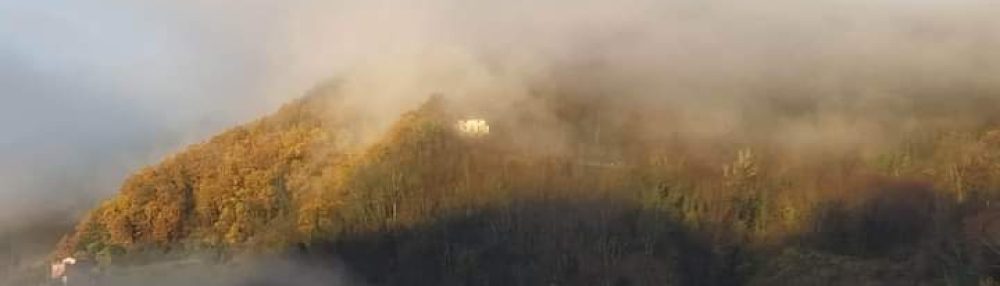
There’s absolutely no need to go to Abetone for one’s skiing in the Bagni di Lucca area, especially if one wants to avoid getting skied over by mad fanatics. Much more relaxing is Cutigliano which is a lot closer. Looking, however, through some pictures dating from the winter of 2003-4 I see that we tried out the ski slopes at Vianova which is five kilometres from Careggine, a beautiful village on the slopes of Monte Sumbra, just to the north of Castelnuovo Garfagnana. Here there are three skilifts serving seven kilometres of pistes and, if there wasn’t sufficient of the white stuff, snow generating equipment.
Although best suited for family skiing the slopes should also satisfy more expert skiers. There are also a couple of reasonable places to eat nearby.
From Vianova there’s a dramatic road leading to the Turrite valley and the picturesque, semi-abandoned village of Isola Santa.
The route has some great views. However, if one skids on the often icy winter conditions it’s a long way over the edge down to the valley floor.
Isola Santa is on the road which takes one across the main ridge of the Apuan mountains via the Cipollaio tunnel. One can also continue back to Castelnuovo and find the return route to Bagni di Lucca.
We have very fond memories of these places when our sole means of transport was our scooter, when everything seemed so amazingly new and when we were a little younger…
Last month I helped out in a wedding as celebrator of marriage vows. The words were put together by Lisa Redgrave who is creator and director of the nuptial magic that is called ‘Hitched in Italy’ and whose web site is at http://www.hitchedinitaly.com/.
The words, which were very beautiful, started:
Friends and Family of the bride and groom welcome and thank you for being here on this important day.
We are gathered together to celebrate the very special love between ***** and *****, by joining them in marriage.
All of us need and desire to love and to be loved.
Let me say I am not a vicar or priest – just an enlivener of special occasions. The actual legal marriage ceremony was performed in Lucca’s noble palace which I have described at
I’ve assisted a couple of times at Lisa’s beautifully organized wedding events which are always set in stunning settings such as aristocratic villas and rustic villages. The one I attended, however, must take the crown for uniqueness. Nicknamed ‘Casa farfalla’ (Butterfly house) the house has to be one the most original modern building in the Lucchesia or indeed in the world. Designed by Michel Boucquillon and Donia Maaoui, artists, architects and designers the estate spreads its wings on the hills just to the south of Lucca.
The ensemble consists of a villa, a guest house and a pool, all proving that contemporary architecture married to technology can create a new magic. There is a harmony between the buildings and their environment which only the most traditional architecture would have been able to capture. Yet the project is as up-to-date as it gets.
The main building has an openable roof with two wings fanning out at an angle of 30 degrees (hence the name). This structure is operated by six hydraulic pistons. The opened-out roof can thus provide natural ventilation to the house and can also give its lucky occupants the reality of literally dreaming and sleeping in a starlight hotel.
Being invited in such an extraordinary place is quite a privilege. For more information on using the location for both receptions and holidays see the following sites:
For me, apart from having the chance of being invited to participate in a happy event, the most extraordinary feature of the house, together with its award winning design (an award shared with Renzo Piano’s London’s Shard) are the most wonderful views it has towards the city of Lucca.
PS If you are interested or know anyone who is interested in having an otherworldly wedding ceremony in a stunning location beautifully and professionally organized for you do check our Lisa Redgrave’s web site at
It’s usually quite easy to get a photo of one’s village from the other side of the Lima valley. Just take the road up to Benabbio and Granaiola and Pieve di Monte di Villa and several other villages this side of the river are easily spotted. Not so easy with our village Longoio and its neighbour Mobbiano. This is because they’re tucked away in a valley which has no road facing it on the other side of the Lima valley.
Looking at the map I decided that the best way to photograph our villages would be to take the Benabbio road and then head eastwards through the Pizzorne woods. The other day we did just this and found an Ideal place to take our photos. Remember, Longoio is seen to the left and Mobbiano is seen to the right. The mountain above is called the Monte Incoronata.
The palazzo Bove is a favourite of ours both for its location and for the variety of musical events it offers. It’s an elegant aristocratic summer villa dating back to the seventeenth century and is beautifully situated at the summit of the ancient village of San Gennaro above Collodi. The palazzo used to be the summer residence of Lucca’s archbishop Giuseppe Palma. At the end of the eighteenth century it was sold to the Scatena-Burlamacchi family and is now the residence of Count Bove. The sumptuous interior with an original eighteenth century kitchen and a frescoed private chapel was previously shown to us by the count.
Last night we attended a premiere – not of the music, which was familiar – but of the pianist. Michele Franceschi played his first public recital. He is studying at Lucca’s famed Boccherini conservatoire. As with all debut concerts there was a certain degree of nervousness and some mistakes in the performance but this did not detract from the general opinion that Michele is, m Continue reading →
Everyone’s birthday should be praised, if not by all at least by oneself. It’s miracle in this world today that we manage to live yet another year. But the number of years I have reached this day are as nothing to that attained by Sandra’s mum. Just reverse the numbers in my age and you’ll see how old she is.
I think that Sandra’s mum is a prime example of how to grow old gracefully. Apart from the conventional wishes given to me I should say that the real wishes today go to her for having undertaking a journey , at her age, certainly fraught with perils, to reach Sandra and me in our little Apennine haven.
So, I say, the very best wishes to Elia. It’s wonderful to have sixty niners and ninety sixers together on this birthday eve! And with our favourite cats too…
Tuscany abounds with fabulous settings for concerts. Sometimes these locations may be ancient abbeys or baroque palace gardens. Sometimes they may be in the natural amphitheatre of mountains such as the rifugio Rossi just below the Pania Della Croce in the Apuan Alps.
Pieve a Elici is one such wonderful location. The ancient Romanesque church dedicated to Saint Pantaleon (one of the fourteen mediaeval helpers against the Black Death) is situated on one of the last outcrops of the Apuans and commands a stunning view over Lake Massaciuccoli and the Tyrhennian Sea.
The church dates back to the eleventh century and the reason why it’s called ‘a Elici’ derives from the ‘leccio’, or ilex trees that abound in the area. The interior consists of a nave and two aisles and a single apse; the campanile was originally a watch-tower.
The pieve contains some lovely artworks. There’s a marble triptych by Ticcomani, a local fifteenth century sculptor who also carved the holy water stoup. The fresco of the Virgin and child is of the fourteenth century.
The site was originally occupied by a castle, of which traces remain, and in the courtyard separating the parish priest’s lodging and the church there’s a square well dating back to Roman times by which I gained a useful viewing point for the evening’s event.
The Pieve is placed on a large lawn and is not surrounded by any houses. This is because a pieve acted as a hub for all the surrounding villages and would be the only religious building where baptisms could take place. Its location, therefore, would be free from association with any particular settlement.
We’ve visited the pieve on previous occasions for the lovely chamber music concerts organised by the Associazione Musicale Lucchese under the aegis of Egisto Matteucci.
In 2015 the Cremona quartet played Schubert and Mozart: see
Pieve a Elici has, indeed, become part of our annual calendar of unmissable music events.
This year we were treated to one of the twentieth century’s chamber music masterpieces, Messiaen’s ‘Quartet for the End of Time’, composed in a concentration camp near Gorlitz ,Silesia in 1940. It’s a work I’ve played countless times on my old vinyl recording with artistes Michel Béroff, Gervase de Peyer, Erich Gruenberg and William Pleeth . In fact, I’m hearing that recording at this moment and it is still a very valid performance.
There are various apocryphal stories about the quartet and here I want to put some facts straight.
There were just 300 people at the first performance, not 5000.
The ‘louanges’ (lauds) were already composed in the 1930’s.
The instruments were not that decrepit and the cello did have all its strings, not just three as often stated. It’s true, however that the piano keys stuck from time to time. (May it be appropriate to have an authentic – or historically informed – performance of this work with such a piano perhaps?)
A camp assistant, Carl-Albert Brüll, who supplied Messiaen with score-writing paper and without whose help the first performance would certainly never have taken place, was indeed rebuffed by Messiaen when he visited the composer after the war. (Perhaps Messiaen didn’t want to be reminded of the terrible hardships of the concentration camp?). Much later, however, Messiaen repented of his behaviour and sent an invitation to Brüll. Unfortunately it arrived the day after Brüll had been mown down by a car and killed (in 1989).
Gorlitz concentration camp exists in a few mouldering bits of concrete. It was never an extermination camp but used for prisoners-of-war including Brits and even Italians. It is now a European Union cultural centre with regular art exhibitions.
Gorlitz itself is a very beautiful town mercifully saved from the ravages of war. Indeed, it’s often used for costume-drama film settings. Despite the fact that Gorlitz was divided by the Oder-Neisse line after 1945 into Polish and German areas it is now, thanks to both countries being part of the Schengen agreement, able to be visited without national barriers,
One thing is certain, however: the first performance was well-publicised in the camp and was a great success which it has remained ever since.
In the performance we attended the players were as follows:
Mario Brunello (cello), Marco Rizzi (violin), Gabriele Nirabassi (clarinet) and Andrea Lucchesini (piano).
As in the original first performance the concert took place in the open air. This was not because of lack of accommodation (although the audience was very extensive) but because, with the ‘Lucifer’ African bubble giving Italy temperatures ten degrees above normal for this time of year, the Pieve’s interior would have been unbearably hot.
I reminded myself that the original performance took place in a temperature of minus 15 centigrade in the freezing Silesian winter.
The Elici performance was excellent, although the acoustics did suffer a little as a result of the outside location. For example, in the ‘louanges’ the pulsating piano chords did tend to swamp the clear lines of the solo string players. In the movements where all the instruments play together, however, the balance was good.
The clarinettist had a strange habit of suddenly getting off his chair. At first I thought he was going to walk off but then I realised that Nirabassi was moving around – jazz-like – to extract the most effective sound dynamics from his instrument.
The performance was introduced by writer and radio presenter Gabriella Caramore who gave the audience a long (for non-Italian listeners, unbearably over-long..) reflection on the apocalypse. As Messiaen quoted from the Bible:
And I saw another mighty angel come down from heaven, clothed with a cloud: and a rainbow was upon his head, and his face was as it were the sun, and his feet as pillars of fire … and he set his right foot upon the sea, and his left foot on the earth…. And the angel which I saw stand upon the sea and upon the earth lifted up his hand to heaven, and sware by him that liveth for ever and ever … that there should be time no longer: But in the days of the voice of the seventh angel, when he shall begin to sound, the mystery of God should be finished…
Here are the sections of this mind-expanding work.
Liturgie De Cristal
Vocalise, Pour L’Ange Qui Annonce La Fin Du Temps
Abîme Des Oiseaux
Intermède
Louange À L’Eternité De Jésus
Danse De La Fureur, Pour Les Sept Trompettes
Fouillis D’Arcs-En-Ciel, Pour L’Ange Qui Annonce La Fin Du Temps
Louange À L’Immortalité De Jésus
It’s significant that this is one of the first works in which Messiaen uses bird-song. He was also an expert ornithologist and extensively studied avian sounds. We were lucky enough to be part of the audience when the composer’s opera Saint Francoise d’Assisi was performed in a non-staged setting at the Royal Festival Hall in 1988 for the composer’s birthday with the great man himself present.
Since Saint Francis famously preached to the birds the opera gave Messiaen every opportunity to display his instrumental talent in bird song imitation. Frankly I still think it was a bit of a cheek for Saint Francis to have preached to the birds. Birds have a lot more to teach us in my opinion and I expressed my feelings about this in the following poem:
SAINT FRANCIS
Preaching to the birds
you showed a strange, surpassing presumption,
uncommonly modest man.
What in creation could you teach them
they did not know already?
Singing lessons were out:
there are more perfect notes in the sky
than in all our chants and manuscripts,
sonatas, cantatas, songs of the earth.
Clearly, flying lessons too seemed out of place
when hospitals are filled with
once-hand-gliding paraplegics
descended from Icarus.
And finding one’s direction in life
when we still don’t know our own home
and albatross can locate the nesting space
among a billion square miles
year in year out
with instinct’s love-infinity;
when avian gyroscopic navigation
– live reckoning –
adds on the index yet another
computer-unsolved enigma.
And what of the discovering of worlds,
revelation of new lands
and smell of alien flowers?
Geese flew the Americas so many spans before
a Genoese sea-captain
and the Antarctic has been tern’s summer hideaway
since the Triassic and dinosaur cousins.
So what did you tell them?
Of the praise of God and his works,
of his love for the creatures of the air
(for the flesh of man is not
the flesh of birds)
when a pelican’s upbringing is a parable of gospel-light?
When the finger-cast seed grows into the greatest of herbs
that rooks might lodge in its branches.
When petrels are breaths of God’s providence:
The birds have their nests but the son of man…
Nowhere to lay down your head?
Is that it? Some sort of pre-memorial regret,
some little envious demon
spoiling hard rock cushion
among crucified trees
in the forests of your night?
And then … and then
are not two sparrows sold for a farthing
and none are forgotten before God,
neither shall one fall without His knowledge?
Despite your dispensation of the family wealth
naked in towered city square
before ermine and gold,
the council chamber
and your discarded courtesan
did you not insanely fear you’d be forgotten
or that you would fall and He
would not notice it?
For wheresoever the carcass is
there will the eagles be gathered together.
PS There are further concerts in this unmissable season at Pieve a Elici. They are listed on the site at:
This one is on the pass leading towards Massarosa from Lucca. These shrines are dedicated to the Virgin Mary and are usually situated by a source of fresh water. They are adorned with blue and pink rosettes denoting the happy birth of a boy or a girl in answer to prayers to the Madonna.
The shrines are in effect ancient fertility sites and date back well before the advent of Christianity. For example, there’s one in the cave of Castelvenere on the side of Monte Penna near us in which Etruscan stylised votive statuettes have been found. I’ve described this fascinating cave at https://longoio.wordpress.com/2013/05/22/the-tuscan-underground/ . In Castelvenere, too, there’s also a little stream denoting its importance as a centre of fertility rituals.
With an ever-decreasing birth rate such places have become even dearer to the hearts of many Italians. Italy is now the country with the eleventh lowest native-birth rate in the world. (Monaco has the world’s lowest birth rate).
There are several reasons to explain the country’s decreasing birth-rate. Perhaps the most important one is that Italians love to cut a fine figure (‘fare bella figura’) and that means that their kids too must have the best of everything: the latest buggies, griffe clothes and so forth. Children are particularly loved to bits by Italians (no exclusion of children from classy restaurants, for example) and the way they are dressed are indications of the degree of love shown.
The reason, therefore, for lack of children is connected with the difficulty of finding jobs and the fact that job mobility is avoided as much as possible . For that would take the young parents away from their own mums and dads, whose free child-care service is essential for any working couple.
Since 1990 there have been more deaths than births in Italy and this last year there were almost 150,000 fewer Italian birth than the previous year. The average Italian nuclear family today produces 1.34 offspring.
With already over 100,000 migrants this year voyaging across from Libyan to Italian shores (enough to equal the size of the population of Worcester in the UK) and with their birth-rate in excess of two per nuclear family (some with as many as six or more – similar to the size Italian families once used to be in the previous centuries) and with other European countries closing their frontiers in northern Italy, one doesn’t have to be a statistician to realise that within a century the texture of the Italian population could be radically altered. It’s the reasoning behind the Italian government’s policy of spreading out migrants equally over the whole country, whether they are allocated in cities, town or villages – the last thing Italy wants is ethnic ghettoization.
The Italian government’s policy seems on the whole to be working, although if one goes to Prato, for example, ghettoization does occur (in that city it’s the Chinese). Do not be surprised, therefore, if you see black faces in the remotest hill villages of the peninsula.
In Bagni di Lucca, a traditionally conservative town with very inter-related families, this migrant spreading-out policy using a quota system has become a key issue in local politics. For example, the use of a hotel in an area near the thermal establishment at Bagni Caldi has upset many local people. It’s not just the number of migrants living in the ex-hotel, it’s the point that the native population of the town is ageing fast and decreasing while the migrant population is ever-increasing.
These are all very delicate issues. The point is, however, that, as much as it would like to, Italy can no longer cope with the never-ending flood of desperate people fleeing war and famine in Africa and the Middle East. For the first time the government here has decided to turn off the tap by introducing a new crime punishable by law: that of inciting illegal immigration through mafia-controlled people-trafficking.
NGO’s (or ONGs as they are termed in Italy) have also been targeted and, clearly in a large number of cases, there has been the simple motive of lucre for their ships in saving lives. Now, thanks to the lack of interest shown by other European countries, the absence of further resources to deal with the problem and in response to a growing impatience (which can, and does, so easily spread into populism and an increasingly hostile reaction to the newcomers) the government has finally realised that its priority is to stem the tide.
(World map showing birth rate by area: red highest, green lowest)
Whatever happens, Italy is becoming increasing affected by problems which are principally caused by the arms-trade and global warming all fuelled by unscrupulous groups in the world’s richest countries. Simply put, it’s not fair that this beautiful country, which shows a natural generosity and greatheartedness, should have to face this huge demographic problem alone.
Let’s hope, too, that the little shrines to the Madonna will encourage Italians to return to having more children and that the government will actively support young families in an ever more difficult economic situation.
***
If you enjoyed this post, please consider clicking the Like button or leaving a comment. It lets me know that my writing is reaching people.
Yehudi Menuhin said of her “she has a wonderful talent with a lively temperament, virtuosic brilliance and a very high professional level.”
Maria Solozobova is indeed a great violinist who has achieved fame throughout the world. Born in Moscow and now living in Switzerland (where she is leader of the Orchestre de la Suisse Romande) she issued her debut album in 2007 to great acclaim. On her beautifully toned Nicolò Gagliano violin, dated 1728, Maria gave us an enthralling solo violin recital outside Giacomo Puccini’s ancestral home in the delightful village of Celle di Pescaglia last July 29th.
(Maria and the Puccini Museum at Celle, run by the ‘Lucchesi’ nel Mondo Association)
Maria warmed us up (if that could be the right word in these balmy summer evenings) with J. S Bach’s solo violin sonata no 1.
She then proceeded to what must be her showpiece: the devilishly difficult variations on “Nel cor più non mi sento” from Paisiello’s 1788 opera ‘L’amor contrastato, ossia La molinara’.
Here is Solozobova’s recording of it taken from a concert in Zurich. What technique and what passion!
More Paganini and an Ysaye sonata followed:
(Recognize the tune? Rachmaninov used it in his Rhapsody on a theme of Paganini!)
If one is thinking that a solo violin recital before Puccini’s house is somewhat unusual then you’re right. Normally concerts before this beautiful setting tend to consist of operatic arias. However, it should be remembered that Paganini has a strong connection with Lucca’s music scene. His first job was with Napoleon’s sister Elisa Baciocchi, princess of Lucca and Piombino (to whom he gave music lessons and perhaps something a little more).
It was a totally unforgettable, fabulous evening!
To conclude here’s a photo I took of the lovely Maria Solozobova standing by the bed in which Giacomo Puccini was born in 1858 (the one in Puccini’s birth-house in Lucca is a copy).
Last Thursday, as part of the Shelley, festival there was a lovely event in front of the house the Shelleys stayed in when they first arrived in Italy – the villa Chiappa in the old part of Bagni di Lucca. A group of local Bagni di Lucca poets, comprising Rossana Federighi, Maura Bertolozzi, Francis Pettitt, Roberto Ragghianti and Valerio Ceccarelli, met to celebrate Percy Bysshe Shelley.
Luca PB Guidi, of Shelley House bookshop in Bagni di Lucca, was the presenter and each of the poets read a classic poem plus two from their own collections. My classic poem was Shakespeare’s first sonnet which was later read in an Italian translation by Valerio Ceccarelli.
There was a very full house in the balmy summer evening and some of the audience had to sit on the wall behind the rows of chairs.
It’s interesting to note that poetry has come back in a big way, thanks also to the leader of the opposition in the UK government, Jeremy Corbyn. He, like so many others, senses the significance from Shelley’s ‘A defence of Poetry’ that ‘Poets are the unacknowledged legislators of the world.’
What this means is that poets can express concepts and feelings which cannot be properly articulated in any other discipline, whether it be philosophy, history, psychology or science. Poets in a sense are seers: they can somehow look into the future. Ultimately, however, poetry is, as Wordsworth famously said, emotion recollected in tranquillity.
Certainly we all left the pleasant poetry evening feeling both refreshed and recharged.
For more information about other events in the Shelley Festival see the facebook page at:
The Italian revue at Roberto Ragghianti’s page at ‘Righe d’inchiostro’ (the title of his recently published book) was also very positive:
‘Ieri sera la magia della Poesia ha trasformato una normale serata d’estate, in un momento carico di Emozioni, di brividi sulla pelle, di Amicizia e spiritualità. Le parole di Shelley, (sotto casa sua), le parole di Dante, di Shakespeare, del Petrarca hanno risuonato nella notte e hanno trapassato e colpito al centro del cuore tutti coloro che insieme a noi hanno condiviso questo momento. Poi abbiamo osato leggere anche le nostre di Poesie, nell’emozione di Valerio che mi ha fatto sospirare, nella dolcezza di Maura, nella determinazione di Rossana, nella bravura stratosferica di Francis. La regia di tutto questo è stata di Luca e di Rebecca della Shelley House due ragazzi straordinari, due Amici Veri. Grazie di cuore a tutti.’
Bagni di Lucca is truly the town of poets and poetry . Indeed how could it not be when there are such great poets as Mario Lena living here!
Italy is on fire. This year has been particularly bad for forest fires and the sad thing is that most of them have been started deliberately. Why should anyone want to destroy the wonderful arboreal heritage of Italy? There are various reasons related to illegal land use. Many of the reasons are just to get rid of illegal fly-tipping.
The vilest methods have been used by mafia-inspired pyromaniacs to spread fires. Perhaps the most shocking is the finding by the forestry guards of cat carcasses burnt by the flames on Mount Vesuvius. Here’s a typical headline which doesn’t need much knowledge of Italian to translate.
ORRORE SUL VESUVIO: ANIMALI VIVI USATI PER ESTENDERE LE FIAMME
Our area is certainly not exempt from forest fires. Luckily although there are traces everywhere of fires they have so far been extinguished before they spread too far. Often it’s the lazy smoker-motorist who throws his/her cigarette out of the car window. Why else do so many of these fires start by the road side?
(A local fire at Balbano put out in time)
In spite of all this we enjoyed our time at the seaside yesterday in temperatures above thirty centigrade by the Tyrhennian Sea.
Let’s hope that some rain falls soon because this dryness not only encourages forest fires: it destroys crops, to say nothing of wildlife and air pollution.